


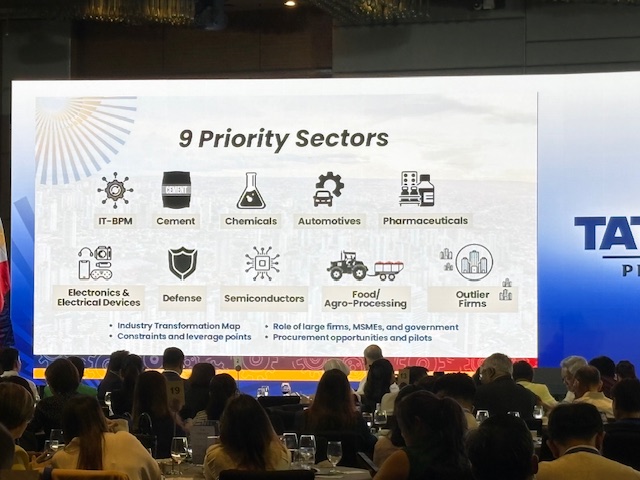
The government has identified nine domestic industries as priority sectors that will receive preferential treatment in government support — including bidding advantages in procurement, green-lane processing, and expanded financing — as part of a broader effort to strengthen local industries and position the Philippines within strategic global value chains.
Under the Tatak Pinoy Strategy, created through the The Tatak Pinoy Act, designated as Republic Act No. 11981, authored by then-Senator Sonny Angara, nine industries have been selected for priority development: IT-BPM, cement, chemicals, automotive, pharmaceuticals, electronics and electrical devices, defense, semiconductors, and food/agro-processing.

According to Bryan L. Ang, vice president of the Philippine Chamber of Commerce and Industry (PCCI), a Tatak Pinoy Council — composed of the Department of Trade and Industry, Department of Finance, National Economic and Development Authority, Department of Budget and Management, and representatives from the private sector — will oversee the accreditation process for becoming a Tatak Pinoy Enterprise or Tatak Pinoy Investor.
Ang explained that the strategy aims to empower domestic suppliers and companies that utilize locally sourced materials. For example, a bidder in a Department of Public Works and Highways (DPWH) project who uses locally produced inputs may receive preferential treatment. A contractor using Philippine-made steel or cement could be granted up to a 25 percent “buffer support,” allowing the bid to remain competitive even if priced higher than other offers.
“Because today, there’s no rule on sourcing local so you just source the cheapest. That’s why China and Vietnam always win,” he said.
Given the scale of DPWH’s infrastructure pipeline, Ang noted that the potential reinvestment into domestic capacity-building could be substantial.
The strategy also seeks to encourage government banks to expand lending to small and medium enterprises, many of which struggle to secure financing due to collateral requirements. With government-backed contracts, however, banks would have greater assurance of repayment. “This time, the government will pay for their debt as long as you’re enrolled in the Tatak Pinoy program,” he said.
“Nothing is excluded right now,” Ang added, emphasizing that even MSME suppliers can qualify, including those participating in small-scale government procurement.
Suppliers that use local inputs will also be granted green-lane processing across government agencies.
“Government agencies are to create a green lane for all Tatak Pinoy investors. For example, the Bureau of Internal Revenue may offer a green lane for VAT refund for exporters, while the Bureau of Customs will create a green lane for exporter that is importing raw materials.
“If you have a green lane, the permit will be released immediately, no harassment and delay,” he said.
Ang believes this scheme will strengthen domestic industry capabilities, build a competitive, inclusive and resilient industrial base, and deepen domestic value chains with increased sectoral linkages.
The strategy has already set timelines in the short-run (2025-2026), medium-run (2027-2030) and long-run (2031-2040).

