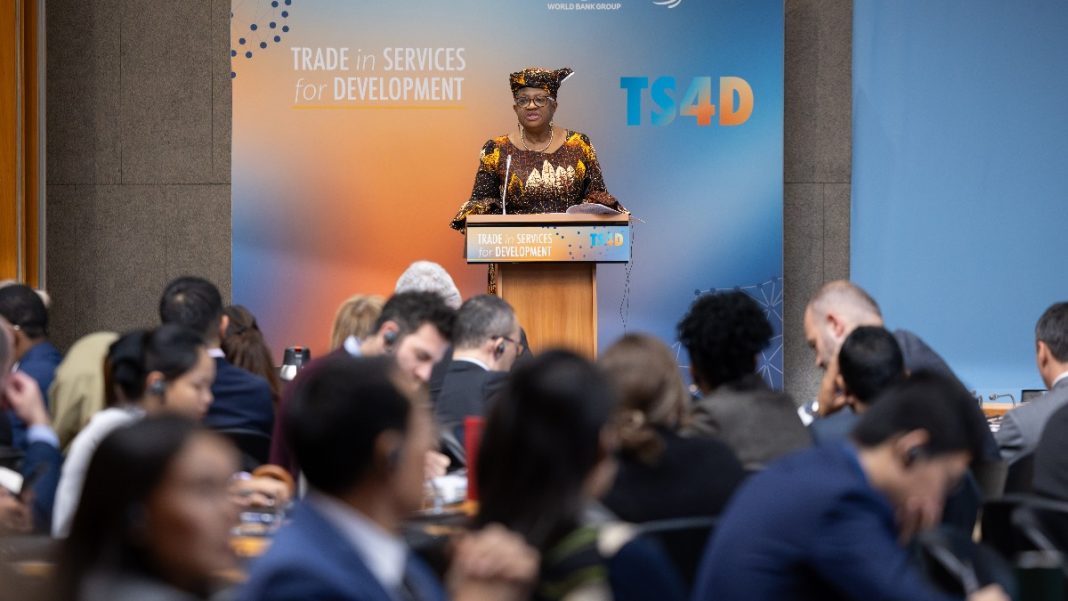
The World Trade Organization (WTO) and the World Bank opened the Trade in Services for Development (TS4D) Conference, highlighting significant progress in their joint initiative to help developing economies leverage services trade for growth and development.
WTO Director-General Ngozi Okonjo-Iweala emphasized the transformative potential of services, which have been the fastest-growing component of world trade over the last two decades.
“Our hope in organizing this conference is to open a new chapter in how we think about trade, development, and cooperation,” DG Okonjo-Iweala stated.
Services trade is increasingly critical, super-charged by the digital revolution. According to the WTO’s latest forecast, global commercial services trade is expected to grow by 4.6% in 2025 and 4.4% in 2026 (in volume terms).
By contrast, merchandise trade is expected to expand by only 2.4% this year and 0.5% next year.
Digitally delivered services are the most dynamic segment, with projected growth rates of 6.1% in 2025 and 5.6% in 2026.
Recognizing that services are now central to economic transformation but often face complex regulatory barriers, DG Okonjo-Iweala announced new tools developed under the TS4D umbrella:
TS4D Platform: A central hub providing access to key resources.
Services Trade Competitiveness Diagnostic Dashboard: A tool to help countries identify areas of competitive advantage and constraints.
Handbook on Good Regulatory Practices to Facilitate Trade in Services.
The DG stressed that mainstreaming services into national development strategies is “no longer optional” and is a necessity for diversification, productivity, and resilience. She called for greater cooperation from partner organizations and urged donor partners to be “engaged and ambitious” to amplify the impact of these new tools.
Denis Medvedev, incoming World Bank Director for Trade, Competition and Business, underscored the tremendous economic opportunities presented by services, noting that 72% of the global stock of Foreign Direct Investment (FDI) is in the services sector. He emphasized the initiative’s role in helping developing economies reform, especially to reduce non-tariff barriers and deepen regional integration.
“Fully implementing the Africa Continental Free Trade Agreement could double inter-regional exports by 2035,” Medvedev noted.
Other speakers highlighted national strategies leveraging services:
Nigeria’s Minister Jumoke Oduwole noted that the services sector is the lifeblood of Nigeria’s economy, representing 58% of GDP and over 45% of formal employment.
Saudi Arabia’s Vice Minister Eiman Al-Mutairi shared the country’s strategy to diversify away from oil by focusing on 20 service sectors, including logistics, tourism, and digital services, and establishing a knowledge hub to share reforms.
Cambodia’s Secretary of State Tekreth Kamrang stressed the role of services trade in fostering inclusive growth, where the sector accounts for more than 40% of GDP and employs almost 40% of the labour force, including 80% of women in tourism/hospitality.
UK WTO Ambassador Kumar Iyer reaffirmed his country’s support and encouraged developing economies to use the new tools to identify their competitive advantages.
The conference continues tomorrow, focusing on policy design to unlock services sector growth and trade.