


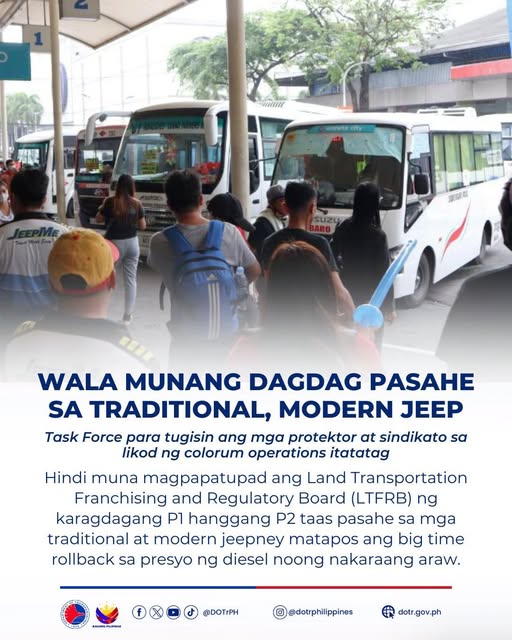
The Department of Transportation (DOTr) and the Land Transportation Franchising and Regulatory Board (LTFRB) have officially announced that the proposed additional P1 to P2 base fare increase for traditional and modern jeepneys will not be implemented at this time. This decision comes in light of recent significant rollbacks in diesel prices and a directive from President Ferdinand Marcos Jr. to seek a balanced solution for all stakeholders.
Transportation Secretary Giovanni Lopez emphasized that the timing is not right for a fare increase, citing its potential negative impact on the economy, especially on provinces still recovering from recent severe disasters, including earthquakes and typhoons.
“The high fare will have a big impact on the economy and in general, especially as some provinces that have been reaping from severe disasters such as the previous earthquakes and typhoons,” said Secretary Lopez. “Not only commuters and their families are affected, but also the families of drivers and operators, because it will affect the price of basic goods that are usually used by the citizens.”
LTFRB Chairperson Vigor Mendoza confirmed that consultation and dialogue revealed significant opposition to the proposed hike, particularly from regions recently affected by natural calamities.
“At least five regions, including the three most populous regions, are the majority opposing the proposed additional fare. This includes Central Luzon, CALABARZON, Bicol Region, Central Visayas and Metro Manila—areas that were severely affected by the disasters,” said Chairperson Mendoza.
A study by the Department of Economy, Planning and Development (DepDev) further supports the government’s stance, indicating that an increase in the jeepney base fare could contribute to a rise in the inflation rate over the next two years.
While halting the fare increase, the DOTr and LTFRB fully recognize the financial grievances of transport groups. In line with the President’s directive, the agencies are actively looking for alternative ways to help drivers and operators maintain viability.
One of the immediate and visible solutions is the intensification of the campaign against illegal ‘colorum’ Public Utility Vehicles (PUVs).
The DOTr and LTFRB will establish an Anti-Colorum Task Force, partnering with the Department of Justice (DOJ) and the Presidential Anti-Organized Crime Commission (PAOCC), to prosecute the protectors and syndicates behind these illegal operations. Estimates suggest that colorum operations currently siphon off approximately 30 percent of the daily income of legitimate PUV drivers and operators.
Secretary Lopez issued a stern warning to illegal operators: “We will hunt down and arrest those involved in this illegal operation. The DOTr and LTFRB will not stop pursuing you because the welfare of legitimate PUV drivers, and even commuters depend on it.”
Chairperson Mendoza encouraged colorum operators to cease illegal activities and take advantage of legal alternatives. There are currently 17,000 available slots to be included in the Transport Network Vehicle Service (TNVS).
“This is a good opportunity to turn away from illegal activities. We ensure that the process is fair and fast. This is much better than always living in fear of being caught, jailed, and fined heavily,” Chairperson Mendoza added.
The DOTr and LTFRB remain committed to finding solutions that protect both the livelihood of transport workers and the purchasing power of the commuting public.

