


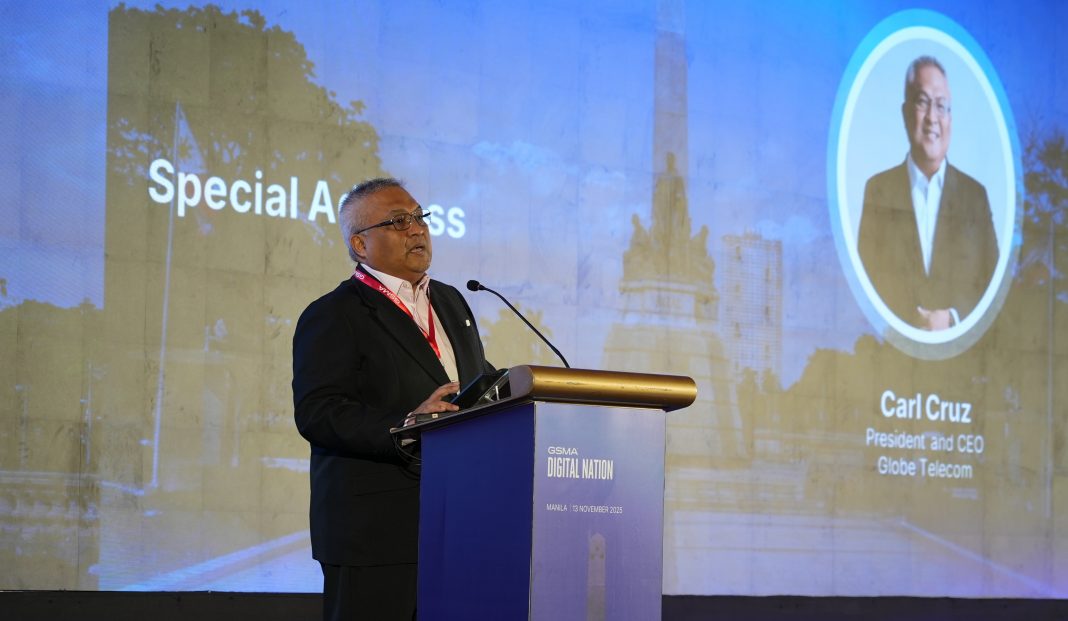
Globe affirmed that the Philippines is moving into a more connected and opportunity-rich phase of digital growth. Globe President and CEO Carl Cruz said the country’s momentum remains strong despite shifts in the global mobile landscape.
“I’m hopeful and optimistic about the Philippine telecom industry because we still have many opportunities ahead,” Cruz said. “We have a young population, strong digital habits, and real demand. We need to further unlock that potential.”
Cruz shared these insights at the GSMA Digital Nations Summit Manila, noting that while the contribution of mobile services to GDP has softened over time, the Philippines continues to outperform the global average. The GSMA Digital Nations APAC Report 2025 places the country’s mobile ecosystem contribution at 8.4 to 8.6 percent of GDP, higher than the global benchmark of 7.7 percent.
The broader industry also continues to invest at levels well above global norms. Worldwide, operators invest around 16 percent of revenues in capital expenditures. In the Philippines, the industry invests about 37 percent, reflecting sustained expansion to meet nationwide demand.
The Philippines remains one of the world’s most active digital communities. Filipinos spend nearly nine hours online each day, placing the country third globally for daily internet use. The Philippines also ranks sixth worldwide in adoption of AI tools such as ChatGPT, showing strong readiness to participate in the digital economy.
Tower density remains low in relation to population size. The country has an estimated forty thousand towers serving more than 115 million people. Thailand, with only seventy million people, has around ninety thousand towers. The comparison highlights significant latent demand and the need for more efficient infrastructure builds.
Artificial intelligence is expected to place increasing pressure on both wireless and fixed networks. Mobile networks alone cannot support future traffic requirements. AI will require higher-capacity fiber systems, scalable data transport, and lower latency. The development of a national fiber backbone is a critical step toward meeting these requirements, and early work from government agencies is establishing an initial framework.
Other Globe leaders at the summit also contributed perspectives on infrastructure evolution, open API adoption, cybersecurity and scam prevention, AI readiness, and digital inclusion. Industry and government cooperation will play a major role in enabling these priorities, especially in areas involving shared infrastructure and standards.
The country’s outlook remains positive. The Philippines has a young, tech-forward population and a policy environment that recognizes the importance of digital access. These conditions place Globe in a position to keep strengthening its network, platforms, and digital capabilities that support the country’s growth and help unlock more opportunities for Filipinos.

