


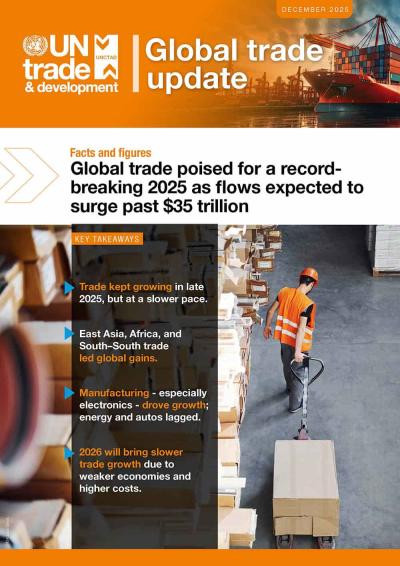
Global trade in goods and services is on track to reach an all-time high, projected to exceed $35 trillion for the first time in 2025, according to the latest analysis by UN Trade and Development (UNCTAD). This represents a significant increase of about $2.2 trillion, or approximately 7%, compared to 2024.
The surge in trade is fueled by robust growth in both goods and services.
-
Services trade is projected to grow by roughly $750 billion (nearly 9%), outpacing goods trade.
-
Goods trade is expected to contribute about $1.5 trillion to the overall rise.
While earlier increases were partly driven by higher prices, UNCTAD expects trade growth in the fourth quarter to be driven by volume rather than price, as the prices of traded goods are anticipated to decline. Total growth is expected to slow in Q4 to a positive rate of 0.5% for goods and 2% for services.
Trade between developing economies, known as South-South trade, expanded by approximately 8% over the last four quarters, demonstrating increasing resilience across these regions.
-
East Asia recorded the strongest export growth at 9%, with intra-regional trade rising by 10%.
-
Africa showed solid import growth (10%) and strong export performance (6%).
-
Europe saw exports rise 6% and imports increase 8% over the last four quarters.
-
North America imports grew by 6%, though exports only grew 2%.
-
South America also experienced strong intra-regional trade, rising 7%.
-
Manufacturing remains a major engine, growing 10% over the past four quarters. Electronics led this expansion with 14% growth, supported by strong AI-related demand.
-
Agriculture trade saw a significant rise of 6% over the past four quarters, with notable third-quarter gains in cereals, fruits, vegetables, and oilseeds/oils (all around +11% or +9%).
-
Automotive trade remains weak, falling 4% over the last four quarters. However, trade in hybrid vehicles soared by 22%, offsetting declines in combustion-engine vehicles (–13%) and electric vehicles (–5%).
-
In commodities, iron and steel saw the sharpest increase, rising about 40%, while overall natural-resource trade was subdued due to lower prices for mineral fuels.
UNCTAD projects a weakening of momentum in 2026. Trade flows are likely to be weighed down by slower global growth, rising debt burdens, higher trade costs, and continued global uncertainty.
Global goods-trade imbalances, while stabilizing, remain high. The United States’ overall trade deficit narrowed in the third quarter of 2025, and China’s goods surplus also narrowed but remained significantly higher than the previous year.

