


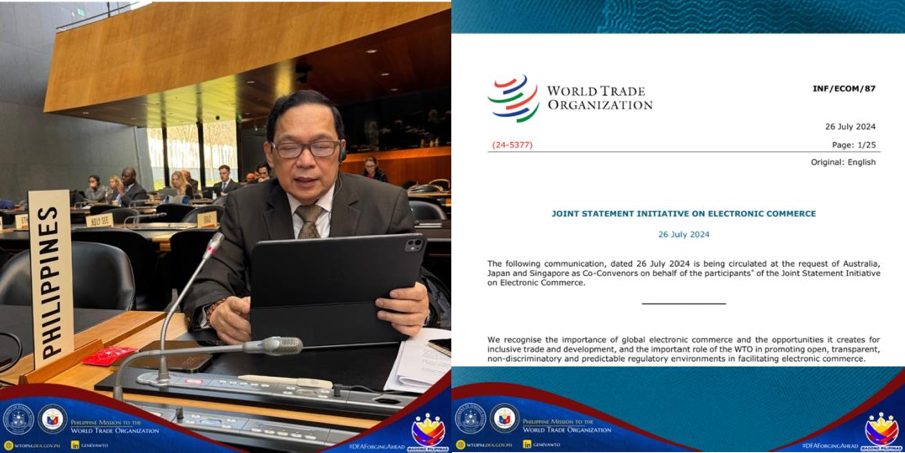
The Philippines announced its decision to accept the stabilized text of the Agreement on Electronic Commerce during the World Trade Organization (WTO) General Council meeting held on December 17, 2025. By joining as the 72nd co-sponsor of the initiative, the Philippines reinforces its position as a proactive leader in modernizing global trade rules for the digital age.
The Agreement represents the most comprehensive set of multilateral digital trade rules to date, covering essential pillars such as paperless trade, electronic signatures, consumer protection, and cybersecurity.
In its official intervention, the Philippines emphasized that integrating this Agreement into the formal WTO legal framework is vital for ensuring global regulatory coherence. By embedding these rules into the WTO architecture, the Philippines aims to reduce market fragmentation and provide businesses—particularly Micro, Small, and Medium Enterprises (MSMEs)—with the legal certainty needed to thrive in cross-border e-commerce.
“The Philippines’ decision to join reflects our clear commitment to building a modern, secure, and open digital trade environment,” said Ambassador Manuel Teehankee, Permanent Representative of the Philippines to the WTO. “Incorporation of this Agreement is a strategic step toward ensuring a stable, rules-based digital trading system for all economies, big and small.”
Ambassador Teehankee highlighted that the Agreement aligns with the Philippines’ domestic priorities:
Expanding Opportunities for MSMEs: Lowering compliance costs and expanding market access for smaller entrepreneurs.
Consumer Protection: Strengthening safeguards and building trust in digital transactions.
Trade Facilitation: Promoting paperless trade and interoperable digital systems to speed up the movement of goods and services.
Recognizing the varying levels of digital readiness among member nations, the Philippines welcomed the Agreement’s flexible implementation architecture. This includes provisions for technical assistance, capacity building, and transition periods. The Philippines stressed that such support is essential for developing and least-developed members to realize tangible benefits, such as improved connectivity and stronger digital infrastructure.
This move at the WTO complements the Philippines’ active regional and bilateral agenda. The country is currently advancing digital trade provisions through several key frameworks:
The Philippines-United Arab Emirates Comprehensive Economic Partnership Agreement (CEPA).
Negotiations for the ASEAN Digital Economy Framework Agreement.
Ongoing Free Trade Agreement (FTA) talks with the European Union and Chile.
By joining the co-sponsors, the Philippines signals its intent to shape the trajectory of global digital governance at the upcoming 14th WTO Ministerial Conference (MC14). The Philippines remains ready to engage in future discussions, including data-related issues, provided they respect diverse regulatory contexts and developmental needs.
The Electronic Commerce negotiations currently involve 91 WTO Members, representing over 90 percent of global trade, marking a significant milestone in establishing shared disciplines for the 21st-century economy.

