


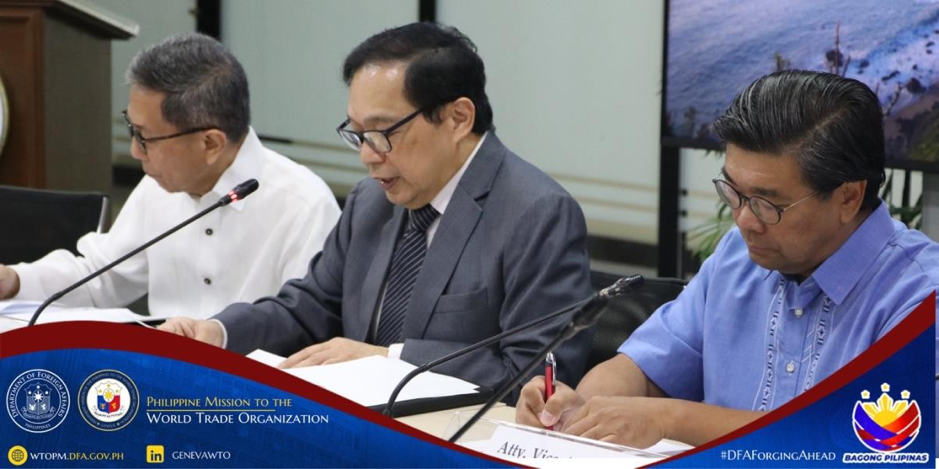
The Philippine government launched a strategic initiative to bridge the gap between national trade policy and climate development objectives.
Spearheaded by Environment Secretary Raphael Lotilla and Ambassador Manuel A.J. Teehankee, the initiative underscores a firm stance: climate action must be fair, development-oriented, and supported by credible implementation to be sustainable.
The program will culminate in the Philippine Trade-Related Climate Strategy for Climate-Resilient Development by 2026, providing a roadmap for the country’s engagements at the WTO, ASEAN, and UNFCCC.
In his keynote address, Secretary Lotilla emphasized that for a climate-vulnerable, middle-income nation like the Philippines, trade and climate cannot be decoupled from development. He cautioned international partners against demanding higher numerical targets in the upcoming Nationally Determined Contribution (NDC 3.0) without providing the necessary means of implementation.
“For us, the issue is not about making bigger promises on paper,” Secretary Lotilla stated. “It is about how to deliver on what we pledge, while protecting our people, our competitiveness, and our development prospects.”
The Secretary also highlighted that the Philippines has already internalized carbon costs through domestic energy and fiscal reforms. These “de facto” carbon prices—reflected in higher power rates and fuel taxes—must be recognized by the international community when assessing the country’s level of effort.
Ambassador Manuel A.J. Teehankee, Permanent Representative to the WTO, situated the initiative within the Philippines’ broader diplomatic work in Geneva. He noted that well-designed trade policy is essential for managing the impact of new climate regulations abroad while fostering a “just transition” at home.
“Trade policy can help the Philippines manage adjustment to new climate measures abroad and strengthen our own competitiveness,” Ambassador Teehankee said. The initiative focuses on critical areas including:
Renewable Energy & Circular Economy: Mobilizing technology and investment.
Carbon Market Development: Aligning domestic reforms with global standards.
MSME Support: Ensuring small businesses can navigate new green requirements in overseas markets.
The initiative is a collaborative effort with the Forum on Trade, Environment and the SDGs (TESS) and the University of the Philippines Law Center Institute of International Legal Studies (UP IILS). It follows a structured five-step methodology:
Stocktaking: Assessing existing commitments and reforms.
Diagnosis: Analyzing how global measures affect local trade.
Prioritization: Identifying key sectors for intervention.
Design: Selecting policy options.
Implementation: Executing and assessing impact.
International Alignment
The Philippine effort aligns with the Integrated Forum on Climate Change and Trade (IFCCT) launched by the Brazilian Presidency at COP30 in Belém. This global platform aims to reconcile trade measures with climate ambition, a movement already supported by partners such as Australia.
By grounding this strategy in inclusive consultations with workers, local communities, and MSMEs, the Philippines aims to ensure that its transition to a climate-resilient economy leaves no one behind.

