


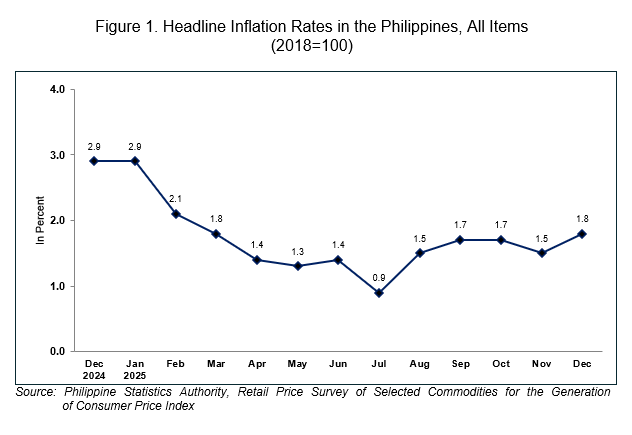
The Philippine Statistics Authority (PSA) reported that the country’s annual average inflation rate for 2025 settled at 1.7%, a significant decrease from the 3.2% average recorded in 2024. This downward trend for the year was primarily driven by lower costs in food, non-alcoholic beverages, and transport services.
While the annual average showed a cooling economy, the headline inflation rate for December 2025 saw a slight month-on-month increase, rising to 1.8% from 1.5% in November. However, this remains well below the 2.9% recorded in December 2024.
The slight acceleration in December’s headline inflation was fueled by:
-
Food and Non-Alcoholic Beverages: Inflation in this sector jumped to 1.4% in December from a nearly flat 0.1% in November.
-
Clothing and Footwear: Prices rose to 2.2%, up from 1.8% the previous month.
Conversely, several commodity groups saw lower inflation rates during the month, including Transport (0.3%), Housing and Utilities (2.5%), and Alcoholic Beverages and Tobacco (3.3%).
The drop in the full-year average to 1.7% highlights a more stable price environment compared to the previous year.
| Category | 2025 Annual Average | 2024 Annual Average |
| Headline Inflation | 1.7% | 3.2% |
| Food & Non-Alcoholic Beverages | 1.2% | 4.4% |
| Restaurants & Accommodation | 2.4% | 4.8% |
| Transport | -0.4% (Deflation) | 0.9% |
The Transport sector was a major factor in the annual decline, shifting from a price increase in 2024 to an average annual drop of 0.4% in 2025.
Food inflation at the national level rose to 1.2% in December 2025. This uptrend was largely influenced by:
-
Rice: While still in a deflationary trend, the decline slowed to -12.3% in December from -15.4% in November.
-
Vegetables & Tubers: Prices spiked to 11.6% from 4.0% in the previous month.
-
Corn: Prices shifted from a 4.1% decrease in November to a 7.3% increase in December.
The primary contributors to food inflation for the month were Fish and other seafood, followed by Vegetables and Meat.
Core inflation, which strips out volatile food and energy items to measure underlying price pressures, remained steady at 2.4% in December 2025. The annual average core inflation for 2025 stood at 2.4%, down from 3.0% in 2024, indicating a general easing of inflationary pressures across the broader economy.

