


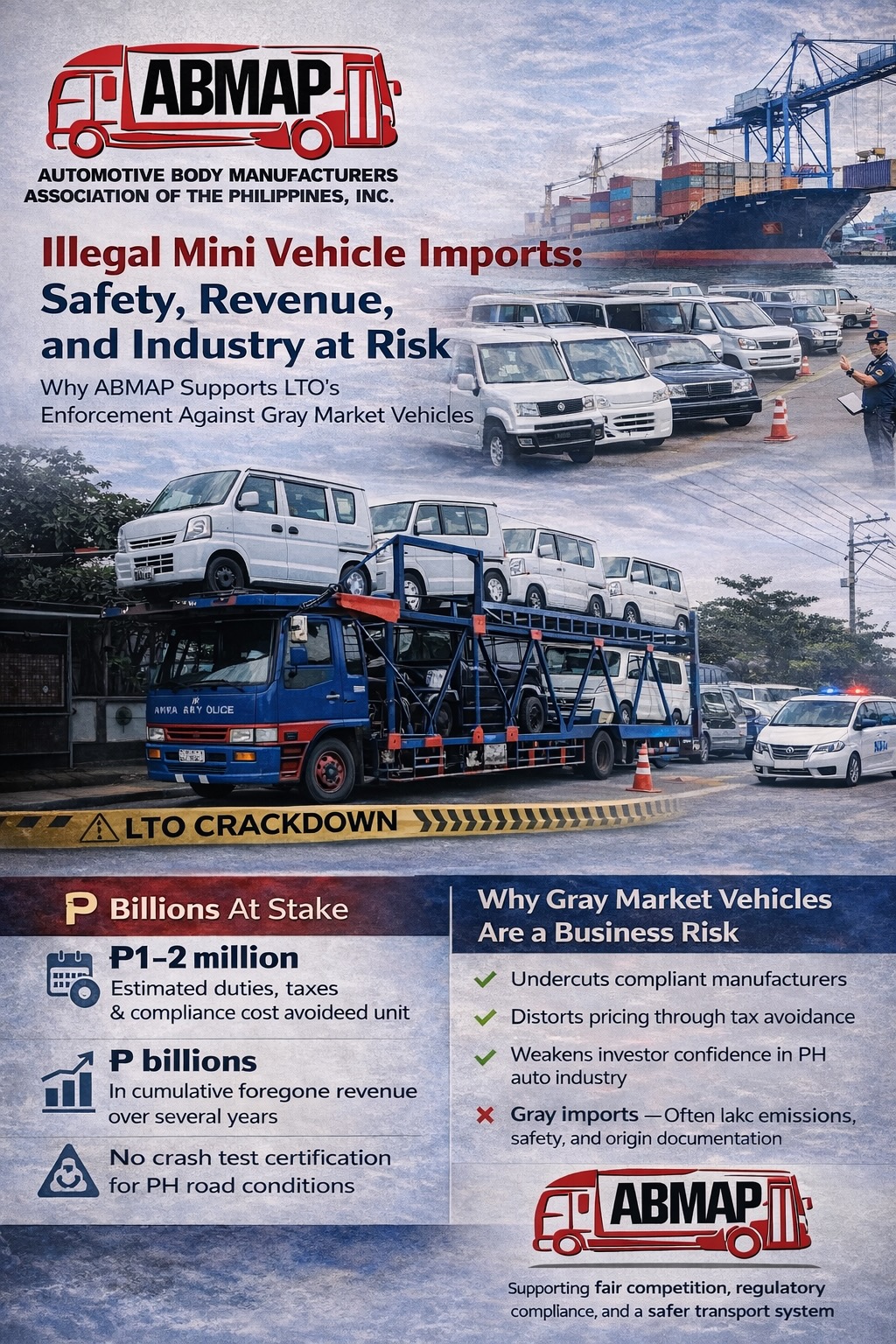
The Auto Body Manufacturers Association of the Philippines (ABMAP) has publicly backed the Land Transportation Office’s (LTO) enforcement actions against the registration of illegally imported mini vehicles and Japan Domestic Market (JDM) kei cars, warning that the unchecked gray market undermines road safety, government revenue, and the Philippines’ automotive manufacturing ecosystem.
In recent months, the LTO has restricted or denied registration of several gray market mini vehicles—particularly imported variants of the Suzuki Jimny, Hustler, Spacia, Palette, Wagon R, and Stingray—that were not brought in through official distributor channels. These units often enter the country via used-vehicle auction exporters and are either driven RHD or converted to left-hand drive (LHD).
Under Republic Act No. 8506, right-hand-drive vehicles are barred from operation on Philippine public roads. While some importers perform RHD-to-LHD conversions, the LTO and safety regulators have consistently raised concerns over the structural integrity and crashworthiness of these modifications.
“Conversion is not simply flipping the steering wheel. If improperly done, it affects the vehicle’s steering geometry, braking systems, crash structure, and overall safety performance,” said Edgar Manuel, Executive Director of ABMAP. “Given these engineering realities, the LTO’s careful enforcement is justified.”
Beyond the safety considerations, ABMAP emphasized the broader economic implications of gray market imports. The Philippine automotive sector is a significant part of the manufacturing base, contributing an estimated 1.5% to 2% of national GDP and directly and indirectly supporting 250,000 to 300,000 jobs in vehicle assembly, body fabrication, parts production, logistics, dealership networks, and aftermarket services.
Gray market imports circumvent many of the regulatory and compliance costs that legitimate manufacturers and distributors absorb—including homologation, emissions compliance, safety certification, and duties—creating an uneven playing field. Industry sources estimate that each illegally imported vehicle can evade ₱300,000 to ₱600,000 in combined duties and taxes. When aggregated across tens of thousands of gray units that circulate through gray channels each year, foregone government revenues may total ₱3 billion to ₱6 billion annually.
“These vehicles do not go through proper homologation, emissions testing, or safety certification,” Manuel explained. “Legitimate manufacturers invest heavily in compliance and quality assurance. When gray imports dodge these costs, it rewards non-compliance and penalizes structured investment.”
ABMAP also stressed that many kei cars are engineered for Japan’s urban context—with narrower roads, lower average speeds, and stringent traffic controls—not for the Philippines’ mixed traffic environment that includes heavy trucks, buses, motorcycles, and pedestrians. This mismatch, the group said, raises legitimate safety concerns, especially in higher-speed and suburban road contexts.
Compounding the issue is the entry of rebuilt or misdeclared vehicles, some imported as “used parts” and reassembled locally—practices that the LTO has increasingly scrutinized as potentially linked to unlawful “chop-chop” operations.
“Cracking down on illegally registered and rebuilt vehicles is about safety, but also about fairness and economic integrity,” said Manuel. “For the Philippines to attract more investment in manufacturing and automotive technology, regulatory consistency matters.”
ABMAP emphasized that its support for enforcement does not reduce consumer choice. Vehicles imported through authorized distributors—fully compliant and legally documented—remain eligible for registration and use.
As the government strengthens transport policies and industrial regulation, ABMAP said that predictable and enforceable rules will be key to supporting growth in jobs, investment, and road safety across the automotive sector.

