


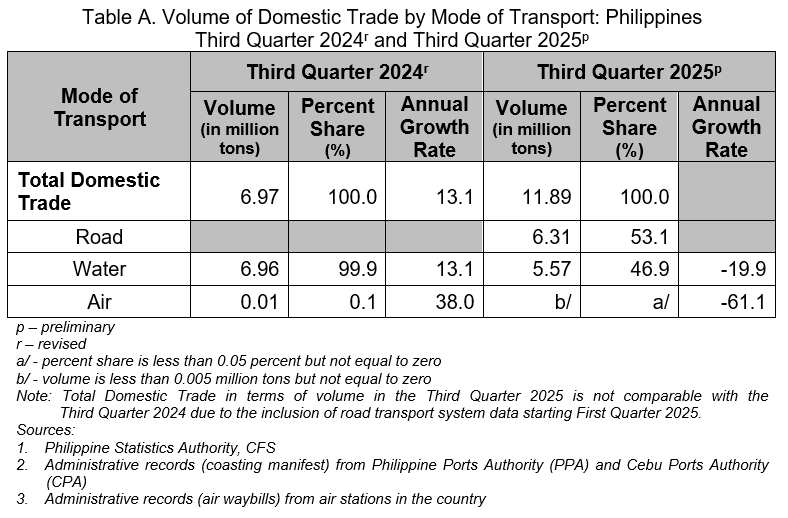
The Philippine Statistics Authority (PSA) reported that domestic trade figures for the third quarter of 2025 reveal a total trade volume of 11.89 million tons, with a combined value of PhP 561.14 billion. While road transport emerged as the dominant mode of logistics, both water and air trade experienced significant annual declines.
Road transport continues to be the primary artery for domestic commerce, accounting for 53.1% of the total trade volume (6.31 million tons) and 56.7% of the total trade value (PhP 318.20 billion).
In contrast, other sectors saw a downward trend:
-
Water Trade: Recorded 5.57 million tons, a 19.9% decline compared to the same period in 2024.
-
Air Trade: Experienced a sharp 61.1% drop in volume, falling to 3.38 thousand tons.
The movement of goods was concentrated within a few key regions, with CALABARZON and the National Capital Region (NCR) acting as the primary hubs.
| Metric | Leading Region | Volume (Million Tons) | Share (%) |
| Highest Outflow | CALABARZON (Region IV-A) | 3.49 | 29.3% |
| Highest Inflow | NCR | 2.90 | 24.4% |
| Lowest Outflow | CAR | 0.02 | 0.2% |
| Lowest Inflow | BARMM | 0.04 | 0.4% |
The trade balance—the difference between outflow and inflow volume—varied significantly across the archipelago.
Top Positive Trade Balances:
-
CALABARZON: +2.32 million tons
-
Negros Island Region (NIR): +0.86 million tons
-
Northern Mindanao (Region X): +0.27 million tons
Conversely, the National Capital Region (NCR) recorded the most significant trade deficit at -1.25 million tons, highlighting its role as a primary consumer and destination hub for goods produced in neighboring regions like CALABARZON and Central Luzon.
While volumes dipped in certain sectors, the economic value of domestic trade remains substantial. The total value of PhP 561.14 billion was distributed as follows:
-
Road: PhP 318.20 billion
-
Water: PhP 242.54 billion (down 13.5% annually)
-
Air: PhP 0.40 billion (down 51.3% annually)

