


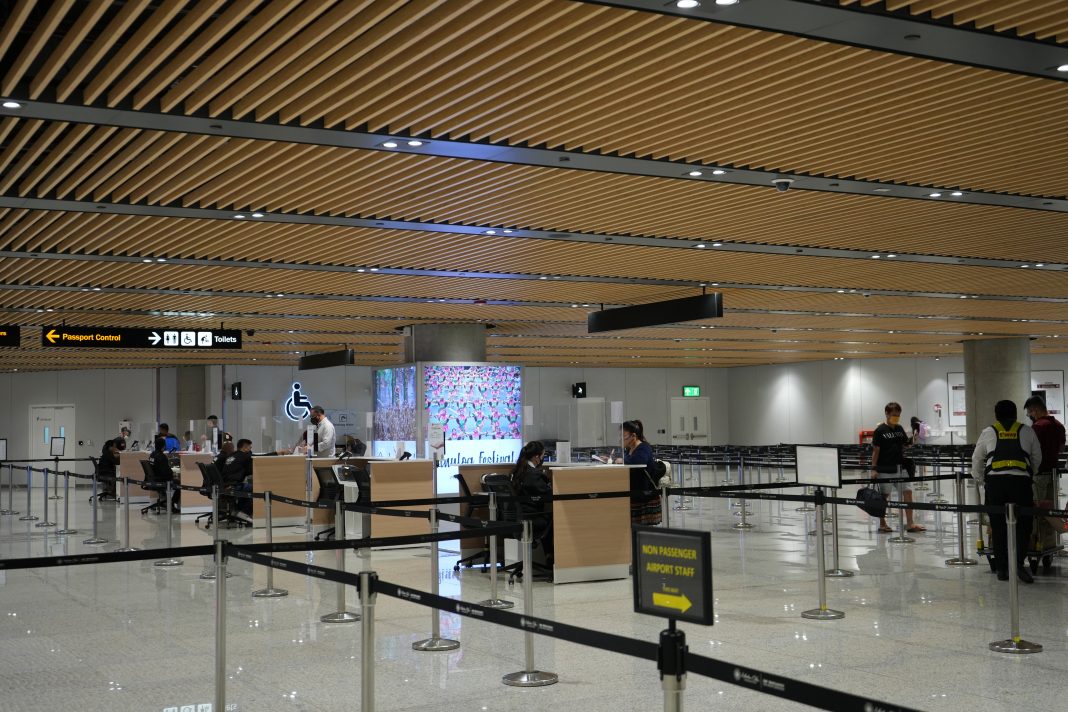
Mactan-Cebu International Airport (MCIA), the country’s busiest gateway outside Manila, is gearing up for an influx of tourists seeking access to other destinations in the Visayas and Mindanao this 2026.
This anticipation was further solidified after the Philippine government’s announcement granting Chinese nationals visa-free entry to two Philippine airports, including MCIA, for up to 14 days for tourism and business purposes.
The visa-free policy, which aims to boost inbound tourism and strengthen people-to-people exchanges, is expected to boost international arrivals to Philippine gateways such as MCIA.
At present, MCIA serves as a central hub for travelers connecting to domestic destinations through its expanding and efficient air-to-air connectivity.
Travelers can now enjoy remarkably hassle-free access to Cebu and beyond through MCIA. Prime examples are the accessibility of going to Bohol via fast ferry and the entry to Northern Mindanao via Laguindingan International Airport (LIA) in Misamis Oriental.
With the new visa policy, eligible Chinese travelers arriving in Cebu can already access multiple locations via direct domestic flights as well as integrated transfer initiatives designed to streamline onward travel.
Among these initiatives are CEB Connects, MCIA’s premier air-to-air transfer service, which shortens connection times to 60 minutes for international flights and 35 minutes for domestic flights, allowing travelers to reach their island destinations with minimal transfer times; and CEB+, a seamless airport-to-seaport connectivity program that once officially launched, will enable travelers to conveniently reach nearby island destinations by combining air and sea travel.
“Improving connectivity allows travelers arriving in Cebu to move more efficiently to other parts of the country, whether by air or sea. These initiatives are designed to support tourism growth while helping distribute visitor traffic across the regions,” said Aboitiz InfraCapital Vice President and Head of Airports Rafael M. Aboitiz.
The latest Department of Tourism data showed that of 5.6 million foreign tourists to the Philippines last year, 262,144 were from China – a figure that is expected to increase with the new visa policy.
This improved connectivity makes it simpler for foreign visitors to do business or experience the Philippines’ rich culture—all in one seamless trip to or from MCIA.
MCIA and LIA have been under the operation of Aboitiz InfraCapital, Inc. (AIC) since October 2024 and April 2025, respectively. They form an integral part of the overall AIC Airports platform, which also includes the country’s ninth-busiest airport – Bohol-Panglao International Airport (BPIA).
United under a single vision, AIC Airports is developing a growing network of world-class airports across the country, each serving a distinct role in national connectivity and expected to collectively account for around 16 million passengers by end-2025, or over 20 percent of the country’s passenger traffic.
AIC is currently undertaking the development and modernization of BPIA and LIA over the short- to medium-term beginning 2025, under a broader transformation under the multi-year concession agreements awarded by the government in 2024.
Starting 2025, AIC Airports, under the oversight of the Department of Transportation and Civil Aviation Authority of the Philippines, has begun introducing more modernization projects that will elevate the passenger experience and make Philippine airports globally competitive.

