


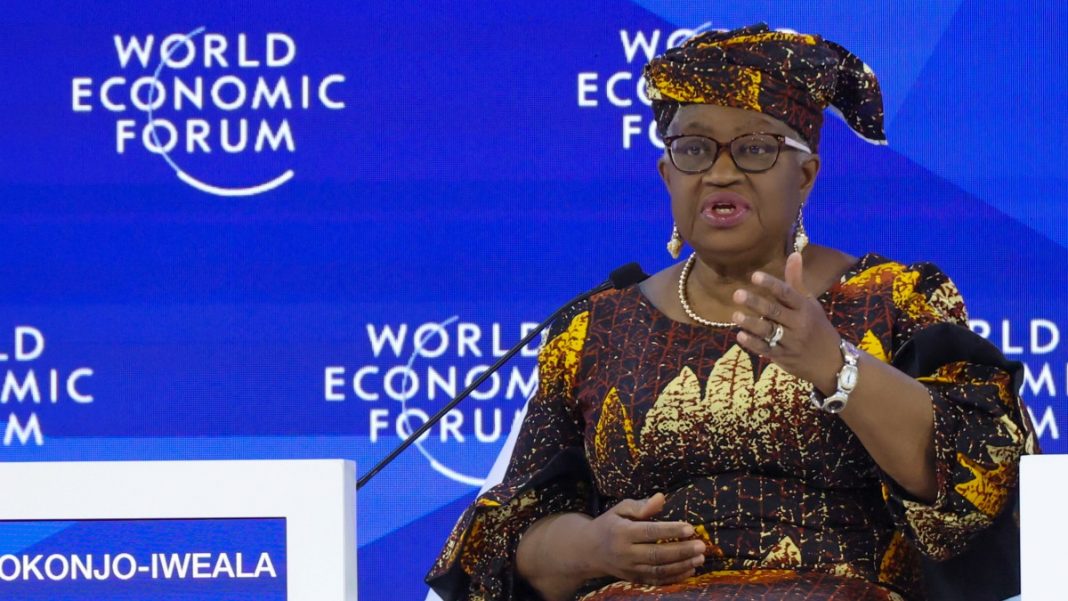
World Trade Organization (WTO) Director-General Ngozi Okonjo-Iweala concluded her participation in the World Economic Forum (WEF) Annual Meeting today, calling for calm leadership and accelerated reform as the global trading system faces its most significant disruptions in eight decades.
Throughout the week of January 19–23, the Director-General engaged with heads of state, business elites, and high-level officials to champion the role of trade as a driver of stability. Addressing the rising tide of tariff threats and geopolitical friction, Dr. Okonjo-Iweala urged global leaders to maintain “steady nerves” and avoid reactionary policies that could further fragment the international market.
During the “Many Shapes of Trade” session, Dr. Okonjo-Iweala highlighted the resilience of emerging sectors, noting that global services trade is projected to grow by 4.4% in 2026. She specifically pointed to the explosive growth of “green trade,” which has now reached a value of US$ 2 trillion.
The Director-General also addressed the dual nature of Artificial Intelligence (AI) during the “Global Economic Outlook” panel: “AI will help reduce trade costs and increase productivity. However, we must ensure adoption is equitable; the benefits will be significantly diminished if the digital divide leaves certain regions behind.”
A pivotal moment of the week occurred on January 22 during an informal ministerial meeting hosted by Swiss President Guy Parmelin. Trade ministers gathered to align on priorities for the 14th WTO Ministerial Conference (MC14), scheduled for March 2026 in Yaoundé, Cameroon.
Key outcomes of the ministerial dialogue included:
-
Commitment to Reform: Convergence on the urgent need to modernize WTO dispute settlement and operational frameworks.
-
Political Guidance: A collective pledge to deliver clear, actionable strategies at MC14 to preserve the rules-based multilateral system.
-
Regional Synergy: Dr. Okonjo-Iweala dismissed concerns that new bilateral agreements undermine the WTO, noting that most regional deals leverage WTO standards as a foundational platform rather than competing with them.
Concluding her mission in Davos, Dr. Okonjo-Iweala shared her aspiration for the future of the organization: “I dream about an organization that can be flexible enough so that members can seize these opportunities.”
The WTO remains focused on ensuring that the transition to a digital and green global economy remains inclusive, stable, and grounded in international law.

