


Loss of confidence in government and its institutions, coupled with devastating typhoons, proved to be a sure recipe for an economic plunge.
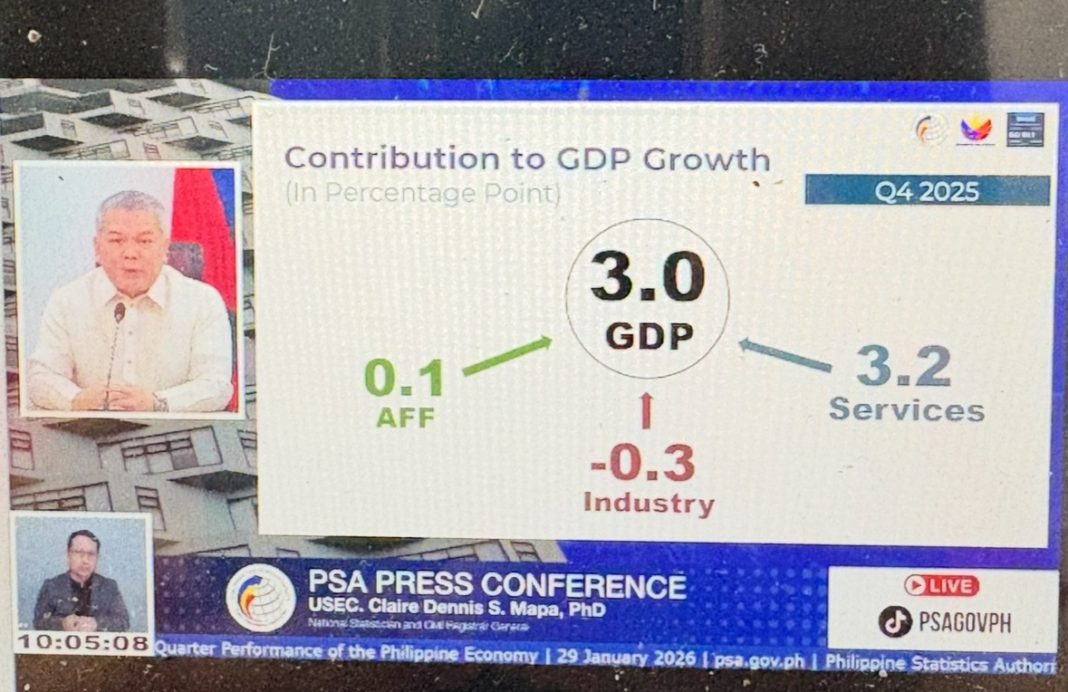
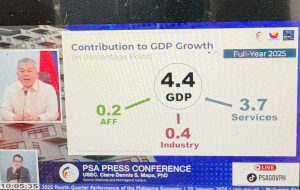
This is what happened to the Philippine economy, whose gross domestic product (GDP) growth in the fourth quarter fell to 3.0 percent—the slowest rate outside the pandemic period—bringing full-year 2025 GDP growth down to 4.4 percent from 5.7 percent in 2024. In value terms, full-year GDP in 2025 amounted to about PHP28.01 trillion, translating to per capita GDP of roughly PHP246,000 per person.
The sharp decline came as a shock, one that even Economic Planning Secretary Arsenio Balisacan himself acknowledged during the scheduled GDP briefing by the Philippine Statistics Authority on Thursday, Jan. 29. While he had expected a slowdown, he admitted he did not anticipate it would be this severe.
“To be honest, I did not expect it to be this sharp. I expected a slowdown as a consequence of measures we’ve put in place we all recognize that, but to this extent i myself did not expect,” said Balisacan.
Notably, the scandal reached its crescendo in the fourth quarter, as growth plunged to 3.0 percent from 3.9 percent in the previous quarter and 5.3 percent in the same quarter of 2024.
“This outcome reflects several converging factors. These include the adverse economic effects of weather and climate-related disruptions. Admittedly, the flood control corruption scandal also weighed on business and consumer confidence.”
Balisacan, however, said the governance measures put in place—though they may cause some delays—would ultimately deliver quality government spending and help pave the way for the return of public and business confidence in government and its institutions.
He added that it is better to endure an economic slowdown now to correct problems and rebuild trust in institutions rather than pursue growth that is unsustainable because of widespread corruption. “So, I would rather have that slowdown … and the private sector is one with us, than preferring short term gains,” Balisacan stressed.
The governance measures are also expected to start having an impact on the economy in the second quarter of this year, as the budget shifts toward quality expenditures, infrastructure, and social spending that would be truly felt by the people.
Rally point
Thus, 2026 is being considered a “rally point” for the Philippines, when it is expected to regain public trust in government and its institutions.
“2026 is a rally point for us … to turn the corner around and bring the economy back on its track as early as second quarter this year. We don’t expect to recover growth to recover in the first quarter because of lingering effects of measures especially delayed budget release in late February … so, we see face improvement in 2026 and beyond.”
The country’s ASEAN Chairship is also seen as an opportunity to promote the Philippines to neighboring countries and ASEAN partner nations.
Already, the Development Budget Coordination Committee (DBCC) has decided and endorsed to the President GDP growth targets of 5 to 6 percent for 2026 and 5.5 to 6.5 percent for 2027. Assumed export growth for those two years is 2.0 percent and 3.0 percent, respectively.
For services exports, the DBCC has assumed growth of 5.0 percent in 2026 and the same rate in 2027. The target exchange rate for the 2026 to 2027 period is PHP58 to PHP60.

