


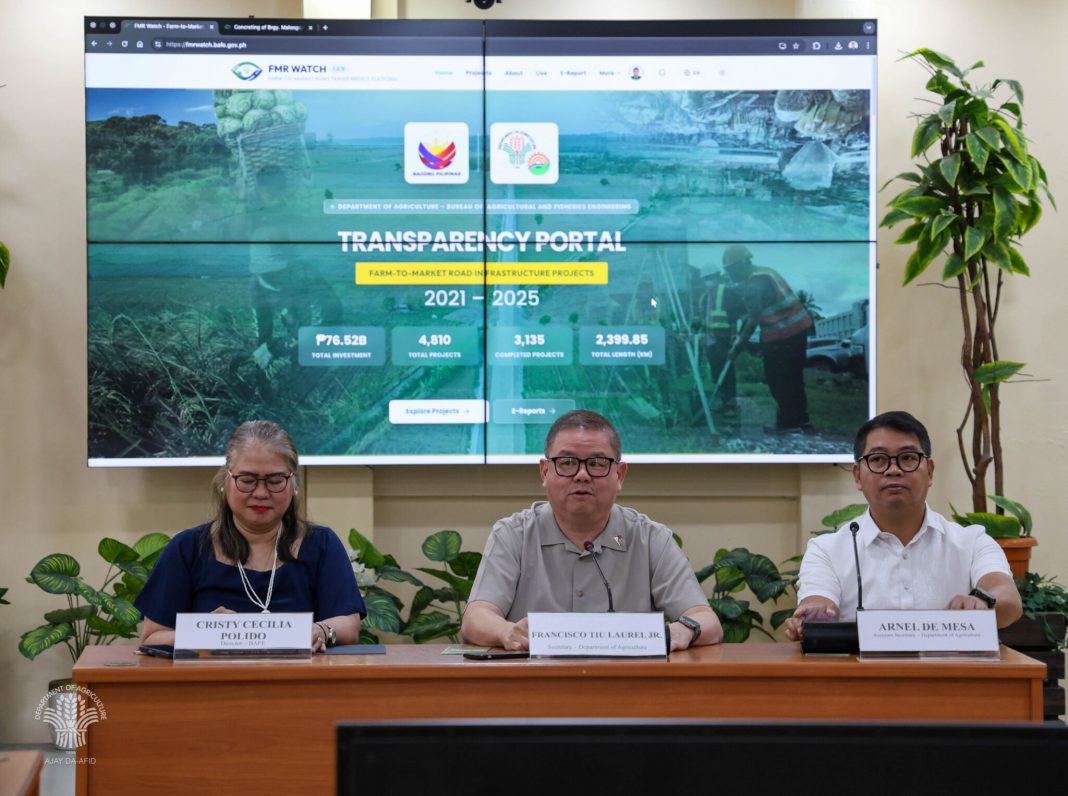
The Department of Agriculture (DA) is tightening oversight on its farm-to-market road (FMR) projects to ensure public funds translate into real, durable access for farmers and fisherfolk to lower production costs and better income as well as lasting rural development and food security.
Agriculture Secretary Francisco P. Tiu Laurel Jr. said the return of the FMR program to the DA reflects a renewed commitment to accountability. “Farm-to-market road implementation was returned to the Department of Agriculture not because we are perfect, but because we are determined to be transparent—with everyone’s help and cooperation,” he said.
He said the DA’s Bureau of Agricultural and Fisheries Engineering (BAFE) has been designated to lead the nationwide implementation of FMR projects. Centralizing responsibility under BAFE is intended to ensure consistent engineering standards, particularly in agricultural heartlands where road quality directly affects farm incomes, logistics efficiency, and access to markets, the DA chief added.
Complementing this move is FMR Watch, a public transparency and monitoring portal developed and managed by BAFE’s Information Systems and Digitalization Division.
The platform enables stakeholders to track projects from proposal to completion by integrating official records from the Agriculture and Biosystems Engineering Management Information System with budget data, construction milestones, geotagged photos, and citizen feedback.
FMR Watch has tracked 4,810 projects undertaken between 2021 and 2025, with a combined investment of P76.52 billion and coverage of nearly 2,400 kilometers of roads nationwide. Of these, 3,135 projects have been completed. DA Regional Field Offices handle day-to-day coordination and address issues raised on the platform.
All public comments are automatically acknowledged and forwarded for verification and action, typically within three days, depending on complexity. Tiu Laurel described FMR Watch as a practical tool for public oversight. “This is a digital flashlight,” he said.
“Farmers, fisherfolk, LGUs, and citizen watchdogs can see where roads should be, how projects are progressing, and whether implementation meets standards. There are no smoke and mirrors—only maps, data, and accountability,” he said.
The initiative comes after the DA was allotted P33-billion FMR budget this year to construct more than 2,300 kilometers of roads. “These roads are not just asphalt and concrete,” Tiu Laurel said.
“They lower production costs, raise farm incomes, reduce food prices, and support long-term rural development.” He added that the platform also aims to restore public trust. “When public funds build real roads instead of private fortunes, everyone benefits—farmers and consumers alike.”

