


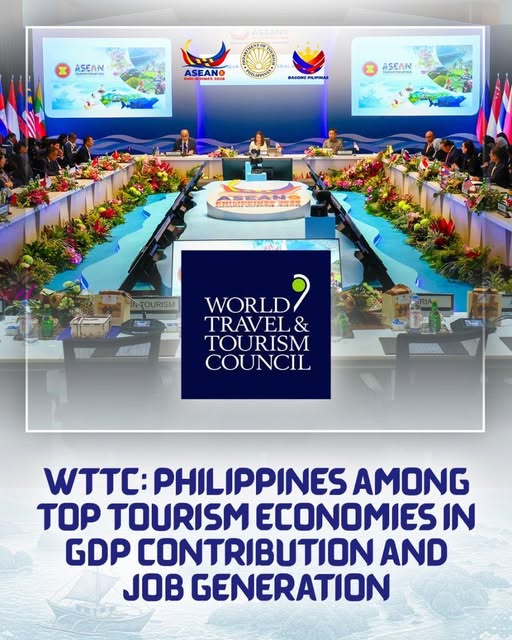
The Philippines has officially solidified its position as a powerhouse in the Southeast Asian tourism landscape. According to the 2025 World Travel and Tourism Council (WTTC) Economic Impact Report, presented during the ASEAN Tourism Ministers’ Meeting on Thursday (Jan. 29), the Philippines now leads the region in tourism GDP and employment impact.
The report reveals that the Philippines’ tourism GDP reached a staggering USD 91.8 billion, the highest among all ASEAN member states. This performance places the Philippines ahead of established regional tourism giants:
-
Philippines: USD 91.8 Billion
-
Indonesia: USD 71.7 Billion
-
Thailand: USD 67.3 Billion
-
Singapore: USD 54.6 Billion
Tourism now accounts for 19.9 percent of the total Philippine economy, underscoring the sector’s critical role in national stability and growth.
Beyond revenue, the Philippine tourism sector is a primary engine for livelihoods. The industry currently supports 11.22 million jobs, representing 23.0 percent of the nation’s total employment.
While Indonesia leads in absolute workforce numbers due to its population size, the Philippines maintains the second-largest tourism workforce in the region and ranks among the highest in terms of employment intensity—surpassed only by Cambodia in the share of total national jobs.
Department of Tourism (DOT) Secretary Christina Garcia Frasco noted that these milestones reflect the Marcos Administration’s commitment to inclusive development.
“These figures clearly show that the Philippines ranks among ASEAN’s leading tourism economies,” Secretary Frasco stated. “With tourism contributing nearly $92 billion to our economy and supporting over 11 million Filipino jobs, it remains a powerful driver of inclusive growth and economic resilience.”
Secretary Frasco emphasized that the DOT’s strategy focuses on strengthening the entire tourism value chain, ensuring that the economic gains are felt directly by local communities.
As the Philippines prepares to take on the ASEAN Chairmanship in 2026, the nation has reaffirmed its commitment to regional cooperation. The goal remains to position Southeast Asia as a competitive, resilient, and highly integrated global tourism destination.

