


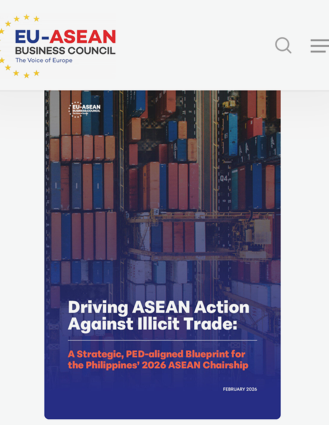
EU businesses urged the Philippine government to prioritize rising illicit trade during its ASEAN 2026 chairship, warning this could significantly hinder development across the region as it affects trade and investment integration, supply chain resilience, and sustainable growth, among others.
A new report titled “Driving ASEAN Action Against Illicit Trade: A Strategic, PED-aligned Blueprint for the Philippines’ 2026 ASEAN Chairship” unveiled today, February 12, 2026, by the EU-ASEAN Business Council said illicit trade is a strategic economic risk to ASEAN’s growth and should be highlighted in the 2026 Priority Economic Deliverables (PEDs) of the Philippines.
The report, which has been submitted to the Philippines government and ASEAN secretariat, outlines five main recommendations to integrate prevention into the Philippine Chairship’s economic agenda.
First is to strengthen institutional coordination through a consolidated platform for intelligence sharing, joint action, commitment implementation and public-private engagement.
Second is to align policy and regulatory frameworks across ASEAN Member States in licensing and supply chain oversight, risk-based pre-export assurance and shipment control, and other key areas.
The other recommendations include leveraging digital tools, developing common regulatory principles, and increasing structured collaboration with the private sector and key Dialogue Partners to strengthen supply chain integrity.
If implemented in full, the report said, these strategies are expected to improve fiscal outcomes, strengthen supply chains and investor confidence, enhance coordination and enforcement, and support the success of the Philippines’ 2026 PEDs.
Jens Ruebbert, chairman EU-ASEAN Business Council (EU-ABC), said the reports recommendations are important to achieving Philippines 2026 Chairship, which places strong emphasis on strengthening trade and investment linkages, enhancing supply chain resilience, accelerating digital transformation, and advancing sustainable and innovative economies.
“Achieving these objectives requires not only deeper integration, but also stronger safeguards to ensure that trade remains secure, transparent, and rules-based. Illicit trade undermines these shared goals by distorting markets, eroding fiscal resources, and weakening confidence in cross border supply chains. Addressing these risks is therefore integral to the delivery of ASEAN’s PEDs, particularly in the area of Strategic Trade Management,” said Ruebbert.
EU-ABC Executive Director Chris Humphrey added illicit trade comes with huge costs for the region.
“Economic loss aside, communities suffer from health and safety risks, environmental harm, organised crime enabled by illicit trade, and worst of all, the loss of human lives. It must be met with a firm and coordinated response. The Philippines is well-placed to lead this charge, and we are confident our report will prove useful in ASEAN’s fight against illicit trade,” said Humphrey.
The report’s recommendations are designed to supplement several Priority Economic Deliverables (PEDs)—key economic objectives for the Philippines’ Chairship—and promote improved outcomes within existing parameters, rather than introduce new objectives that could dilute focus. The report also examines how the Philippines’ experience in implementing national reforms could be applied at the ASEAN level.
“This is the moment for ASEAN to turn economic risk into opportunity. The Philippines has always been a strong champion of cooperation and constructive dialogue, and we look forward to working closely with them towards a stronger, more resilient ASEAN,” Humphrey said.

