


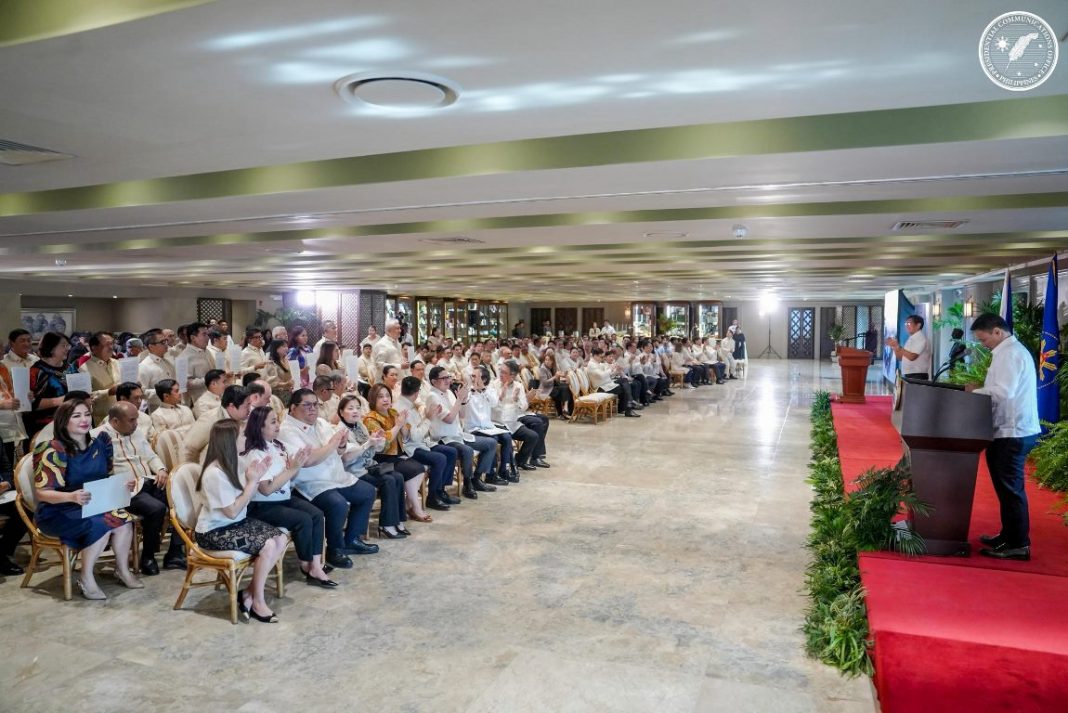
President Ferdinand R. Marcos Jr. spearheaded the signing of a landmark Memorandum of Agreement (MOA) between the Department of Education (DepEd) and Local Government Units (LGUs) on Wednesday, launching a streamlined strategy to eliminate the nation’s persistent classroom shortage.
The agreement marks a pivotal shift in infrastructure delivery, empowering LGUs to take the lead in the procurement and construction of school facilities to bypass traditional bureaucratic bottlenecks.
As of December 2025, the Philippines faces a shortage of 145,000 classroom units. President Marcos emphasized that the “too slow” systems of the past are being replaced with agile, decentralized solutions.
“We cannot wait another five or ten years to ensure that every student has a comfortable classroom,” President Marcos stated. “This partnership is an effort to make sure that every Filipino student has a safe and decent space to learn.”
The initiative is backed by a substantial PhP 85.39 billion allocation for Basic Education Facilities under the 2026 General Appropriations Act (GAA). The first tranche of the MOA involves an immediate investment of PhP 9.6 billion to deliver 4,000 classrooms:
-
PhP 4.1 Billion: To fund approximately 1,200 classrooms built directly by provincial governments.
-
PhP 5.5 Billion: To fund the delivery of 2,800 pre-fabricated classrooms by DepEd.
Under the new framework, roles are clearly defined to ensure speed without sacrificing quality:
-
DepEd: Responsible for setting technical standards, providing architectural designs, and securing funding.
-
LGUs: Responsible for the direct procurement and on-ground construction phase.
To maintain high standards, the President guaranteed “full transparency,” noting that no project will be accepted until DepEd provides written validation that the facilities meet all national safety and educational requirements.
Beyond physical infrastructure, the President highlighted the administration’s progress in digital integration, noting that nearly 34,000 public schools are now equipped with internet access.
“For students, it means classrooms will be completed sooner. For teachers, it translates to a more conducive environment. And for parents, this gives them peace of mind,” the President concluded, framing the initiative as a cornerstone of the Bagong Pilipinas (New Philippines) campaign.

