


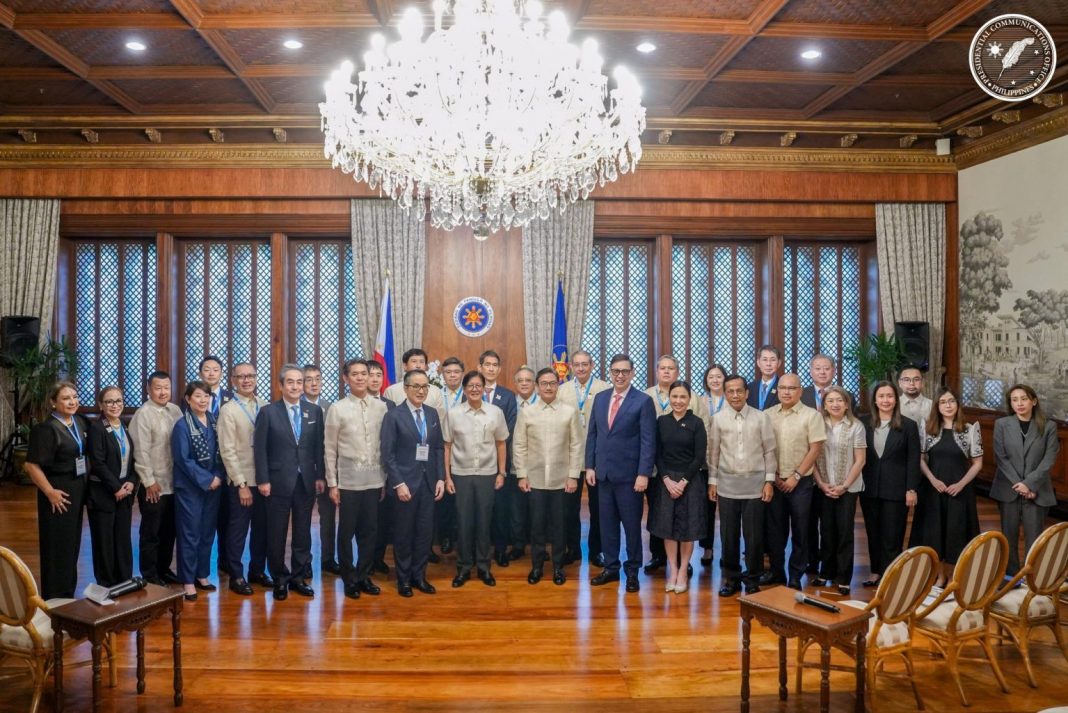
President Ferdinand R. Marcos Jr. underscored the enduring strength of the Philippines-Japan economic alliance on Wednesday, identifying Japan as a cornerstone partner in the nation’s pursuit of high-quality infrastructure, robust trade, and regional stability.
The President’s remarks were made during a courtesy call at Malacañan Palace with delegates from the Japan-Philippines Economic Cooperation Committee (JPECC) and the Philippines-Japan Economic Cooperation Committee, Inc. (PHILJEC). The meeting served as a high-level precursor to the 42nd Annual Joint Meeting of the two committees in Manila.
In his address to the delegates, President Marcos Jr. noted that the presence of the joint committees reflects a “shared commitment to regional growth and stability.” The dialogue focused on aligning Japanese investment with the Philippines’ current economic priorities and ongoing structural reforms. “Japan remains one of the Philippines’ most valued strategic partners,” the President stated, emphasizing the collaborative effort to build resilient supply chains and deeper regional economic integration.
The Philippine government identified several high-value industries where Japanese expertise and capital are poised to make a significant impact. Key opportunities highlighted during the meeting include:
-
Technology & Manufacturing: Semiconductors, electronics, and aerospace.
-
Green Mobility: Automotive manufacturing, with a specific focus on Electric Vehicles (EVs).
-
Sustainable Energy: The renewable energy value chain.
-
Infrastructure: Continued collaboration on “quality infrastructure” projects.
To support these opportunities, the President briefed the delegation on strategic reforms aimed at liberalizing priority sectors and increasing foreign participation in industries critical to long-term national development.
Building on the momentum of the Palace meeting, PHILJEC and JPECC announced that the 42nd Joint Meeting will focus on practical measures to tackle pressing economic issues. The agenda includes:
-
Strengthening Bilateral Trade: Streamlining exchange and reducing barriers.
-
Infrastructure Development: Enhancing connectivity through Japanese technology.
-
Human Capital: Advancing human resource development and training.
-
Tourism: Expanding travel and cultural exchange between the two nations.
Both committees expressed a unified goal of fostering inclusive growth that benefits the broader ASEAN region while maintaining the unique, decades-long synergy between Tokyo and Manila.

