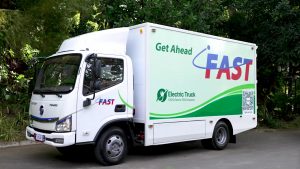
FAST Logistics Group, the Philippines’ premier end-to-end logistics solutions provider, has identified the reduction of truck dwell time as the most critical factor in making Electric Vehicles (EVs) commercially viable for the Fast-Moving Consumer Goods (FMCG) industry.
Speaking at a high-level American Chamber of Commerce of the Philippines (AmCham) discussion titled “The Future of FMCG Logistics: Navigating Electric Vehicle Fleets for Sustainability and Commercial Viability,” FAST CEO for Logistics Manuel L. Onrejas Jr. stressed that while sustainability is a priority, the math for EVs only works through high utilization.
In the logistics sector, “dwell time” refers to the hours a vehicle spends idle while waiting to be loaded at warehouses or unloaded at retail outlets. In the Philippines, these delays can stretch up to 12 hours.
For traditional diesel trucks, these delays are costly; for EVs—which carry an upfront price tag more than double that of Internal Combustion Engine (ICE) vehicles—they are a deal-breaker.
“To justify the investment in an electric fleet, a truck must complete 30 to 40 trips per month,” Onrejas explained. “Excessive dwell time directly undermines the return on investment (ROI), making it difficult for logistics providers to transition without passing costs onto the consumer.”
To bridge the gap between sustainability and commercial reality, FAST proposed several operational shifts:
-
Warehouse Efficiency: FMCG companies should adopt advanced picking processes to ensure cargo is ready the moment a truck arrives.
-
“Green Lane” Priority: Modern trade retailers (supermarkets and malls) should provide electric trucks with priority unloading lanes, similar to those used for perishable goods, to ensure rapid turnaround.
-
Financial Inclusion: Onrejas called for more accessible credit, longer amortization periods, and lower interest rates to help small-scale trucking partners afford the transition.
As a partner to the country’s largest multinational firms, FAST moves essential household items ranging from milk and coffee to detergents and diapers. Onrejas emphasized that the “green transition” must not come at the expense of the Filipino household’s budget. “We cannot simply pass sustainability costs to our Principals if those costs are passed on to consumers already struggling with the rising costs of goods,” Onrejas said. “The transition must be practical, inclusive, and economically viable.”
Despite the challenges of a limited national charging infrastructure, FAST has already successfully deployed an EV prime mover with a customized 40-foot trailer wing van. This pilot project, powered by a dedicated solar-charging station, operates between controlled hubs for a multinational partner, proving that large-scale EV logistics are feasible when variables like charging and scheduling are managed efficiently.