


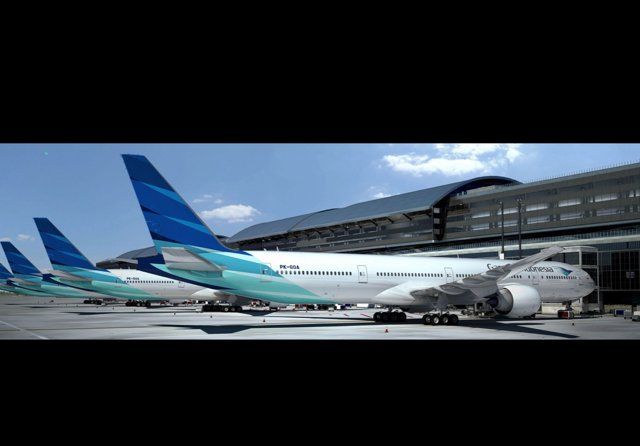
Indonesia is moving from airline-level survival to a system-wide rebuilding of its aviation sector, with the restructuring of flag carrier Garuda Indonesia, the rapid return of low-cost capacity and a new cycle of fleet modernization restoring connectivity across the world’s largest archipelago.
After suffering one of the deepest pandemic-era collapses in Asia, Southeast Asia’s biggest air transport market by geography is rebuilding the financial, operational and industrial foundations of flight — from balance sheets and aircraft leases to maintenance, manufacturing and airport infrastructure — in a recovery now increasingly visible in rising frequencies, reopened routes and returning wide-body operations.
LogisticsNews.ph sources from the recently concluded Singapore Airshow said the center of the turnaround is Garuda Indonesia’s court-supervised debt restructuring, which slashed more than USD10 billion in liabilities and reset lease rates, allowing grounded aircraft to gradually return to service.
Reuters reported that the rehabilitation of the full-service carrier is restoring long-haul capability while its budget arm, Citilink, is expanding domestic capacity in a price-sensitive market of more than 270 million people spread across thousands of islands.
The two-brand strategy reflects a structural shift in how Indonesia’s air transport system is being rebuilt. Garuda is refocusing on premium international routes and high-yield traffic, while low-cost operators are rebuilding the domestic network that functions as the backbone of national mobility.
Low-cost airlines led by Lion Air Group, Citilink and newer entrants now account for the bulk of passenger recovery, as travelers respond to higher post-pandemic fares and reduced aircraft supply by prioritizing price over service frills. The result is a volume-driven rebound in domestic traffic that is reconnecting secondary cities and restoring inter-island economic links.
International capacity is returning more gradually, but key tourism corridors are expanding again. Australia has re-emerged as one of the strongest long-haul markets, with additional frequencies to Bali signaling the revival of inbound leisure travel. Japan is another priority, with commercial partnerships and coordinated scheduling aimed at accelerating the return of high-spending visitors.
India and China are widely viewed by industry planners as the next major growth flows, particularly as Southeast Asia competes for post-pandemic tourism and transit traffic.
Fleet strategy is central to the recovery. Indonesia’s airlines are reactivating stored aircraft while preparing for the arrival of new-generation models that promise lower fuel burn and operating costs. Garuda is scheduled to receive Airbus A330-900neos later in the decade, a move expected to rebuild long-haul capacity while improving efficiency.
At the same time, the country is emerging as one of the first markets in Southeast Asia where Chinese-built commercial aircraft have entered scheduled service, adding a new source of lift at a time when delivery delays from the world’s two dominant manufacturers have constrained airline expansion globally.
The rebuilding effort extends beyond airlines. State-owned maintenance, repair and overhaul provider GMF AeroAsia is seeing activity recover as more aircraft return to service, restoring a critical link in the regional aerospace supply chain. Domestic aircraft manufacturer Indonesian Aerospace has also resumed serial production of its N219 turboprop, underscoring Jakarta’s long-term ambition to maintain an indigenous aviation capability.
Airport and air navigation upgrades are proceeding in parallel. Capacity optimization at Soekarno-Hatta International Airport, expansion of secondary international gateways and modernization of air traffic management are designed to support future growth while reducing the historic concentration of international traffic in Jakarta and Bali.
For policymakers, aviation is no longer treated solely as a commercial sector but as strategic infrastructure for tourism, trade and national integration. Improved air links are essential for moving people and goods across an archipelago that stretches more than 5,000 kilometers from west to east.
The recovery is also reshaping competition within Southeast Asia. Indonesia’s return to capacity growth comes as regional airlines race to secure aircraft, rebuild networks and capture surging travel demand. With one of the largest domestic markets in the world and a rapidly recovering inbound tourism sector, the country is positioned to become one of the region’s most influential air transport players again.
Industry analysts say the pace of expansion will depend on access to financing, aircraft delivery timelines and the ability of airlines to maintain lower cost structures after restructuring. But the direction is now clear: the focus has shifted from survival to growth.
As more aircraft re-enter service and new ones join the fleet, routes that disappeared during the pandemic are reappearing on departure boards, reconnecting cities and restoring the air bridges that underpin Southeast Asia’s largest economy.

