


HD Hyundai Heavy Industries, one of the world’s leading shipbuilding giants, is expanding its global construction operations and dedicated MRO support in Subic on top of the ongoing USD2-billion large-scale projects, delivering state-of-the-art vessels in the former U.S. naval base.
During a presentation Tuesday at the Philippines-Korea Business Forum held in Manila in time for the visit of South Korean President Lee Jae Myung, HD Hyundai conducted a presentation of its Philippine operations and its strategic partnership in maritime security in the Indo-Pacific region.
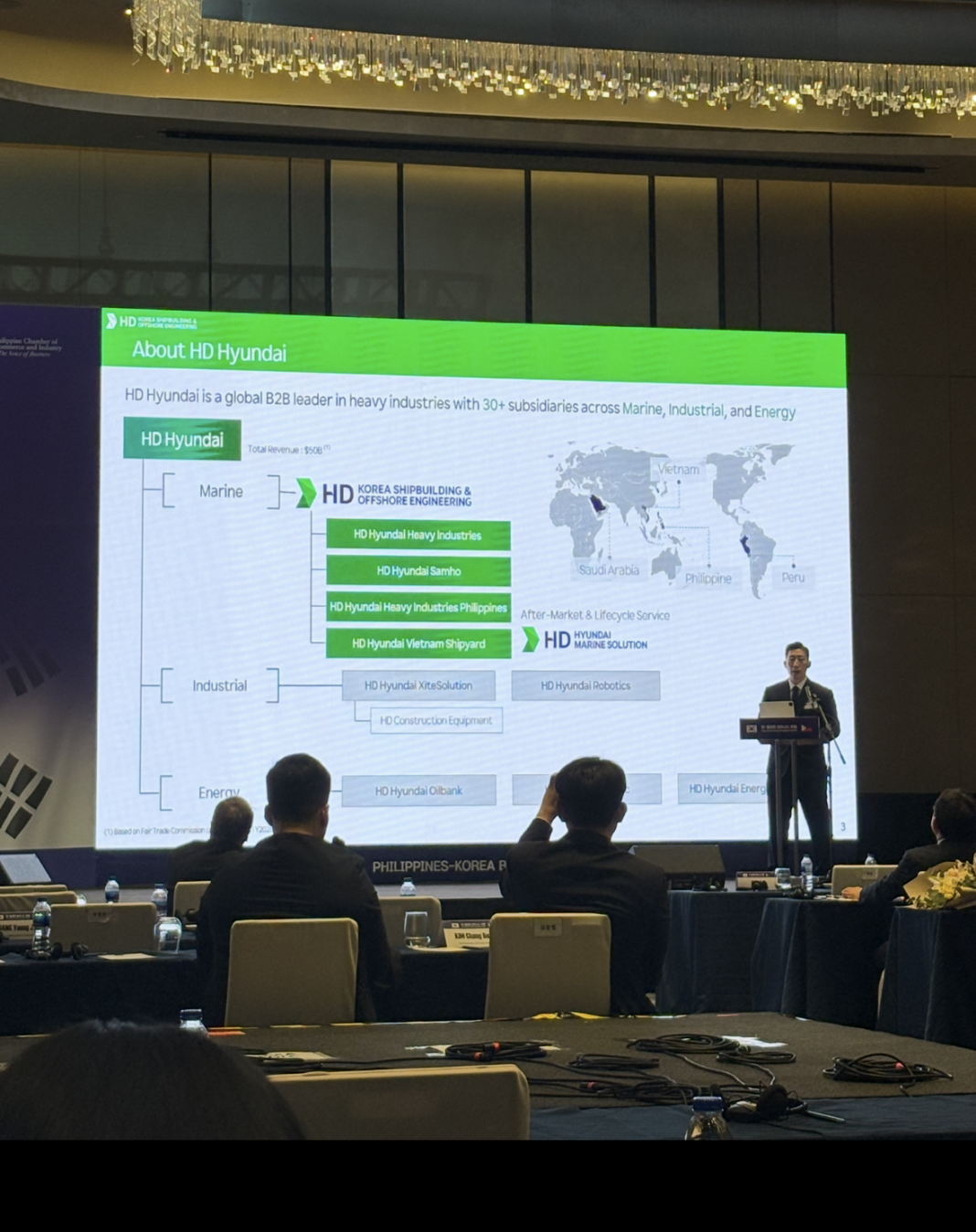
Inho “Robin” Lee of HD Hyundai said in a presentation “Co-Navigating the Future,” that through its Philippine subsidiary, HD Hyundai Philippine Shipyard, they are expanding global construction and building dedicated MRO support for the Philippines.
“Soon, we will open a new commercial port and trading center in Subic,” said Lee, noting that these projects will drive the modernization of the country’s naval forces.
Lee justified the company’s choice of the Philippines, stating that the country holds an irreplaceable position as a front-line state for regional maritime security. Second, he said, the Philippines is an ideal MRO and logistics hub.
While Korea handles the full spectrum, Subic focuses on global construction and the critical naval environment, which stands for maintenance, repair, and overhaul.
“From an operational perspective, the Philippines is the optimal location for life-cycle sustainability and supply chain efficiency,” he said.
At present, HD Hyundai is executing its USD 2-billion worth of large-scale projects, including the delivery of combatant vessels to the Philippine Navy and patrol boats to the Philippine Coast Guard.
Lee emphasized that HD Hyundai’s commitment to the Philippines goes beyond exporting ships. “We are localizing operations and investing in the future,” he said.
The partnership with the Philippines aims to build a secure and sustainable maritime ecosystem together. “Because of this strategic value, HD Hyundai has successfully delivered and continues to execute multiple major programs,” Lee said.
This also allows the company to manage the whole life cycle as a global total solution provider, ensuring that more strategic assets are maintained by global experts using globalized supply chains and elevating maritime security.
HD Hyundai’s shipyard in Subic already occupies 33 percent of the entire facility, which is equivalent to 120 football fields in size. The vision is for it to be the core of rotational building in its global expansion.
HD Hyundai is fully prepared to lead the best solutions for the Indo-Pacific region, enhancing naval capabilities through a strong shipbuilding and industrial base. “We are committed to strategic globalization. We understand the need for global production of allied strategic assets, and we are proactively exploring base capability transfers and industrial risk mitigation to meet those demands,” he said.
Earlier in the forum, HD Hyundai signed a memorandum of understanding with the Philippines’ Technical Education and Skills Development Authority to support the skills requirements of workers needed for the projects and to build a resilient global ecosystem. The MOU is among the seven MOUs signed between Filipinos and S. Korean firms.
“By building an ownership culture, we are creating a long-term safety net for both of our nations,” Lee said.
As a global B2B leader in heavy industries with more than 30 subsidiaries and total revenue of over USD 50 billion, HD Hyundai provides comprehensive solutions.
First, he said, HD provides a truly end-to-end solution from design to construction to manufacturing core components and life-cycle sustainment.
Second is industrial, where HD Hyundai is advancing future infrastructure through its world-class construction equipment, robotics, and automation technologies. And finally, energy.
“We are building a sustainable ecosystem that covers the entire spectrum from oil refining and chemicals to power transformers and renewable energy. Together, these capabilities allow us to provide comprehensive solutions for a sustainable future,” he said.
In Korea, the company operates two mega shipyards — HD Hyundai Heavy Industries in Busan and HD Hyundai Samho in Yeongam.
Combined, these facilities cover an area of over 1,300 football fields and generate more than USD17 billion in revenue. The company builds 145 vessels annually, representing more than half of Korea’s total production and one-seventh of all vessel building worldwide.

