


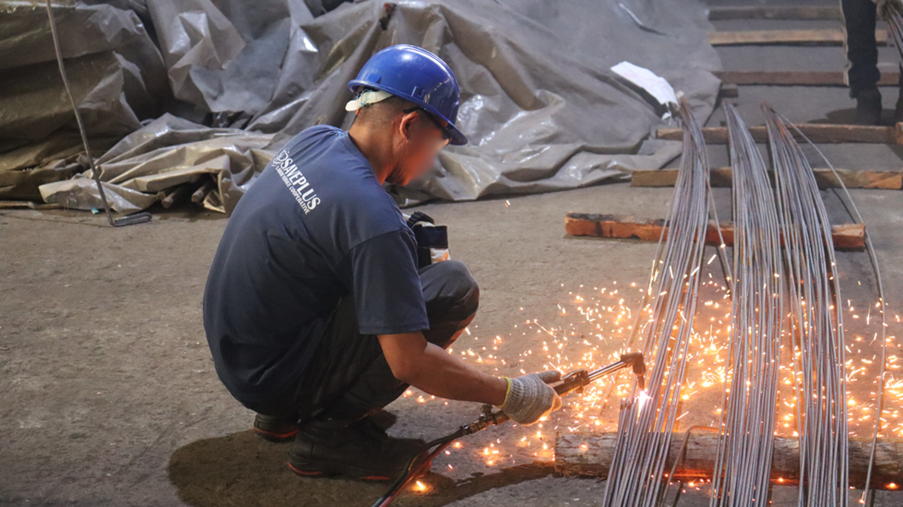
Filipino steel product manufacturers want the Department of Public Works and Highways (DPWH) to strictly implement Philippine standards on steel products in government infrastructure projects, particularly the massive Bataan-Cavite Interlink Bridge under the Luzon Economic Corridor project.
Joel Ronquillo, president of the Philippine Iron and Steel Institute (PISI), said the association is joining several technical working groups (TWGs) to push its objective of ensuring the safety of infrastructure projects through the strict implementation of proper standards for steel, a major construction material.
Among these TWGs are those led by agencies such as the DPWH, the Bureau of Customs (BOC), the Bureau of Internal Revenue (BIR), and the Department of Finance, which oversees the BOC and BIR.
Ronquillo said this is the organization’s first engagement with the DPWH, where discussions will focus on the issue of mandatory standards for steel products used in government infrastructure projects.
With the BOC, Ronquillo said they will discuss related trade issues, including smuggling and the technical valuation of imported steel, as well as whether these products meet the mandatory Philippine Standards.
The standards issue surfaced as local steel manufacturers seek to participate in supplying steel products for infrastructure projects under the Luzon Economic Corridor initiative, particularly Phase 4—the Bataan-Cavite Interlink Bridge project—which could employ ICB (integral composite bridges).
The Bataan-Cavite Interlink Bridge is a planned 32.15-kilometer, four-lane bridge across Manila Bay, designed to connect Mariveles, Bataan, and Naic, Cavite. This flagship project aims to reduce travel time between the two provinces from five hours to approximately 30 to 45 minutes. Construction is set to begin in 2025, with major financing provided by the Asian Development Bank and other countries, particularly the U.S., Japan, and some Western countries.
“We have some issues about standards. Because they want to use the ICB. We’re excited about the bridge, it’s huge, there’s a lot of steel. And we want to make sure that Philippine standards are always used in our infrastructure,” said Ronquillo.
While bidding will be open to all, PISI members want to ensure that steel suppliers—whether local or foreign—strictly observe Philippine standards.
“All we’re saying is that let’s follow Philippine standards. By law, when you build in the Philippines, you follow Philippine standards. It doesn’t mean foreigners cannot supply,” he said.
This concern is related to issues surrounding the integrity of bridges and other government infrastructure projects.
“There are substandard issues, number one, underweight issues,” he said.
PISI has previously raised standards issues on steel products with the Department of Trade and Industry, which is responsible for enforcing Philippine Standards for mandatory products. However, this will be the first time PISI will work with the DPWH.
“Our collaboration with DPWH is just starting,” he said.
PISI is composed of 63 manufacturers of various steel products from different sectors, including long products, rebar producers, flat products, steel billets, roofing manufacturers, steel fabricators, as well as some rolling mills, traders, importers, and equipment suppliers.

