


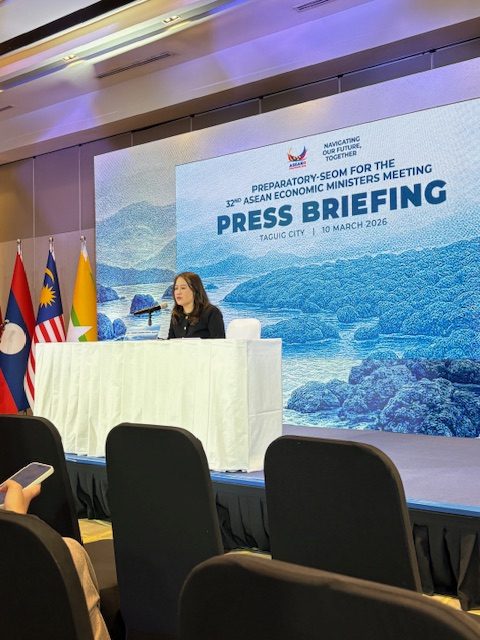
The Philippines, chair of the 2026 ASEAN, is pushing to conclude negotiations for the ASEAN Digital Economy Framework Agreement (DEFA) for signing of the landmark deal in November during the ASEAN Leaders’ Summit in Manila. The agreement is expected to pave the way for interoperability of digital payment systems and processes among member countries.
Marie Sherylyn D. Aquia, director of the Bureau of International Trade Relations of the Department of Trade and Industry (DTI), said during a briefing for the Preparatory Senior Economic Officials’ Meeting (Prep-SEOM) scheduled on March 11–12, 2026 in Manila, that concluding the DEFA negotiations is a key Philippine milestone, as it is one of the country’s 19 Priority Economic Deliverables (PEDs) as this year’s ASEAN chair.
Aquia said ASEAN is currently convening the Legal Experts Meeting for DEFA, where specialists are conducting the legal scrubbing of the agreement.
“They will review the agreed provisions to ensure clarity, consistency, and readiness of the text before it is signed in November at the sidelines of the ASEAN Summit,” she added.
The DEFA is one of the 19 Priority Economic Deliverables during the Philippine chairship.
One of the most crucial issues under the DEFA is the interoperability of payment systems among ASEAN countries. “That’s what DEFA is talking about, what measures to be in place to allow interoperability for electronic payments,” she said.
The results of the ASEAN Senior Economic Officials’ Meeting will be submitted to the upcoming 32nd ASEAN Economic Ministers’ (AEM) Retreat also in Manila, to be led by Trade and Industry Secretary Cristina Roque.
Roque is scheduled to hold a press conference at the conclusion of the AEM Retreat in March to announce the outcome of their discussions. The Philippines is advancing priority economic deliverables such as the DEFA negotiations, supply chain strengthening, and support for micro, small, and medium enterprises.
Once the DEFA is signed in November, each ASEAN member state will undertake its respective ratification process. In the Philippines, the agreement will undergo public consultations prior to ratification of the treaty by the Executive or the Senate.
With the DEFA in place, electronic payment systems and operators could be used across the region. For instance, payments through Globe and Maya would not only be recognized in the Philippines but also in other ASEAN countries participating in the DEFA. This is expected to translate into lower transaction costs.
Transaction costs remain an issue that payment systems will need to address.
By steering this critical phase of the DEFA negotiations, Aquia said the Philippines reaffirms its commitment to work with ASEAN member states to complete the agreement and achieve its signing within the year.
The Philippines has championed the conclusion of the DEFA negotiations because of its transformative potential to strengthen digital trade, innovation, and connectivity across the region.
The DEFA is envisioned to be the most comprehensive regional agreement on the digital economy and e-commerce in ASEAN. It aims to create a digital environment that is open, secure, interoperable, competitive, and inclusive.
While negotiations remain confidential, Aquia said the agreement seeks to strengthen trust in the digital environment through measures such as online consumer protection, personal data protection, cybersecurity, and safeguards against online scams.
“These rules will help support businesses, particularly micro, small, and medium enterprises, through improved cooperation in areas such as digital payments and electronic documentation,” said Aquia.

