


A truckers’ group lambasted government red tape and what it described as lopsided policies affecting a sector that moves the economy, yet is often discriminated against and treated as a nuisance on the road.
Rina Papa, representing the Alliance of Concerned Truck Owners and Organization (ACTOO), said in a presentation on “Advocacy for the Development and Adoption of Enabling Policy Infrastructure for the Logistics Industry” at the 2026 Logistics Summit that most policies governing their sector—largely composed of small and medium enterprises—actually obstruct and disrupt the supply chain.
Red tape
Foremost, one policy requires that all trucks for hire engaged in the transportation of goods must secure a franchise.
Papa said the intention is to ensure public safety, accountability, and industry standardization through government-issued operating authority. “But in real life, we get our franchise license in a minimum of six months and a maximum of three years,” she said.
While waiting, an applicant may be granted provisional authority, which is renewable every three months.
Inspection systems— Motor Vehicle Inspection System and Private Motor Vehicle Inspection Centers —are not only insufficient, she said, but trucks often cannot even fit into these facilities.
Truckers must also undergo multiple accreditations and registrations from Securities and Exchange Commission, Department of Trade and Industry, Bureau of Internal Revenue, Land Transportation Office, Land Transportation and Franchising Regulatory Board, the Mayor’s Office, the Philippine Ports Authority, and even barangays, making them among the most regulated sectors.
This layering of regulations and accreditations adds to delays and increases operating costs for trucking companies.
Papa even suggested in jest that they might as well secure permits in all areas they pass through if it would satisfy local governments.
Truckers, she said, cannot even use good roads without being accused of damaging them. “But we are paying road user’s tax,” she said, noting that truckers pay almost 200 percent more than a typical motorist, while still shouldering additional pass-through fees imposed by local government units.
In the first place, she said, the law was not designed to prevent road damage, but merely to generate revenue from the cargo being transported. “Unfortunately, the truckers do not own the cargo, but it’s the truckers who pay,” she said.
Despite extensive compliance, she added that overlapping requirements create confusion and poor coordination, often leading to unintended fines and penalties. “So instead of enabling safety and efficiency, regulatory systems often become administrative bottlenecks that slow logistics operations and increase the cost of moving goods,” she said.
Papa also criticized what she called selective toll fee exemptions for trucks carrying agricultural products. The problem, especially for port-based trucks, is that containers may carry onions at one time and screws at another. Yet truckers are consistently treated as nuisances and often blamed for traffic congestion.
She questioned the selectivity of the policy. “Don’t we contribute equally? All these products contribute equally to the economic activity, the national market, and the national economy.”
She explained that a toll exemption focused solely on agricultural cargo overlooks the broader supply chain. Since manufacturing and food production depend on multiple transported inputs, logistics costs remain embedded in production, limiting the policy’s ability to meaningfully reduce consumer prices.
Class 3 trucks pay the highest toll rates on national expressways, yet are sometimes barred from areas such as Marilao, forcing drivers to reroute to MacArthur Highway and endure an additional three hours of travel. “How is this helping the supply chain? How is this helping the distribution of goods?” she asked.
Trucks are also banned from major highways in Metro Manila, including EDSA, Quezon City, España, and Quezon Avenue. “These trucks are delivering commodities. Why are we being deprioritized in road use?”
“Why are our policies stopping our trucks from moving? Our policies are driven by objectives of traffic management, road infrastructure, revenue generation, regulation and enforcement, environmental consideration, and even aesthetic concerns.”
However, she said truckers have yet to see a government policy that ensures the unhampered flow of commodities. “We don’t see a policy that would actually enable and strengthen our national supply chain,” she said.
This gap persists across areas such as goods transport, supply chain connectivity, job creation—whether direct or indirect—market access, trade facilitation, economic multiplier effects, and even disaster response.
She recalled that during the COVID-19 pandemic, while most people stayed home, truckers remained on the road. The same is true during disasters.
Cargo
She noted that 50 percent of the country’s cargo is still moved by trucks, with about 250,000 units operating on roads across the Philippines.
“And we are creating millions of jobs, whether direct or indirect hiring as I’ve mentioned. The bottom line is why are our policies as such?”
She added that other countries give premium importance to the trucking sector. Truckers are included in policy design, consulted regularly, and granted incentives such as fuel tax credits, free infrastructure access, and discounts.
In contrast, she said, local truckers are merely recipients of lopsided and restrictive policies—truck bans, limited routes, infrastructure constraints, fragmented local fees, and limited cost relief.
Review
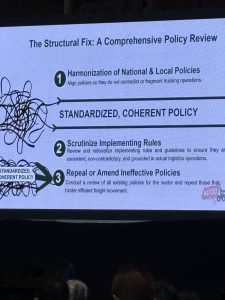
ACTOO is calling for structural reforms through a comprehensive policy review.
First, it seeks to harmonize national and local policies so they align and do not contradict or fragment trucking operations.
Second, it is pushing for a review of national implementing rules and guidelines to ensure they are consistent, non-contradictory, and grounded in actual logistics operations.
Lastly, it calls for a review of all existing policies affecting the sector, with the repeal of those that hinder or create inefficiencies in trucking operations.
Papa said the call is timely given the current global crisis. “ Now is the time to intervene sector that is fast dying and that sector is what moves our economy. (21:06) This is the time to act.”
“We are calling for the long-term strategic interventions that would involve economic infrastructures because truckers keep the economy connected. You should think of plans that would help us stabilize prices and that is in the form of support for truckers. Concretely, here are the key reforms that we are forwarding.
Statutory recognition, declare accredited free trucks part of critical economic infrastructure. Burahin na po natin yung istorbo sa daan. Kapart na inyo po kami sa ating economic activities and the market.”
Other proposed incentives include permanent cost relief tools, institutionalized fuel and toll safeguards, and VAT relief on essential inputs as strategic mechanisms for support.
There is also a need to establish trigger-based emergency support that would be activated during crises, such as the ongoing global fuel crisis.
“To summarize, our actual policy recommendation is to institutionalize fixed fuel discounts and fixed toll discounts for all trucks as a permanent form of economic recognition and operational support for the trucking sector,” she said.
ACTOO said temporary interventions may address immediate crises but will not sustain the sector or the supply chain. “The principle of this policy proposal is society should extend tangible support and recognition of a sector’s enduring contribution to market life and the national economy,” she said.
Truckers, she emphasized, are not asking for special treatment, but for fair recognition through complete and institutionalized support.
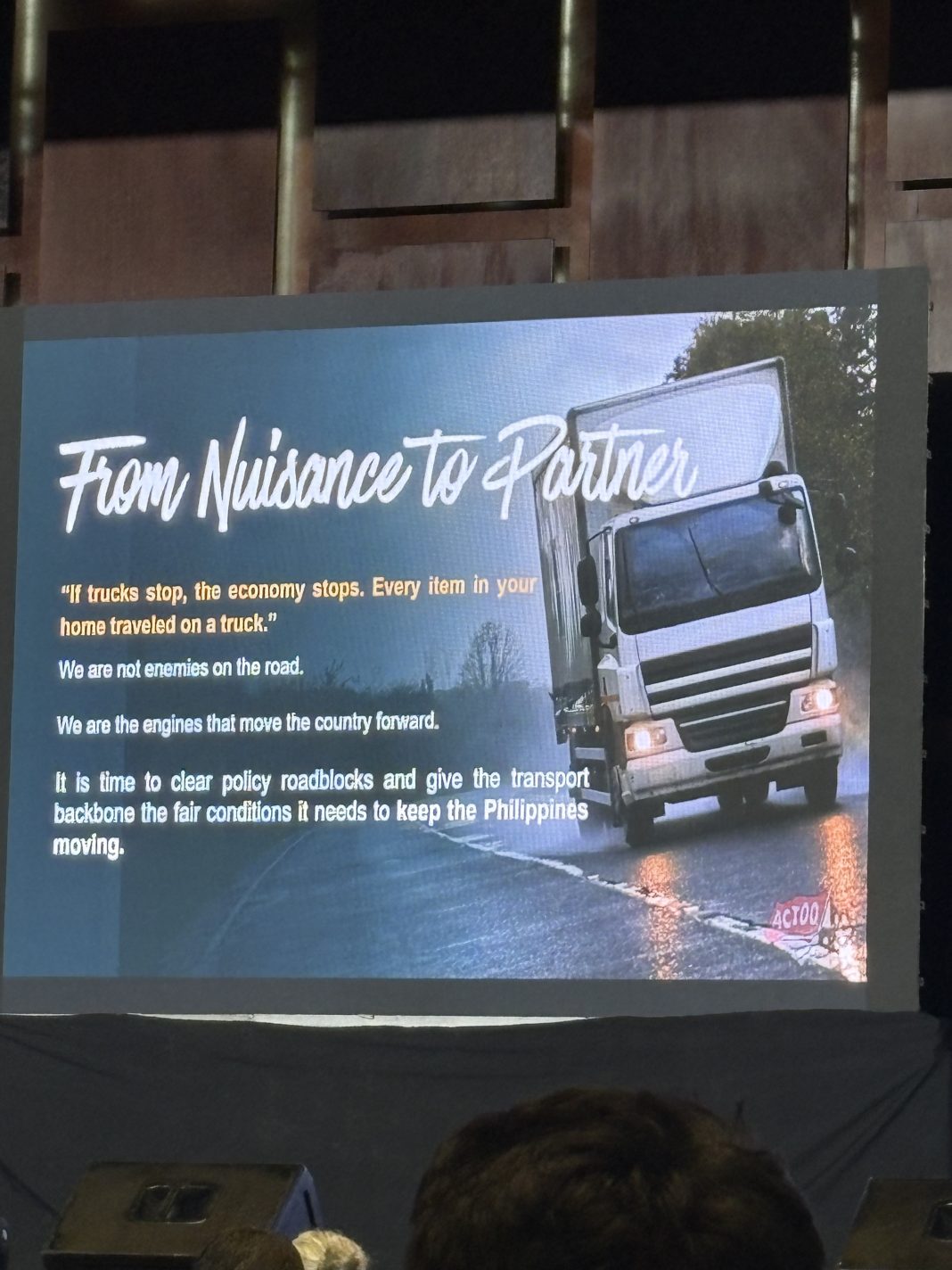
Given their round-the-clock operations, they said they should be treated consistently with state policies that uphold sectors fundamental to society and the economy. “If truck stops, the economy stops, every item in your home travels on a truck. We are not enemies of the road. We are the engines that move the country forward. It is time to clear policy roadblocks and give the transport backbone the fair conditions it needs to keep the Philippines moving.”

