The Bureau of Customs (BOC) is establishing a Trade Facilitation Service—a permanent office aimed at promoting business, reducing costs, and improving the ease of doing business—recognizing this third mandate as equally important as its revenue collection and border protection functions.
Atty. Agaton Teodoro Uvero, Customs Deputy Commissioner for the Assessment and Operations Coordinating Group, said at the 2026 Logistics Summit organized by PASIA that the new office will be created through an executive order. It is targeted for implementation within the year and will be headed by a director.
As an initial step, the BOC is setting up a Large Importers/Stakeholders Office, which will pave the way for the creation of the permanent Trade Facilitation Service.
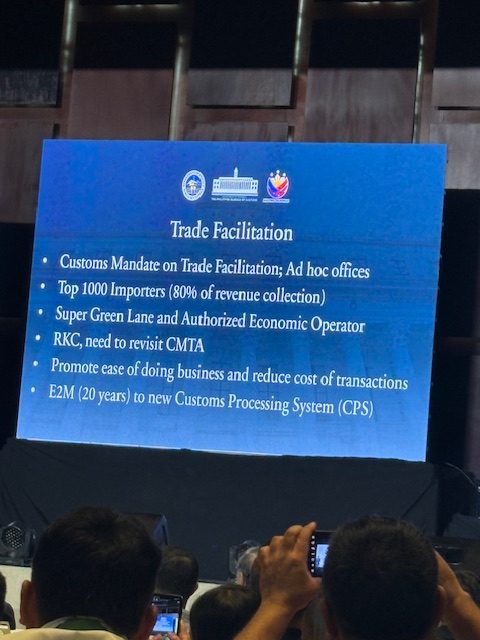
The new service will focus on simplifying and harmonizing processes, as well as eliminating gaps and inefficiencies in the agency’s 20-year-old system.
At present, trade facilitation functions within the BOC are handled by various ad hoc offices. While the agency has designated deputy commissioners for its two primary mandates—revenue collection and border protection—there is no permanent office solely dedicated to trade facilitation.
“While collection and enforcement are important, but facilitation to promote business, to reduce cost, to ease doing good business, is really as important also,” Uvero said.
The BOC is targeting PHP1 trillion in collections this year, up from PHP934.4 billion in 2025.
Uvero noted that the agency’s current approach to trade facilitation remains anchored on frameworks aligned with the revised Kyoto Convention, adopted in 2016, which focuses on the simplification and harmonization of customs procedures based on international standards.
While many of these measures have already been adopted, he emphasized the need for existing systems and policies to adapt to evolving technology, modern business practices, and the rapid growth of e-commerce.
Outdated system
Uvero underscored that digitalization is key to addressing the challenges facing the BOC.
Currently, the country’s second-largest revenue collection agency continues to rely on the outdated E2M system—older than the first Nokia phone released in 1996.
This highlights the urgency of digitalizing its systems as part of its broader trade facilitation efforts. He pointed out that the top 1,000 corporations or importers account for 82 percent of total collections. However, the BOC’s main trade facilitation program, the Super Green Lane (SGL)—a trusted trader scheme that allows accredited importers to process entries and release goods without intervention—covers only about 25 percent of import transactions. This is significantly lower than the roughly 95 percent coverage seen in more advanced customs jurisdictions.
Uvero recalled a previous attempt to modernize the system a decade ago using World Bank funding, which was derailed by legal challenges. By the time the Supreme Court issued its decision, the funding was no longer available.
The need for modernization has become even more pressing given the growing volume of transactions. The BOC now handles around 2.2 million import transactions annually involving 17,000 importers, as well as 3.94 million transactions a year overall—figures still being processed through an inefficient, decades-old system.
“So a lot of processes are being done and still done manually,” he said.
“Really, the volume of transactions, the processes involved, the management systems that you need, require a really fully digitalized system,” he added.
Meanwhile, Uvero said the BOC is in the final stages of preparing agreements for its digitalization project. The project is expected to be published in April and awarded by May, following a Swiss challenge process.
“Then we hope to be able to fully implement that before the end of next year. So, by that time, we hope to create a lot of efficiencies in the processes. We are able to have visibility on most of the processes that currently we don’t have,” he said.
He added that the new system is also expected to reduce existing charges.
“The direction of the commission is to promote accountability and integrity through modernization. So, while in the interim, we’re doing a lot of ad hoc reforms and really promoting good governance,” he said.