


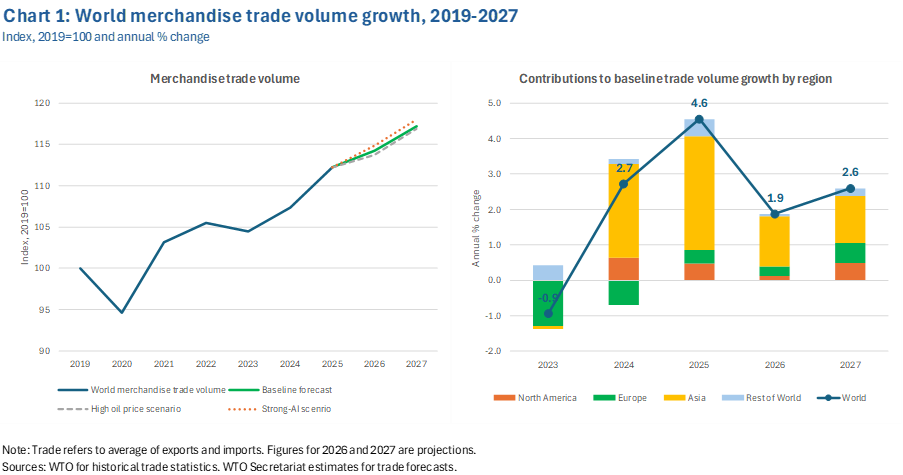
Global merchandise trade growth is seen to signicantly slowdown to 1.9 percent in 2026 from 4.6 percent in 2025 under pressure from the conflict in the Middle East despite a surge in AI-related products and the frontloading of imports to avoid new tariffs, the latest “Global Trade Outlook and Statistics” released on March 19 provides a baseline growth scenario excluding energy price shocks,.
WTO Director-General Ngozi Okonjo-Iweala said: “The outlook reflects the resilience of global trade, buoyed by trade in high technology products and digitally delivered services, adaptations in supply chains and the avoidance of tit-for-tat retaliation on tariffs.”:
However, this baseline forecast is under pressure from the conflict in the Middle East. Sustained increases in energy prices could increase risks for global trade, with potential spillovers for food security and cost pressures on consumers and businesses. Nevertheless, WTO members can help cushion the impact and ease the economic burden on people worldwide by maintaining predictable trade policies and strengthening supply chain resilience.”
The WTO forecast also showed that world merchandise trade volume is then projected to grow by 2.6 percent in 2027. Commercial services trade growth will ease to 4.8 percent in 2026 after this year’s 5.3 percent rise, then accelerate again to 5.1 percent in 2027.
Together, goods and services trade will grow 2.7 percent in 2026 compared with 4.7 percent in 2025. Global GDP growth is projected to moderate slightly from 2.9 percent in 2025 to 2.8 percent in both 2026 and 2027.
However, a scenario where both crude oil and liquefied natural gas (LNG) prices remain elevated throughout 2026 would shave 0.3 percentage points off the GDP forecast for 2026; this would in turn slash 0.5 percentage points off the trade forecast for this year and up to 1.0 percentage point for regions dependent on energy imports. This would mean merchandise trade volumes would grow by just 1.4 percent in the high energy price scenario. Services trade would also grow at a slower rate of 4.1 percent in 2026.
Beyond fuels, the Strait of Hormuz blockade has disrupted fertilizer supplies critical to global agriculture, with around one-third of the world’s fertilizer exports normally passing through the waterway. Major agriculture producers like India, Thailand and Brazil depend on the Gulf for 40 percent, 70 percent and 35 percent of their urea imports respectively. Gulf states face a food security challenge as well, with import dependency averaging 75% for rice and exceeding 90% for corn, soybeans and vegetable oil – commodities that would face higher costs through alternative routes.
WTO economists note there is also some upside potential if the conflict is short-lived and if AI-related spending remains strong throughout 2026 and into 2027, in which case merchandise trade growth could be boosted by 0.5 percentage points leading to growth as high as 2.4 percent this year and 2.7 percent next year.
It is also possible that the upside and downside risks could both materialize, with energy prices remaining high and AI-enabling goods trade continuing to surge. In this case, merchandise trade growth in 2026 might track closer to the baseline scenario.

