


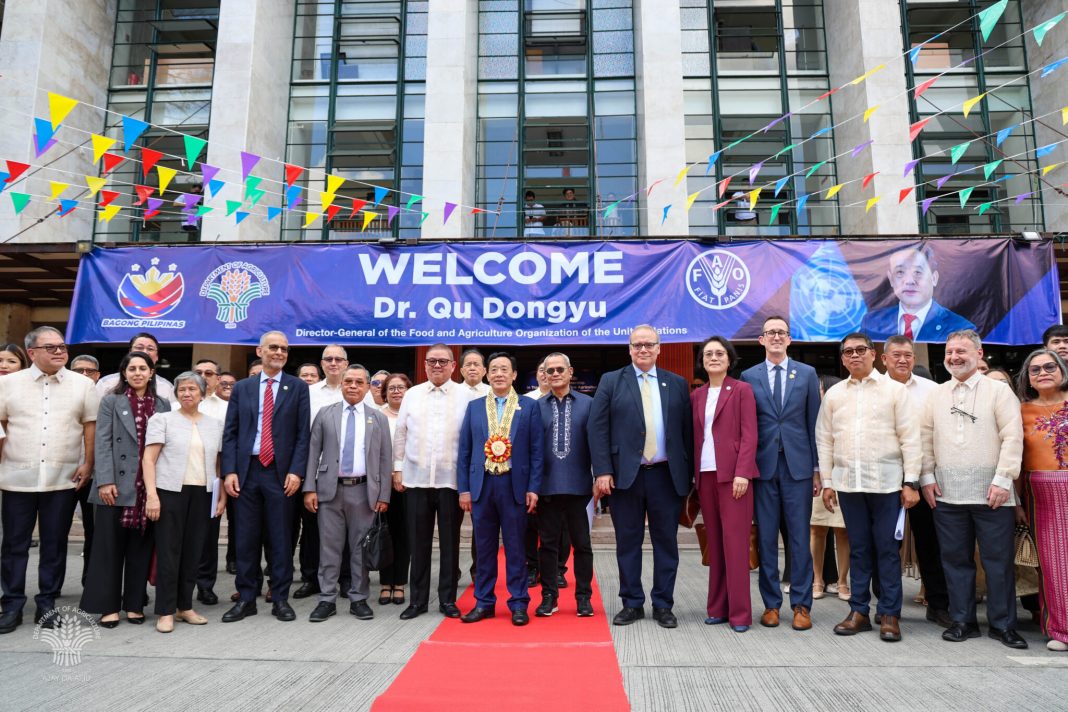
The Philippines and the Food and Agriculture Organization of the United Nations (FAO) moved to deepen decades-long cooperation in agriculture and food security, as FAO Director-General Qu Dongyu paid his first official visit to the Department of Agriculture (DA) headquarters.
Agriculture Secretary Francisco P. Tiu Laurel Jr. said the visit underscores a 48-year partnership focused on transforming food systems, raising farm incomes, and strengthening food security. “Today, that relationship must be further strengthened,” said Tiu Laurel, noting that FAO-backed programs have helped reach farmers and fisherfolk in vulnerable communities.
The Philippines, a founding FAO member, has worked closely with the agency since 1978, with the DA serving as a key implementing partner in initiatives on sustainable agriculture, fisheries, climate resilience, and food security.
Qu, for his part, cited the country’s biodiversity, fisheries, and young workforce as strategic advantages, saying the Philippines is well-positioned to advance FAO’s “four betters”—better production, better nutrition, a better environment, and a better life.
He also lauded the DA’s push to strengthen value chains, attract investments, and cut postharvest losses. During bilateral talks, both sides flagged urgent challenges—from climate risks and biodiversity loss to geopolitical tensions driving up oil and fertilizer prices—and called for coordinated regional action to shield farmers from market shocks.
Tiu Laurel pressed for expanded public-private partnerships to accelerate investments in irrigation, farm infrastructure, and postharvest systems, seen as critical to boosting productivity and farmer incomes.
Collaboration under FAO’s Hand-in-Hand Initiative is also set to ramp up, with the Philippines preparing for a National Investment Forum in April and participation in global investment events in Rome later this year. Priority commodities include seaweed, abaca, bamboo, and mango.
On the regional front, Manila confirmed its participation in the FAO Asia-Pacific Regional Conference in Brunei next month and renewed its bid to host the 2028 edition. The country will also host the first Asia-Pacific conference on agricultural mechanization in November.
Officials likewise reported stable aquaculture output, steady poultry supply, and progress in controlling African swine fever through a vaccine with high efficacy.
Both sides reaffirmed plans to mobilize financing from institutions such as the Asian Development Bank, World Bank, and climate funds to build a more resilient and inclusive agrifood system.

