


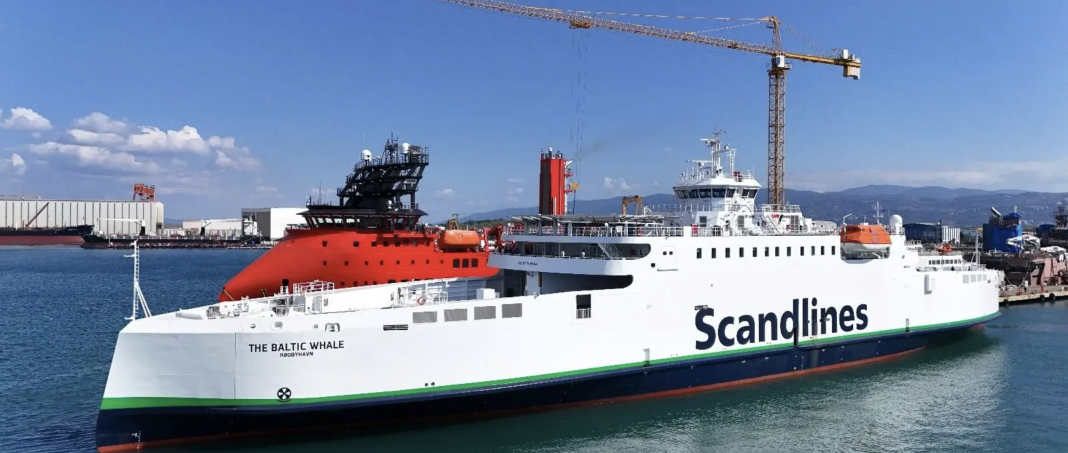
Scandlines entered a new phase of maritime operations March 10 with the official service launch of the Baltic Whale, a freight ferry capable of operating without direct emissions on the Puttgarden-Rodby route.
The vessel, which was delivered in January 2026 and officially named on Jan. 7, represents a transition to next-generation ferry technology for the 18.5-kilometer crossing between Denmark and Germany.
Constructed at the Cemre Shipyard in Turkey in coordination with Scandlines technical experts, the 147.4-meter ship was designed to address growing cargo demands. The vessel increases the route’s current freight capacity by 27 percent. It features the ability to transport lorries on both upper and lower decks, a capability that required the reconstruction of berths in both Puttgarden and Rodby to accommodate dual-deck loading.
The Baltic Whale utilizes a 10 MWh battery system that currently supports a 17-minute charging window in Rodby. This infrastructure is powered by a 50 kV / 25 MW cable and a dedicated transformer system located directly at the ferry berth.
A second 30 kV / 15 MW power cable and charging station in Puttgarden is scheduled for finalization this month. Once operational, the dual-port charging system is expected to reduce charging times to 12 minutes at either end of the route. This will allow the vessel to complete the crossing in 45 minutes with zero direct emissions.
Under current single-port charging conditions, the ferry completes the crossing in approximately one hour in emission-free mode at a service speed of 10 knots. The ship also retains the ability to operate as a hybrid ferry, maintaining a 45-minute crossing time at a service speed of 16 knots when necessary.
The introduction of the Baltic Whale is a primary component of the company’s long-term strategy to achieve direct-emission-free ferry operations by 2040.
The vessel’s construction began with the first steel cut in April 2022, followed by a keel-laying ceremony in August 2022. After its launch in November 2023 and subsequent delivery this past January, the ship underwent final preparations before its deployment this month on the Fehmarn Belt.
The Baltic Whale has a breadth of 25.4 meters and a design draft of 5.3 meters. It is rated to carry 66 freight units, totaling approximately 1,200 lane meters, and has a maximum capacity of 140 passengers. The total investment for the project was 80 million euros.

