


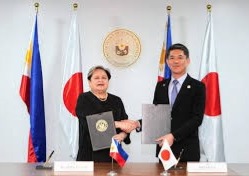
Strengthening a long-standing partnership in infrastructure development, the Governments of the Philippines and Japan officially signed and exchanged diplomatic notes today for two major transport projects aimed at decongesting the capital and boosting connectivity in Mindanao.
The signing ceremony, held at the Department of Foreign Affairs (DFA), was led by Foreign Affairs Secretary Ma. Theresa P. Lazaro and Japanese Ambassador ENDO Kazuya. The event was attended by high-ranking officials from the Department of Transportation (DOTr), Department of Public Works and Highways (DPWH), Department of Finance (DOF), Department of Economy, Planning, and Development (DEPDev), and the Japan International Cooperation Agency (JICA).
The highlight of the ceremony was the formalization of the Fourth Tranche Loan for the Metro Manila Subway Project (MMSP) Phase 1, amounting to JPY 220 billion (approx. PHP 84.81 billion).
This massive undertaking, often referred to as the Philippines’ “Project of the Century,” includes:
-
The construction of a 27.5-kilometer subway line connecting Valenzuela to Bicutan and NAIA Terminal 3.
-
The installation of a 33.1-kilometer electromechanical system.
-
Physical integration with the North-South Commuter Railway (NSCR), specifically the FTI-to-Bicutan segment.
-
The development of 17 stations, a dedicated depot, and the procurement of 30 train sets.
In addition to the subway loan, the two nations signed the loan for engineering services for Section 1 of the Central Mindanao High Standard Highway (Cagayan de Oro–Malaybalay Section). Valued at JPY 1.672 billion (approx. PHP 644 million), this project is a critical component of the DPWH’s regional development strategy.
Targeted for completion between 2026 and 2034, the high-standard highway aims to:
-
Drastically reduce travel time between Cagayan de Oro and Malaybalay from 6.5 hours down to 3.5 hours.
-
Enhance logistics and trade efficiency across Central Mindanao through superior technical road standards.
Secretary Lazaro emphasized that these agreements are a testament to the “strong foundation of existing cooperation” between the two nations.
“These projects reflect our shared commitment to ensuring that progress in connectivity is both efficient and inclusive,” Secretary Lazaro stated. “They provide significant thrust to President Ferdinand R. Marcos Jr.’s ‘Build Better More’ agenda, ensuring that our infrastructure keeps pace with our economic ambitions.”
The collaboration underscores Japan’s role as the Philippines’ top bilateral development partner, consistently supporting the country’s transition toward a more integrated and modern transport network.

