


Domestic nickel miners are bullish on the industry’s prospects amid rising global demand and shifting sourcing strategies for critical minerals, but are pressing for stronger government intervention to sustain growth.
During Thursday’s industry outlook briefing, the Philippine Nickel Industry Association (PNIA) outlined key policy support it hopes to secure, including incentives, the creation of special nickel economic zones or industrial complexes, and improved ease of doing business.
The industry exported a record 63 million metric tons of nickel last year—the highest in its history.
Incentives
To sustain this momentum, PNIA is urging the government to match incentives offered by Indonesia, including lower taxes, economic zone modeling, and streamlined permitting.
PNIA President Dante R. Bravo said existing incentives are helpful but insufficient, stressing the need for adjustments to encourage processors to invest in new equipment and expand capacity to compete with China and Indonesia.
“But if we need to be more competitive, then we have to have some adjustments there. I think the government can do that,” said Bravo, who is also president of Platinum Group Metals Corp.
“This is an opportunity for the Philippines … We are now counting our resources. So if we think that mining, and we believe in the industry that mining is going to help our economy over the long term, and realize a dream at some point in the future that we will have our additional processing capacity,” he added.
He also noted that critical minerals agreements with the United States, Japan, Canada, Korea, and potentially India could open more investment opportunities in the Philippines.
As Indonesia restricts nickel ore exports, it has begun sourcing supply from the Philippines. In 2025, China was the country’s top export market, accounting for 66 percent of exports from 78 percent in 2024 as Indonesia increased imports from the Philippines.
Economic zones
Another proposal is the establishment of dedicated industrial complexes or special economic zones for nickel.
PNIA Director Martin Antonio G. Zamora suggested creating three to four nickel ecozones in resource-rich areas to maximize shared infrastructure and lower costs.
For example, a Surigao-based ecozone could serve all mines and processing plants in the area, improving infrastructure and reducing power costs.
“I’m just bringing Surigao-Del Norte as an example, but the government can probably think of maybe three or four pockets in the Philippines where it makes sense, where you have the nickel resources near each other,” he said.
The goal is to build scale of at least 100 million wet metric tons to ensure commercial viability.
Zamora added that achieving such scale would require partnerships with foreign investors and bilateral agreements.
“By combining our resources, the private sector will step in as long as the circumstances favor the creation of downstream processing,” he said.
Permitting
Industry leaders also called for faster and more streamlined permitting. Bravo emphasized the need to speed up exploration permits.
“If we can do it in one month, then we are all incentivized to invest in exploration. So this is going to signal to the world, to the investing community, that the Philippines can have more value, can help international development, and we can have a better industrialization policy, as far as the nickel industry is concerned.”
Zamora echoed this, calling for a unified national permitting system instead of multiple overlapping requirements from local governments and agencies.
“You know, there are a number of requirements before you can get an exploration permit,” he said.
“It should just be the national level because it’s just perspective. The goal should be that, you make it simple because it doesn’t serve the purpose because there’s no commercial aspect in exploration. It’s just data and information gathering. But there’s all lots of layered requirements.”
He also proposed simplifying environmental compliance by applying a single Environmental Compliance Certificate (ECC) framework within designated nickel zones, rather than requiring separate approvals for each operator.
Permitting delays remain a major hurdle, with some processes—including tree-cutting permits—taking years.
Bravo said improving coordination between national and local agencies would reduce disruptions and attract more investors.
“What we need to do is just continue the momentum, by strengthening further the permitting process, harmonize the gridlock that we are experiencing with the national and local government, policies,” he said.
Scale challenges
Zamora noted that while his company is affiliated with two HPAL plants—Coral Bay in Palawan and Taganito in Surigao—Philippine operations remain less competitive than Indonesia’s.
He cited Indonesia’s advantage in having larger, contiguous ore deposits, enabling greater scale and lower costs.
“And so I think for the Philippines to compete, I honestly think it would be very difficult for us to aim to be lower cost than Indonesia,” he said.
To close the gap, he stressed the need for scale and government support to open new mining areas.
“What we need is scale. So we need government support for us to open up new mining areas. And when I talk about scale, our largest plant right now, our larger plant, is the Taganito HPAL plant, which is 30,000 tons,” he said.
By comparison, Indonesia’s plants typically produce at least 60,000 tons, with some reaching 150,000 tons. Achieving similar capacity would require at least 100 million tons of nickel resources, necessitating collaboration among clustered mines.
Despite calls to boost value-added processing, Zamora opposed a nickel ore export ban.
”We are against that,” he said, warning it could lead to stranded capacity, lower profits, and job losses.
“So I think instead of a ban, we should focus on incentives. How to make life easier for the mining industry,” Zamora said.
Strong outlook
PNIA Director and DMCI Mining Corp. President Tulsidas C. Reyes highlighted the industry’s strong performance in 2025.
“You know, we had a 2025 and a very strong run. We were blessed with a very nice Q4,” said Reyes.
“Our proximity to China and Indonesia gave us a clear advantage. Now, having said that, we’ve been dealing with China for how many years now? For quite some time.”
He said Indonesia’s policy of restricting nickel production presents an opportunity for the Philippines to fill supply gaps.
“It provides the Philippines a strategic location to do direct shipping work. And I believe the Philippines, having seen the numbers earlier, we’ve been taking advantage of that situation,” Reyes said.
He added that strong nickel prices have boosted first-quarter performance. “We’d like to take advantage of this high price. Having said that, we have to take advantage of this now.”
“So, we feel that 2026 will be strong,” he said.
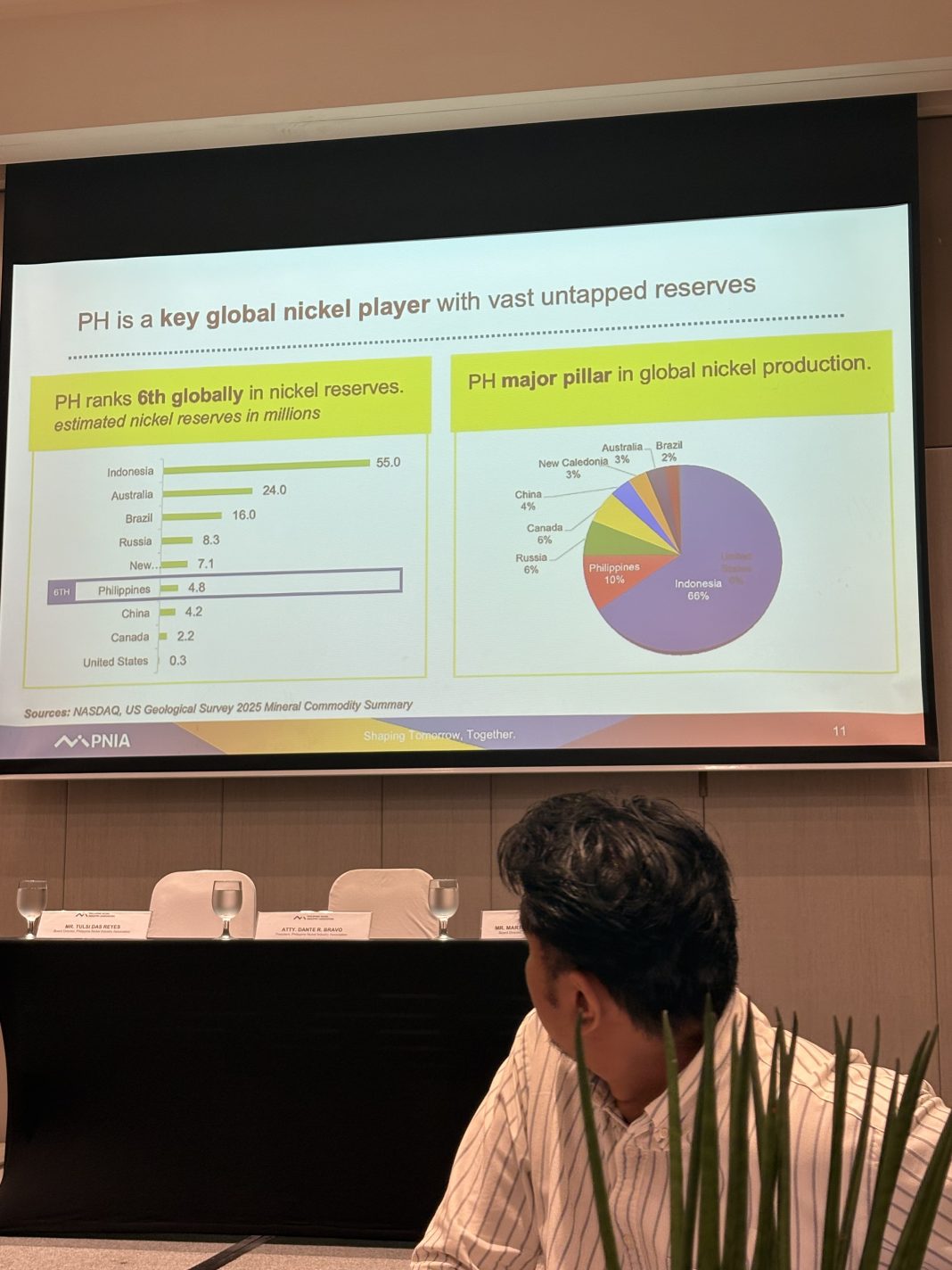
In a presentation, PNIA Executive Director Charmaine Olea-Capili said PNIA members accounted for around 73 percent of national output with total production reaching 37.81 million dry metric tons in 2025. The Philippines ranks 6th globally in nickel reserves and remains a key supplier to international markets.
Last year’s performance was 15 percent higher than the previous year. The industry was also looking at similar growth of 15-20 percent this year.
While optimistic, Reyes flagged potential risks from geopolitical tensions, particularly involving Iran, which could drive up fuel and shipping costs and disrupt supply chains.
Despite these risks, he remains confident in the Philippines’ position.
“The Philippines has put us in a great position to put ourselves in this game. We have the right ESG environmental policies in place. Right now we have the right regulations in place. That should help us take advantage of this 2026 and hopefully onwards.”

