


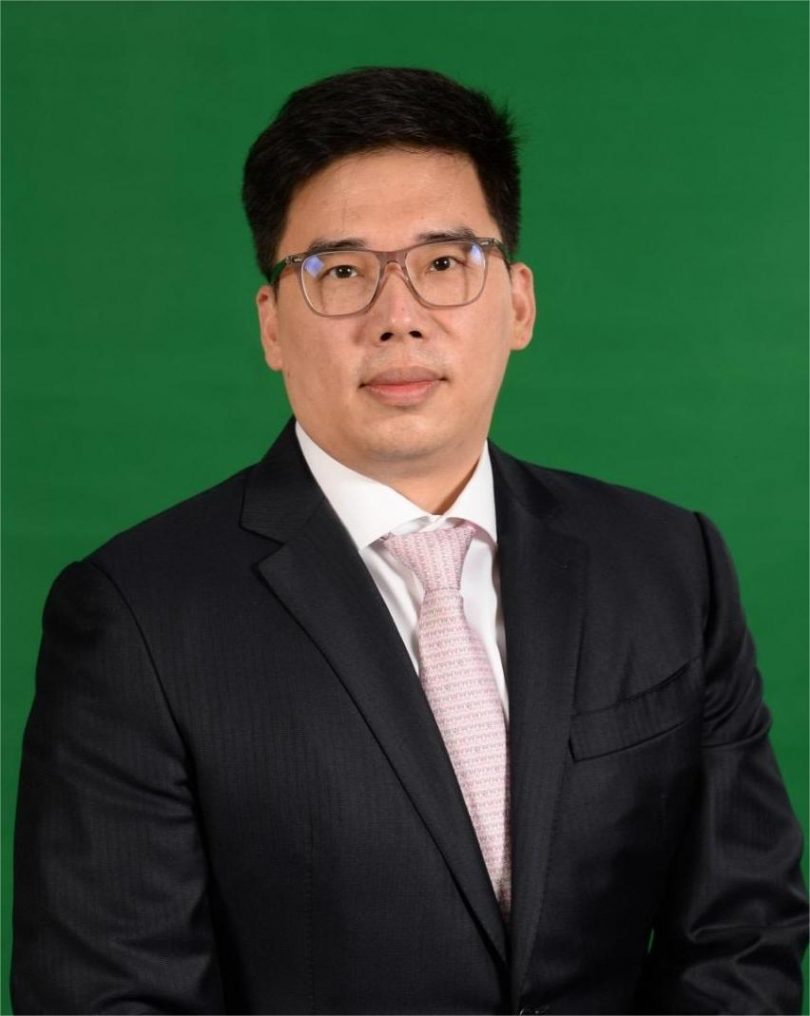
BRYAN ANG, a product of Ateneo and Harvard, is emerging as a young stalwart in the country’s business organizations, championing the ease of doing business for domestic enterprises, especially the micro, small and medium enterprises (MSMEs)
Bryan, son of Francis Chua, former president of the Philippine Chamber of Commerce and Industry (PCCI), now serves as PCCI vice president for trade and industry. He is also vice chairman of the external affairs committee of the and the Federation of Filipino Chinese Chamber of Commerce and Industry, where his father once served as president. He sits on several corporate boards, including as president of his family business – BA Securities, Inc. – and as director of ALL British Cars, Inc., Bell Electronics Corp., Dong Feng Motors Philippines Corp., and Brentwood Realty Corp. He is also president of CLMC Group of Companies and serves in various capacities across trade organizations, including the Philippine Exporters Confederation, as well as in various civic groups.
New blood
“I think there’s a deliberate movement that they want to have new blood, they want to see new capabilities of the officers. They have been assigning key positions to young members,” Bryan said of the new PCCI team.
The old guards at PCCI have begun transitioning leadership to the younger generation. Bryan noted that Ferdinand “Perry” Ferrer, the new PCCI president, is relatively young for the post, as is chairman Raymund Jude Aguilar. He described Mr. Ferrer, chairman and CEO of the EMS Group of Companies, as very energetic and results-oriented.
Among the youngest members of the PCCI board is Christopher Lim, son of former PCCI president Samie Lim, who now heads the committee on retail and tourism. A growing number of younger leaders from the provinces are also being onboarded.
As PCCI director, Bryan remains deeply committed to improving the country’s ease of doing business. He regularly attends meetings on trade facilitation, engaging with the Bureau of Customs, Department of Trade and Industry, exporters, logistics providers, and traders.
“The difference between working in the family and the PCCI is ‘In the family business, you call all the shots but with PCCI you represent a lot of stakeholders. So, you have to be extremely careful.’”
Policy support
While PCCI serves as the voice of business, Bryan emphasized the need for balance. “You cannot just keep attacking the policy and the personality. Instead, the private sector should give advice to the government on what will do good for business,” he said.
He observed that collaboration between the private sector and government increases the likelihood of success, particularly when supported by policy alignment.
Bryan said PCCI currently enjoys strong engagement with government and members of President Marcos’ Cabinet. Within the first two months of the new board, PCCI met with four Cabinet officials, including multiple engagements with Public Works and Highways Secretary Vince Dizon and a meeting with Development and Planning Secretary Arsenio Balisacan.
Most recently, the group held discussions with Foreign Affairs Secretary Lazaro on the Philippines’ ASEAN chairship.
A key development was the signing of a memorandum of cooperation among the Department of Public Works and Highways, the Catholic Bishops’ Conference of the Philippines, and PCCI to promote transparency in infrastructure projects.
Bryan noted a marked improvement in government openness. He recalled that during his first few years with PCCI, it was hard to meet any cabinet member. “Now, it’s just been two months and four Cabinet members, they are reaching out,” he said.
These engagements have produced concrete programs, action plans, and regular monitoring mechanisms. Bryan attributed this momentum to Mr. Ferrer’s leadership, describing him as an action-oriented leader focused on measurable results.
He also cited a shift in PCCI’s direction following public disclosure of corruption in flood control and infrastructure projects.
Trade facilitation
As a trade facilitator, Bryan has been addressing congestion at Manila ports. He recalled concerns raised by truckers and port users, led by the Truckers Association of the Philippines.
Stakeholders—including shipping lines, traders, importers, exporters, truckers, and port operators—have raised long-standing issues over congestion, particularly for reefer containers.
While acknowledging that Manila ports are overcrowded, Bryan noted the difficulty of balancing competing interests among stakeholders.
He recommended that the Bureau of Customs require certain commodities, such as electronics, to be routed through outports. He cited the shift of vehicle imports to Batangas as a positive development.
Bryan emphasized that expanding Manila ports alone will not resolve the issue. Greater utilization of outports such as Batangas and Subic is essential to reduce logistics costs and improve efficiency.
Ultimately, he warned, consumers bear the brunt of port inefficiencies through higher prices and logistical delays.
Reliance
Amid global oil shocks, Bryan proposed the temporary suspension of excise taxes on oil imports to curb rising costs and support domestic businesses, particularly the MSMEs.
“Remove the excise but on a temporary basis. It’s not permanent but for as long as there’s war, as long as the strait of Hormuz is closed, you have to,” he said. Already, President Marcos Jr. signed Republic Act No. 12316 on March 25, 2026, granting him emergency powers to suspend or reduce fuel excise taxes.
He also urged the government to diversify sourcing beyond the Middle East, citing Canada as a potential alternative.
According to Bryan, “U.S. President Trump does not care about oil prices because he got a lot of oil in Venezuela. ‘But will he give it to us?’”
He warned that volatile crude oil prices would first impact consumers through higher costs of basic goods, with MSMEs most vulnerable to closure.
China
On the Philippines-China relations, Bryan, who is of Chinese descent, expressed concern over public disagreements among personalities urging diplomacy over media exchanges.
“If there are disagreements, don’t let it go out to the media. You guys talk. There’s a direct line,” he said.
He welcomed the government’s move to grant 15-day visa-free entry to Chinese tourists, noting its potential to boost tourism revenue.
During a recent meeting with the Chinese ambassador, Bryan raised the issue of reciprocity for Filipino travelers. While full visa reciprocity may not yet be feasible, he said discussions included the possibility of transit visas for Filipino passport holders.
Bryan also cautioned against over reliance on a single geopolitical partner, noting shifting global trade dynamics and tariff policies.
“Why are we afraid of China? China has never bombed any country, but U.S. has bombed countries it considered enemies,” he said.
Economy
Despite global economic uncertainty driven by tariffs and geopolitical tensions, Bryan expressed confidence in the Marcos administration, particularly commending Bureau of Customs Commissioner Ariel Nepomuceno for exceeding collection targets.
“It’s not an easy job,” he said, noting that the Bureau has yet to fully digitalize its operations. He welcomed renewed progress in long-delayed digitalization efforts.
“We’ve been waiting for it for so long,” he added.
Bryan also expressed optimism about the stock market recovery but noted that volatility continues to delay initial public offerings (IPOs). He mentioned famous brands and companies that have been planning their IPOs.
“They have been putting this on hold for the last two years because our market is not good. It’s embarrassing to have an IPO and then the next day, the IPO price went down,” he said.
He also raised concerns about companies delisting from the stock exchange, particularly those that have benefited from public funding. While acknowledging that firms may have valid reasons, he warned that delisting can signal avoidance of regulatory and reporting obligations.
“That’s why it’s ugly,” he said.
However, he distinguished this from share buybacks programs, which he viewed as a sign of confidence in both company performance and the domestic economy.
“I appreciate companies who list and buy their shares back. But don’t buy back your shares using government money to delist it, it’s wrong,” he said.
Looking ahead
Bryan prefers to remain apolitical but expressed support for President Marcos, citing visible progress and the importance of policy continuity.
“I’ve seen a lot of changes and it is important to see continuity of his programs,” he said.
Looking ahead to the 2028 presidential election, he hopes for a leader focused on execution, consistent presence on the ground, and proactive governance.
He identified anti-corruption efforts—particularly in the Department of Public Works and Highways, the Bureau of Customs, and the Bureau of Internal Revenue—as critical to the administration’s legacy.
“If they clean up that image, it will be a big success for us, all the projects will be very transparent,” he said.
“We always support the administration. We can’t complain about the economic policies, very pro-business. Of course, there are problems, but they try to address it,” he added.
Bryan also praised the President’s State of the Nation Address (SONA) for exposing corruption in infrastructure projects and expressed hope for continued momentum.
For now, Bryan remains focused on his work—particularly trade facilitation and outreach initiatives. He intends to continue strengthening business conditions through his role at PCCI.
While he does not aim to surpass his father’s accomplishments, Bryan believes that his youth positions him to do more for the good of MSMEs, which representing over 99 percent of all registered business establishments in the country.

