


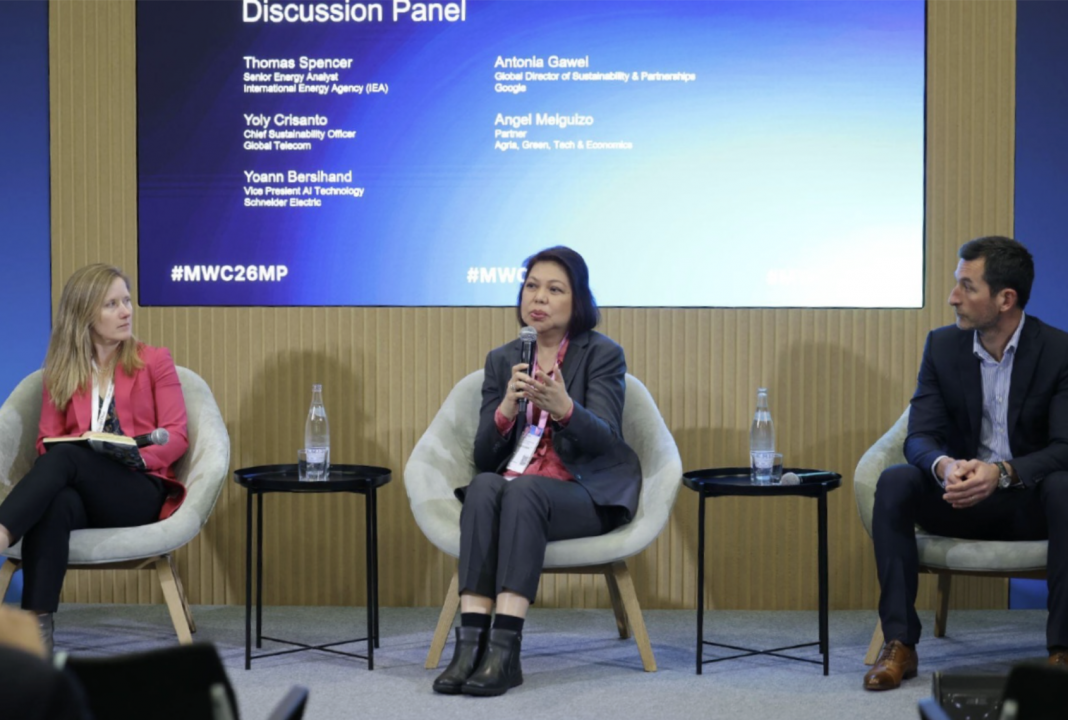
As artificial intelligence rapidly expands across industries, a new question is emerging: how much energy will it consume, and how can telecommunication companies manage energy demand responsibly? This was one of the key topics discussed at the GSMA Mobile World Congress 2026, where Globe joined leaders from the energy and technology sectors, including Google, ARGIA Green, Schneider Electric, and the International Energy Agency (IEA), to examine the environmental impact of AI and the role companies can play in keeping digital growth sustainable.
Globe Chief Sustainability and Corporate Communications Officer Yoly Crisanto said that innovation must move forward responsibly as new technologies scale. “Artificial intelligence is reshaping how economies grow and how people live and work. The challenge is making sure that this progress strengthens, rather than undermines, the global shift towards a sustainable future. We are focused on using technology in ways that make energy use more efficient, help build a more climate transition-ready digital infrastructure, and expand renewable energy. This is especially pertinent with threats to the supply of imported fossil fuel. The transition to more energy efficient technologies paired with renewable energy reduces exposure to fossil fuel price increases and improves energy security for the company’s operations.”
Globe shared how it is using AI to make its own network operations more energy efficient. By analyzing network traffic and adjusting power use at cell sites, AI systems can automatically reduce electricity consumption during periods of lower demand without affecting service.
These improvements may sound technical, but they have real impact. Telecommunications networks operate 24 hours a day and require large amounts of energy to keep people connected. Even small efficiency gains across thousands of network sites can translate into significant energy savings.
Globe said AI-driven optimization has already reduced electricity use across parts of its network infrastructure. The company has also rolled out tens of thousands of green solutions across its facilities, including sodium-nickel batteries and cooling technologies that reduce the need for energy-intensive air conditioning. AI is also being used to regulate the cooling of piping systems and minimize electricity consumption, which has resulted in a 20 to 30 percent annual energy savings.
These innovations are being paired with Globe’s broader shift toward renewable energy as the company aims to shift at least 42% of its electricity use from renewable energy by 2030, compared to 24% RE share in 2024. More broadly, Globe has achieved a year-on-year 15% reduction in Scopes 1 and 2 emissions and a 9% reduction in Scope 3 emissions, significantly surpassing its near-term linear annual reduction rate targets of 4.2% and 2.5%, respectively.
To reflect the company’s evolving business strategy, Globe will resubmit its emissions inventory to the Science Based Targets initiative (SBTi) and establish 2025 as its new baseline year. Globe is recalibrating its Net Zero targets to remain transparent and fully aligned with its current operational footprint. Globe also emphasized the importance of collaboration between industry and government to accelerate the transition to cleaner energy.
More flexible electricity grids and wider deployment of renewable sources, including siting these near data centers, will be important to support both digital growth and climate action in the years ahead.
As AI continues to evolve, Globe believes that technology can become part of the solution rather than the problem. Crisanto emphasized, “technology drives innovation and with AI there is great opportunity to use this technology for greater good.”
With responsible innovation and strong partnerships, AI use can enable companies and the wider economy for sustainable growth. Pioneering the adoption of renewable energy and energy efficient technologies, Globe supports the Philippine government’s initiative to have 35% Renewable Energy share in the national energy mix by 2030.
Globe has recently been recognized as a Climate Leader by CDP after earning an A- score for Climate in 2025. Globe has also earned a coveted spot in the World’s Most Sustainable Companies 2025 list by TIME Magazine and Statista.

