


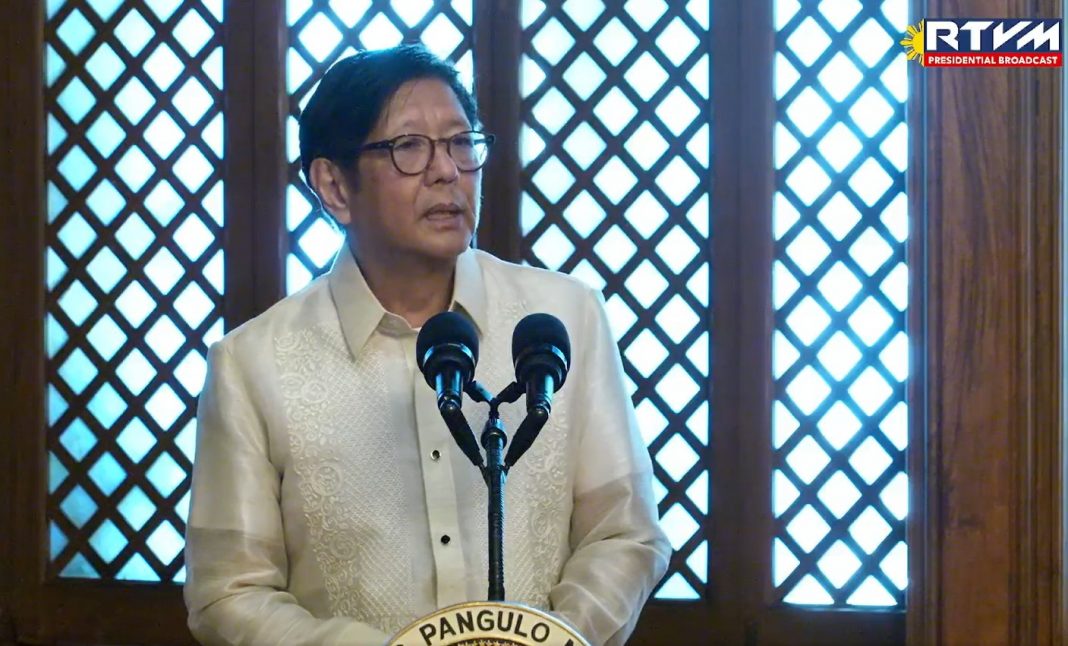
President Ferdinand R. Marcos Jr. reaffirmed the national government’s commitment to empowering local leaders, announcing on Monday that several measures are underway to refine the implementation of the Mandanas-Garcia ruling.
Speaking at the oathtaking ceremony of the Vice Mayors’ League of the Philippines (VMLP) in Malacañang, the President emphasized a future of increased allotments driven by improved revenue collection and streamlined governance.
The Mandanas-Garcia ruling, a landmark 2018 Supreme Court decision, significantly expands the fiscal base of Local Government Units (LGUs) by ensuring their share—the National Tax Allotment (NTA)—is calculated from all national taxes, rather than just internal revenue.
The President noted that while the ruling is technically in effect, the government is currently amending the Implementing Rules and Regulations (IRR) to ensure a smoother transition of responsibilities. A key focus is the clear delineation of duties between the national and local levels.
“We have come to the conclusion that the way to delineate functions… is that those that belong to a program that is national in nature will be attended to by national,” the President stated, clarifying that the national government will continue to support large-scale programs while allowing LGUs to manage localized services.
President Marcos acknowledged that the full impact of the increased tax share has yet to be felt by many LGUs. This was largely due to the economic slowdown during the COVID-19 pandemic in 2020, which resulted in lower tax collections.
“Although technically applied na ‘yung IRA share na increase… wala naman naramdaman dahil wala naman masyadong koleksyon noong 2020,” the President explained. However, he expressed optimism that as the economy continues to recover and revenue collection strengthens, local governments will see a significant and tangible rise in their budgets.
To support LGUs in managing these increased funds, the administration is also working to streamline accounting and auditing documentation. This initiative aims to reduce the administrative burden on local officials and address recurring compliance concerns, ensuring that funds are utilized efficiently for the benefit of their constituents.
The Mandanas-Garcia ruling serves as a double-edged sword: while it provides unprecedented fiscal autonomy, it also demands higher standards of service delivery from LGUs. By focusing on clearer guidelines and better collection, the Marcos administration aims to transform local governments into more self-sufficient and responsive units of the state.

