


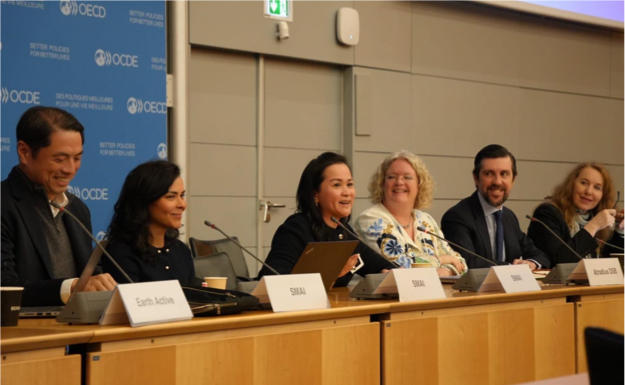
The New Manila International Airport (NMIA) project in Bulacan was presented recently at the 12th OECD Workshop for Financial Institutions in Paris as a case study on how major infrastructure projects can align with international environmental and social standards.
San Miguel Aerocity Inc. (SMAI), the project proponent, was invited to present NMIA before export credit agencies, commercial and development banks, development financial institutions, and specialist environmental and social consulting firms from across the OECD’s 38 member countries.
The project was taken up as a plenary case study, with the presentation focusing on its alignment with the IFC Performance Standards and Equator Principles, which are widely used by international lenders in evaluating large-scale infrastructure developments. SMAI presented alongside Atradius DSB, the project’s export credit insurer, and Earth Active, one of its independent environmental and social consultants.
SMAI said the presentation highlighted NMIA’s shift from local regulatory compliance to international lender-aligned environmental and social frameworks, including stronger internal management systems and the implementation of biodiversity and social risk measures for a challenging coastal site with critical habitat considerations.
Participants viewed the project as a credible and transparent example of infrastructure development under challenging environmental and social conditions. They also noted the company’s openness in discussing early challenges, capacity-building efforts, and adaptive management approaches, particularly in biodiversity offsets and social performance.
The project was also discussed as a practical reference for lender decision-making in emerging market infrastructure, showing how sponsors and lenders can work together to address gaps and strengthen environmental and social performance over time.
“The NMIA project is a clear example on how the cooperation of financial institutions and consultants can help project developers work towards compliance with International Standards. We carefully considered the project, and decided to support it. The results show that it was worth the effort,” Marije Hensen of Atradius Dutch State Business, the Dutch Export Credit Agency, said.
Separately, SMAI said flooding, land stability, and environmental safeguards have been among the key considerations in NMIA’s technical and environmental review from the outset. These continue to be addressed through assessment, mitigation planning, and oversight under both Philippine regulations and international lender standards.
Founded in 1961, the Paris-based OECD has played a leading role in developing policies and standards on corporate governance and sustainability, among others, with many of its frameworks adopted beyond member countries.
SMAI said its participation in the workshop reinforced its engagement with the international project finance and environmental and social practitioner community, while strengthening its position as a Philippine infrastructure developer capable of operating within OECD, export credit agency, and commercial lender governance frameworks.

