


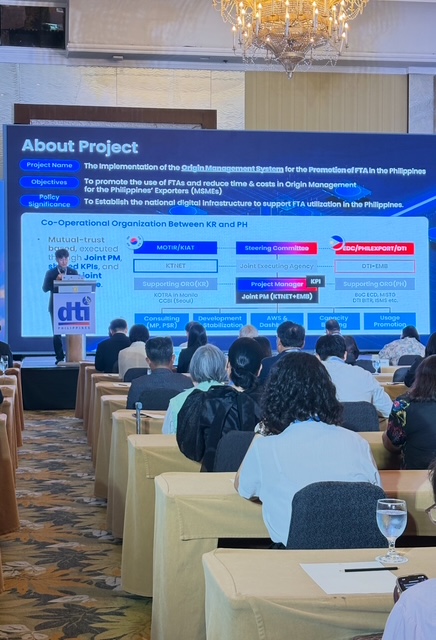
The Philippines has fully operationalized the Free Trade Agreement (FTA) Origin Management System (OMS), streamlining the processing of certificates of origin for export products and boosting the competitiveness of shipments to its FTA partner countries.
Launched Tuesday, Dec. 1, at the opening of the 2025 National Exporters’ Week (NEW), the OMS automates and modernizes origin determination, certification, and document management, making it easier for exporters to avail themselves of tariff preferences. The system—developed through a partnership between the Philippines and Korea—is designed to reduce processing time and help MSMEs navigate FTA rules of origin requirements. The OMS is being implemented by the Bureau of Customs (BOC).
Jenny P. Diokno, chief of the BOC Export Coordination Division, said the OMS is a milestone and part of the agency’s digitalization thrust. While the OMS is independent from the main BOC portal, it operates under the BOC. It was enabled by the issuance of CMO 06-2025 in September this year to make exporting to the 12 FTA partner countries and GSP (Generalized System of Preferences) agreements easier.
Certificate of Origin
Diokno explained that since the Philippines’ 12 FTA partners have different rules of origin, the OMS will determine whether a product qualifies for reduced, preferential, or zero tariffs from the destination FTA/GSP partner country.
For instance, ASEAN rules of origin under the ASEAN Trade in Goods Agreement—which require a regional value content of 40 percent—differ from other Philippine FTA deals such as those with China, Japan, South Korea, and Australia.
The OMS, which applies only to manufactured and processed goods, is free of charge for all exporters. Exporters need only register on the OMS platform and apply for a Certificate of Origin (CO) by submitting documents required under the specific FTA’s rules of origin.
“This is a milestone for Philippine exporters, this is an amazing system for exporters. This will help our export industry,” she said. The system enables a transparent and predictable evaluation of documents for FTA benefits.
Depending on the particular FTA, required documents may include the bill of materials, costing sheets—especially if there are import components—and raw material sourcing information.
Once the Product Evaluation Report is completed, the BOC will issue a paper-based CO, which the exporter will submit to the importing country. The CO demonstrates that the goods qualify for the tariff treatment agreed under the FTA.
Diokno said the regulation allows 20 days for processing because the assessment and computation are technically complex, but if documents are complete, the process may be shortened to as little as two days. BOC’s 17 offices nationwide also process applications through the OMS platform.
During the same event, DTI also launched PHX SOURCE, a comprehensive online discovery platform featuring over 6,000 Philippine exporters and their products and services for global buyers. Developed in partnership with Qsweep Technologies, the platform connects exporters with international buyers through a unified directory, real-time analytics, and engagement tools. PHX SOURCE aims to enhance visibility and expand market access for Philippine exporters, especially MSMEs.
Robust exports
In her speech at the opening of NEW 2025, DTI Secretary Cristina A. Roque highlighted the 19.4 percent increase in October 2025 export figures.
Philippine merchandise exports have grown for ten consecutive months, signaling a strong recovery from the slowdown of the previous two years.
From January to October 2025, total exports reached USD 70.43 billion, up from USD 61.90 billion in the same period in 2024—a 13.80 percent increase.
Electronics, the country’s leading export category, grew by 11.7 percent—from USD36.54 billion in 2024 to USD40.82 billion in the 2025 comparative period. This growth reflects sustained momentum in semiconductor and electronic component manufacturing, supported by export diversification and increased orders from major trading partners.
Non-electronics exports outpaced electronics, posting a robust 16.8 percent growth. Shipments climbed from USD25.35 billion to USD 29.61 billion, driven by stronger performance in manufactured products, minerals, and agro-based goods.
Under a recent U.S. Executive Order, the share of Philippine agricultural exports to the U.S. enjoying exemptions from reciprocal tariffs surged from virtually zero to more than 65 percent of covered categories. Benefiting products include coconut oil and derivatives, pineapple and mango preparations, frozen bananas, cassava, baked goods, coffee, and select spices.
Secretary Roque also reiterated DTI’s commitment to the Philippine Export Development Plan (PEDP) 2023–2028, calling it the country’s roadmap toward a more innovative and competitive export sector.
“The PEDP is more than a policy document. It embodies a collective vision that requires the active participation of every stakeholder,” she said. “To realize this vision, we must continue to strengthen our export ecosystem which is the foundation of a dynamic and thriving export industry.”
The NEW2025 runs from December 1 to 4 and is organized by the DTI-Export Marketing Bureau, the Export Development Council (EDC), and PHILEXPORT.

