


Global economic growth is set to decelerate to 2.6 per cent in 2025, down from 2.9 per cent in 2024, as global trade and investment face escalating pressure from financial volatility and geopolitical uncertainty, according to the new UN Trade and Development (UNCTAD) publication, Trade and Development Report 2025: On the Brink – Trade, finance and the reshaping of the global economy.
The report highlights a critical shift: financial market dynamics, including currency shifts and capital flows, are now driving global trade almost as strongly as real economic activity, significantly influencing development prospects worldwide.
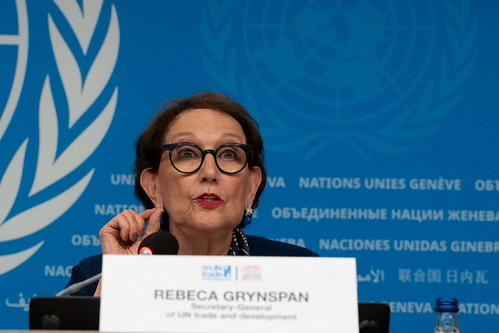
UNCTAD Secretary-General Rebeca Grynspan emphasized this convergence: “Trade is not just a chain of suppliers. It is also a chain of credit lines, payment systems, currency markets and capital flows.” With over 90 per cent of global trade reliant on bank finance, shifts in interest rates or investor sentiment in major financial centers now directly affect trade volumes across the globe.
Despite being forecast to grow at a faster pace of 4.3 per cent, developing economies are disproportionately exposed to these financial pressures. They face persistently higher financing costs—with common borrowing rates of 7 to 11 per cent compared to 1 to 4 per cent in major advanced economies—and increasing climate-related financial risks.
The report finds that climate vulnerability adds significant burdens, estimating that countries repeatedly exposed to extreme weather pay an extra $20 billion annually in interest premiums due to perceived risk. Since 2006, these additional borrowing costs have collectively totaled $212 billion for climate-vulnerable economies, diverting resources from social investment and climate adaptation efforts.
Furthermore, while the global South accounts for nearly half of global merchandise trade, its limited role in global financial markets leaves it highly dependent on the continuing dominance of the US dollar, which anchors global finance.
To build genuine resilience, UNCTAD outlines a set of practical reforms designed to reduce financial vulnerability, improve predictability, and better align trade, finance, and development goals.
The report urgently calls for coordinated international action, including:
Reforming the International Monetary System: To limit harmful swings in currencies and capital flows.
Strengthening Regional and Domestic Capital Markets: To help developing countries raise affordable long-term finance locally.
Fixing the Multilateral Trade Dispute System: To ensure rules are enforced and uncertainty is reduced.
Improving Transparency: Specifically in commodity trading, and expanding access to affordable trade finance for small businesses.
Updating Trade Rules: To incorporate services, digital trade, and climate action.
Secretary-General Grynspan concluded by stating that integrated policy frameworks are essential for lasting stability. “Fundamentally, we cannot understand trade isolated from finance. What does genuine resilience require? Integrated policy frameworks that recognize links between trade, finance, and sustainability.”

