


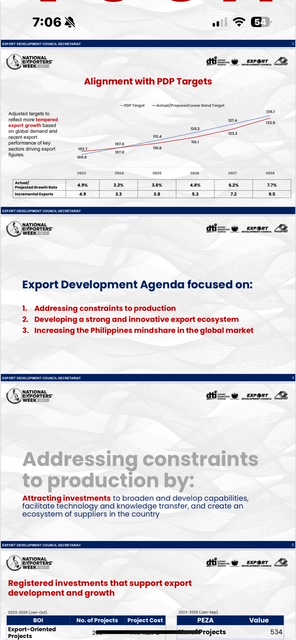
Downward adjustments to the Philippine Export Development Plan (PEDP) 2023–2028 growth targets have been proposed to reflect more tempered growth expectations based on global demand and the recent export performance of key sectors.
The proposed revised PEDP targets, presented at National Exporters’ Week, highlighted the factors—volatility, uncertainty, complexity, and ambiguity—that continue to affect export growth. The scaled-down targets are also intended to align with the Philippine Development Plan (PDP).
Under the proposed revisions, export growth in 2025 is projected at 3.6 percent, with total exports expected to reach USD110.8 billion—lower than the PDP target of USD113.4 billion.
The proposal likewise forecasts exports to reach USD116.1 billion in 2026 (from USD120.2 billion) for a 4.8 percent growth rate; USD123.3 billion in 2027 (from USD127.4 billion) for 6.2 percent growth; and USD132.8 billion in 2028 (from USD135.1 billion) for 7.7 percent growth.
Market intervention
To meet the reduced export targets, the PEDP outlines a more focused export development agenda. This includes addressing production constraints; developing a strong, innovative export ecosystem; and increasing the Philippines’ mindshare in the global market.
The revised PEDP also notes 1,054 projects with combined investments of PHP3.403 trillion registered with government investment promotion agencies from 2023 to September 2025. These projects are expected to support export development and help achieve the revised growth targets.
These investments were registered with the Board of Investments, Clark Development Corporation, and the Philippine Economic Zone Authority.
Production constraints are also being addressed through incentives for export-oriented enterprises (EOEs) under the CREATE MORE Act. These include VAT zero-rating on sales of goods to EOEs, VAT zero-rating on services performed for EOEs, and VAT exemption on importation of goods by EOEs.
The PEDP also emphasized the need to diversify export markets. While the Philippines exports to 200 countries, 80 percent of its exports are concentrated in just 10 markets. The United States accounts for the largest share at 16.6 percent, followed by Japan and Hong Kong with equal shares of 14.1 percent, and China with 12.9 percent.
The remaining markets in the top ten—South Korea, Thailand, Singapore, the Netherlands, Taiwan, and Germany—each account for roughly 3 to 5 percent.
To address this concentration, the plan calls for penetrating new markets through policy interventions such as securing preferential market access via free trade agreements (FTAs), making FTAs more accessible, addressing market access issues, capacitating exporters to enter wider markets, and facilitating market linkages.
In addition, the proposed PEDP calls for enhanced facilitation measures to make exporting from the Philippines easier.

