


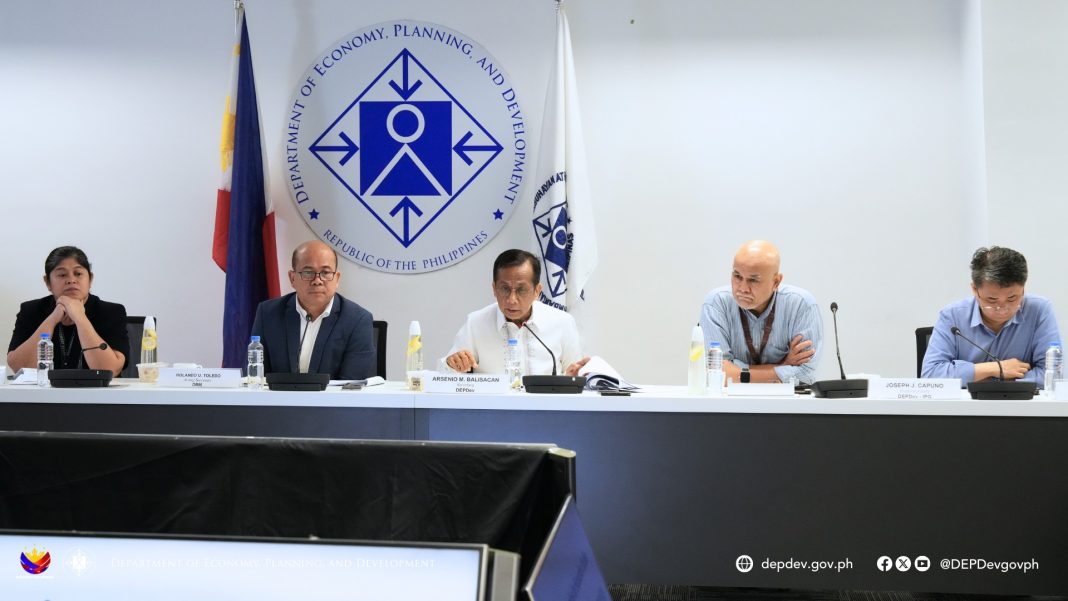
The Department of Economy, Planning, and Development (DEPDev) announced a pivotal step in enhancing the efficiency and effectiveness of government programs as the National Evaluation Policy Framework (NEPF) Steering Committee convened today, December 5, at the DEPDev Office in Mandaluyong City.
DEPDev Secretary and Committee Chairperson, Arsenio M. Balisacan, presided over the high-level meeting. The primary agenda was to strengthen inter-agency coordination and strategic planning for government-wide evaluation efforts spanning the period 2026 to 2028. This initiative underscores the government’s commitment to evidence-based policymaking and ensuring that public funds deliver maximum impact.
“Robust evaluation is the cornerstone of good governance,” said Secretary Balisacan. “The plans we consolidate today will ensure a more systematic, coordinated, and rigorous approach to evaluating the performance of our national programs. By strengthening the NEPF, we are reinforcing our commitment to accountability and driving continuous improvement in public service delivery for the Filipino people in the years 2026 to 2028.”
The meeting brought together key senior officials from the government’s core management and planning agencies, signifying a unified approach to improving evaluation practices across the bureaucracy.
Key attendees included:
-
Hon. Arsenio M. Balisacan, Secretary of the Department of Economy, Planning, and Development (DEPDev) and Chairperson of the NEPF Steering Committee.
-
Hon. Rolando U. Toledo, Officer-in-Charge (OIC) Secretary of the Department of Budget and Management (DBM).
-
Hon. Elaine T. Masukat, Secretary of the Office of the President-Presidential Management Staff (OP-PMS).
The NEPF, established to institutionalize and harmonize evaluation efforts across all government agencies, aims to ensure that evaluations are conducted timely, are of high quality, and inform subsequent policy and budgetary decisions.
The Steering Committee deliberated on the comprehensive work program for 2026–2028, which includes:
-
Identifying priority programs for rigorous evaluation based on national development goals.
-
Harmonizing evaluation guidelines and methodologies across line agencies to ensure consistency.
-
Strengthening the capacity of government evaluators through targeted training and resource sharing.
-
Establishing mechanisms to effectively disseminate evaluation findings and translate them into policy reforms and budget adjustments.
The collective effort of DEPDev, DBM, and OP-PMS in the NEPF Steering Committee is crucial, as it links planning (DEPDev), budget allocation (DBM), and the President’s management oversight (OP-PMS) to the conclusive results derived from program evaluations.

