


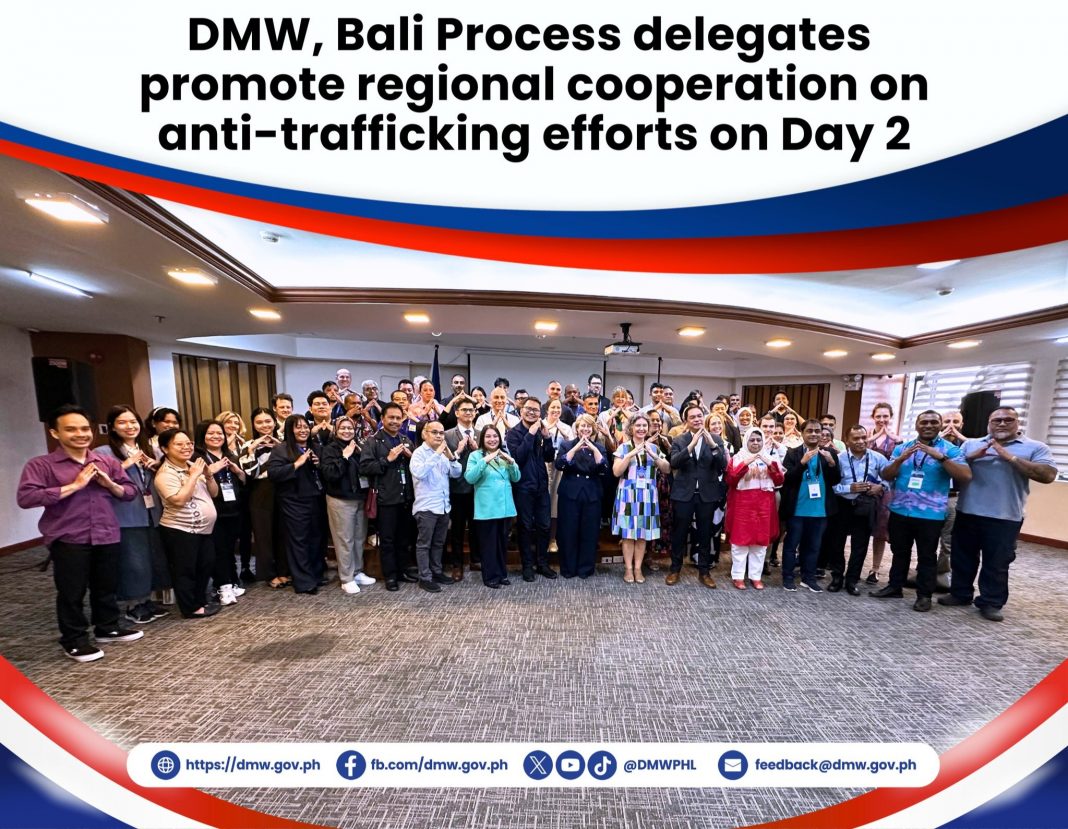
The Department of Migrant Workers (DMW) reinforced its commitment to regional cooperation against human trafficking and migrant worker exploitation during the second day of a crucial study visit by delegates from the Bali Process Working Group on Trafficking in Persons (WG-TIP) and the Technical Experts Group on Returns and Reintegration (TEG-RR) on December 3, 2025.
DMW Undersecretary Bernard P. Olalia stressed the necessity of a unified regional approach, stating that sustainable reintegration, secure migration pathways, and effective referral systems “cannot be developed in isolation.” He emphasized the urgent need for countries to collaborate to protect migrant workers and individuals most vulnerable to exploitation.
The study visit commenced with a briefing from the Inter-Agency Council Against Trafficking (IACAT), highlighting the Philippines’ remarkable achievement of maintaining a Tier 1 ranking in the U.S. Trafficking in Persons Report for a decade—a testament to its sustained, rigorous anti-trafficking efforts.
Delegates subsequently toured key DMW service centers to observe frontline systems in action, including:
The Balik-Manggagawa Processing Center
The National Reintegration Center for OFWs (NRCO)
The Migrant Workers Protection Bureau (MWPB)
A Multi-Agency, Trauma-Informed Approach
The afternoon focused on sites showcasing the country’s multi-agency, trauma-informed response to trafficking survivors:
UP Manila Center for Gender and Women Studies & Philippine General Hospital (PGH): Experts underscored the vital role of Women and Children Protection Units (WCPUs). These units provide integrated, stigma-free support, offering crucial medical, psychosocial, and legal services to survivors. The increasing complexity of cases, particularly the rise in sexual abuse involving children, highlighted the essential need for care delivered by trained trauma specialists.
The repurposed Nasdake Building: Observed as a site for Department of Social Welfare and Development (DSWD) operations.
NAIA Terminal 3: Demonstrated the airport referral mechanism for identifying and assisting potential trafficking victims.
Philippine Coast Guard Vessels (BRP Melchora Aquino and BRP Teresa Magbanua): Showcased the Coast Guard’s role in maritime border security and interception efforts.
The study visit is an integral part of the weeklong Bali Process meetings (December 1 to 5), aimed at significantly enhancing regional coordination on trafficking prevention, fostering safe and orderly migration, and establishing effective mechanisms for the dignified return and sustainable reintegration of victims and workers.

