


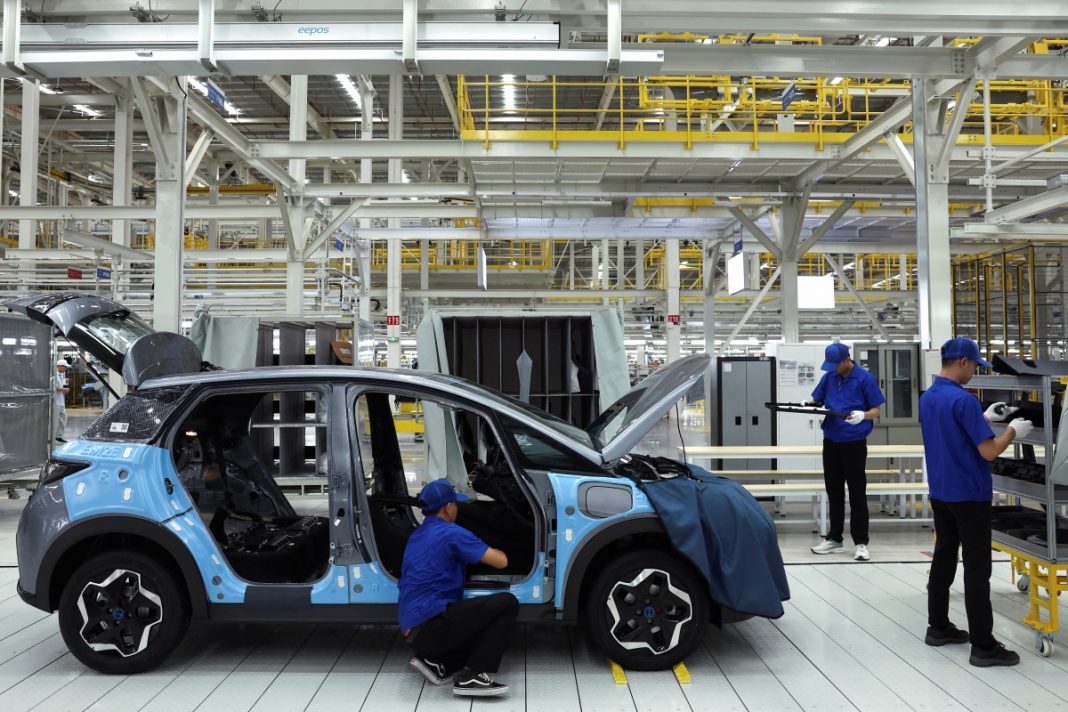
The Electric Vehicle Association of the Philippines (EVAP) has expressed support for ongoing calls to reinstate funding for the Comprehensive Automotive Resurgence Strategy (CARS) and the Revitalizing the Automotive Industry for Competitiveness Enhancement (RACE) programs, emphasizing that the long-term success of the Philippine electric vehicle sector is closely linked to the strength of the broader automotive manufacturing industry.
EVAP acknowledged and welcomed the strong commitment of the Marcos administration to renewable energy and electric vehicle development, citing recent policy initiatives that promote EV adoption, charging infrastructure, and clean energy integration. However, the association stressed that the transition to electric mobility cannot succeed in isolation and must be anchored on a competitive and resilient domestic automotive manufacturing base.
“The EV industry does not exist in a vacuum,” said Edmund Araga, President of EVAP. “Electric vehicles are still vehicles. They rely on the same manufacturing ecosystem, supply chains, skilled workers, and industrial infrastructure that support conventional automotive production. If the local automotive industry weakens, the EV sector will struggle to scale.”
CARS and RACE were designed to rebuild vehicle assembly volumes, strengthen local parts manufacturing, and ensure policy continuity for the automotive sector. Industry groups have warned that without these programs, the Philippines risks falling further behind ASEAN neighbors that continue to invest heavily in automotive and EV manufacturing as strategic industries.
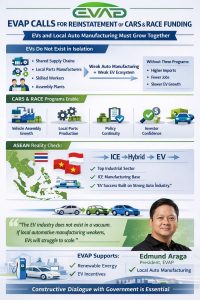
Across Southeast Asia, automotive manufacturing consistently ranks among the top industrial sectors in terms of employment, exports, and value creation. Countries such as Thailand, Indonesia, and Vietnam are now leveraging their strong internal combustion engine manufacturing base to accelerate EV production, battery investments, and new mobility technologies. EVAP noted that these countries did not leap directly into EVs without first building scale and capability in traditional automotive manufacturing.
“The global experience is clear,” Araga said. “Countries that are winning in EVs today are the same countries that protected and nurtured their automotive industries for decades. EVs are the next chapter of automotive manufacturing, not a replacement for the ecosystem.”
EVAP emphasized that local vehicle assembly and parts manufacturing are critical enablers of EV growth, supporting not only vehicle production but also components such as wiring harnesses, electronics, body parts, thermal systems, and eventually batteries and power electronics. Without sufficient production volume and government support, these investments become difficult to justify.
While EVAP reiterated its appreciation for the President’s leadership in promoting renewable energy and electric mobility, the association called for a balanced and integrated industrial policy that supports both conventional and electric vehicles during the transition period.
“We commend the President for his clear support for renewable energy and electric vehicles,” Araga said. “At the same time, we respectfully urge the government to view CARS and RACE as complementary to the EV roadmap. Supporting local automotive manufacturing today strengthens our ability to build EVs locally tomorrow.”
EVAP joined other industry stakeholders in calling for constructive dialogue with government, including economic managers, senators, and members of Congress, to explain how CARS and RACE contribute to jobs, investments, and long-term industrial competitiveness.
“The Philippines has the opportunity to build an inclusive automotive future where ICE vehicles, hybrids, and EVs coexist and evolve together,” Araga said. “Reinstating support for CARS and RACE is a critical step toward ensuring that the country remains competitive in both automotive manufacturing and electric mobility.”

