


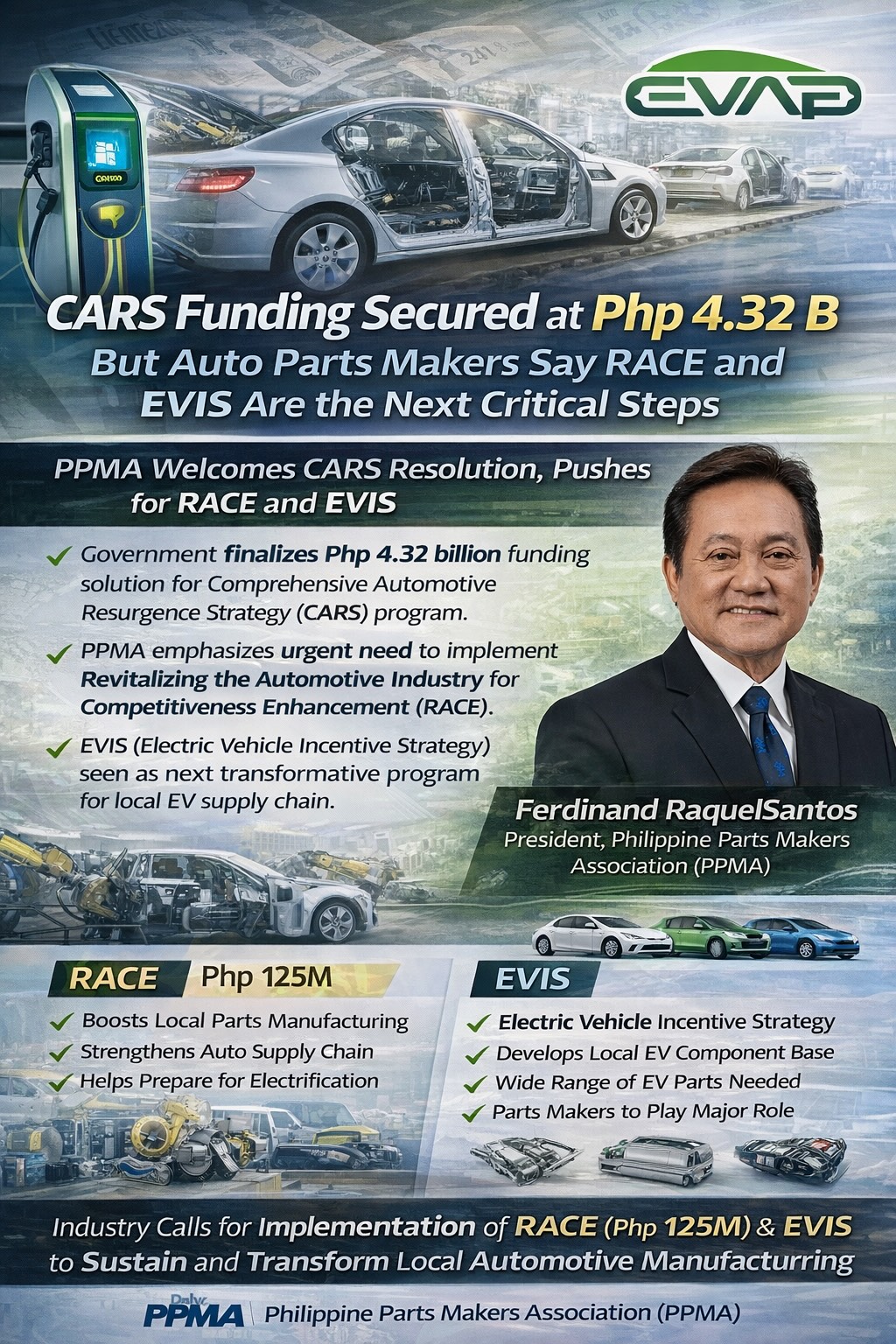
The Philippine automotive industry received a welcome boost this week after the government confirmed it has finalized a funding solution for the Comprehensive Automotive Resurgence Strategy (CARS) program, signaling renewed stability for a sector that has long depended on policy continuity to sustain local manufacturing.
Finance Secretary Frederick Go announced during the Economic Managers’ Briefing on January 16, 2026 that the government has resolved the funding issue and will support CARS this year. The program’s Php 4.32-billion budget was previously among the unprogrammed appropriations vetoed under the 2026 General Appropriations Act, raising concerns among industry stakeholders about the country’s reliability in sustaining long-term industrial incentives.
For the Philippine Parts Makers Association (PPMA), the announcement marks an important step forward. PPMA President Ferdinand RaquelSantos said the decision reassures investors and reinforces the government’s commitment to local vehicle assembly and job creation.
“The resolution of the CARS funding issue is a strong signal of policy stability,” RaquelSantos said. “It protects the manufacturing base that the Philippines has built over decades and helps sustain jobs, supplier activity, and continued investment in local automotive production.”
CARS is an incentive driven program that supports car manufacturers and their local supply chain partners. Its primary participants include Toyota Motor Philippines Corp. and Mitsubishi Motors Philippines Corp., alongside Philippine-based parts manufacturers that provide components used in local assembly operations. With the funding restored, industry watchers say vehicle assembly volumes and supplier planning can move forward with more confidence, especially as automakers and suppliers navigate an increasingly competitive Southeast Asian manufacturing landscape.
However, PPMA emphasized that while CARS addresses assembly support, the broader supply chain still needs its own dedicated long-term strengthening program. The industry group called on government to implement the Revitalizing the Automotive Industry for Competitiveness Enhancement (RACE) program, noting that only PHP125 million is needed to initiate it.
“CARS and RACE should work together,” RaquelSantos explained. “If we want a stronger local automotive ecosystem, we must also help parts makers upgrade tooling, improve quality certifications, invest in productivity, and expand local content. RACE is the bridge that makes that possible.”
Industry stakeholders have repeatedly pointed out that the health of local automotive manufacturing is measured not only by vehicle assembly, but also by the strength of local parts production, which supports more stable employment and wider industrial participation. This becomes even more critical as the Philippines moves toward electrification and next-generation mobility.
PPMA also highlighted the importance of the upcoming Electric Vehicle Incentive Strategy (EVIS) program, where local parts makers are expected to play a major role in the country’s shift to electric vehicles. While EVs introduce new technologies such as batteries and power electronics, many components remain part of a familiar automotive supply chain, including wiring harnesses, structural stamped parts, body components, electronics housings, and thermal systems.
“EVIS is the future, but it will only succeed if the supply chain is ready,” said RaquelSantos. “Local parts manufacturers can be a major contributor to the EV transition, but we need the right support today so we can participate competitively tomorrow.”
With CARS funding now confirmed, industry players say the next challenge is ensuring that policy support remains integrated. For parts makers, the message is clear: restoring CARS secures the present, but launching RACE and moving forward with EVIS will determine whether Philippine automotive manufacturing can compete in the next era of mobility.

