


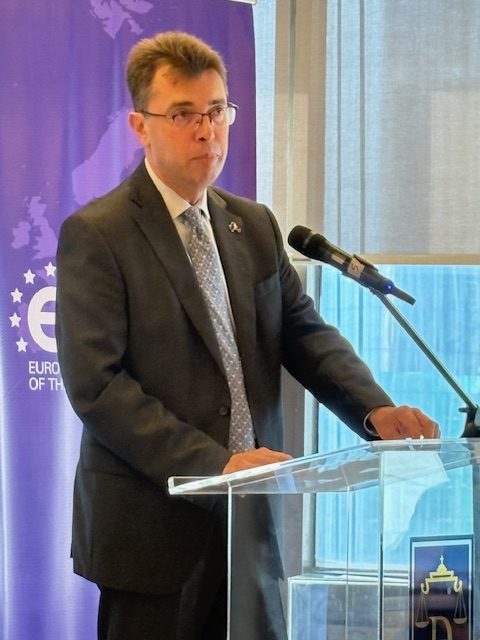
European Union Ambassador Massimo Santoro said that EU, a political and economic union of 27 member states, will continue to support the Marcos administration’s ongoing efforts to fight corruption in government, saying good governance is a critical factor in determining whether investors stay or leave.
Speaking during the launch of the guidebook Doing Business in the Philippines 2026 on Thursday, Jan. 22, the chief diplomat of the EU Delegation to the Philippines emphasized that predictability and strong governance are essential for attracting and retaining investors.
Santoro noted that investors value stability and that good governance is a serious enabler for keeping and attracting investments.
He said the EU expressed its support early on for President Ferdinand Marcos Jr.’s actions and pronouncements during his State of the Nation Address, particularly his initiative to address corruption in government, including so-called ghost flood control projects.
Santoro added that the EU supports the President’s actions and will continue to do so, including additional measures to ensure accountability.
He also said the EU is closely watching the Philippines’ commitment to enforcing key EU principles on governance, labor rights, and environmental protection as both parties work toward forging a bilateral free trade agreement (FTA).
The EU and the Philippines are set to conduct another full round of negotiations early this March in Brussels, along with smaller meetings on specific chapters to accelerate discussions. Completion of the FTA is of vital interest to the Philippines, as the current EU GSP Plus—which grants zero duties on Philippine exports—is set to expire in 2027.
Forging an FTA would provide a more permanent trading regime between the two sides, with broader and more comprehensive coverage.
Paolo Duarte, president of the European Chamber of Commerce of the Philippines (ECCP), said in his presentation that EU companies remain optimistic about the Philippines. He noted that European businesses are closely monitoring the upcoming FTA negotiations, with both sides committed to concluding talks by 2026.
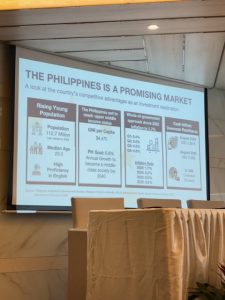
“The ECCP believes these talks will create new opportunities for deeper strategic cooperation, while the Philippines’ upcoming ASEAN Chairship in 2026 is expected to further strengthen its role as a regional hub for trade and investment,” Duarte said.
He cited rising infrastructure and investment spending as one positive indicator. In 2025, the Philippines spent 5.4 percent of GDP, or PHP1.56 trillion, on infrastructure—mostly from local sources—with PHP149 billion coming from foreign investments.
Duarte also highlighted growth in the digital sector, noting that internet users are projected to increase from 97.5 million in 2025 to 110 million by 2030. He added that the government is undertaking 209 major infrastructure projects across transport, water, agriculture, energy, digital connectivity, health, and education, reflecting a comprehensive approach to sustainable development.
“As European trade and investment continue to grow, strengthening both physical and digital infrastructure remains key to attracting investment and supporting inclusive economic growth,” he said.
Duarte further noted the strength of the Philippines’ consumer market, citing its position as the second-largest country in Southeast Asia in terms of population. He also pointed to the country’s resilience and improving macroeconomic fundamentals, including controlled inflation and GDP growth of 6.8 percent, which he said could help the Philippines achieve middle-income status by 2040.
“We are very positive about the Philippines,” he said.

