


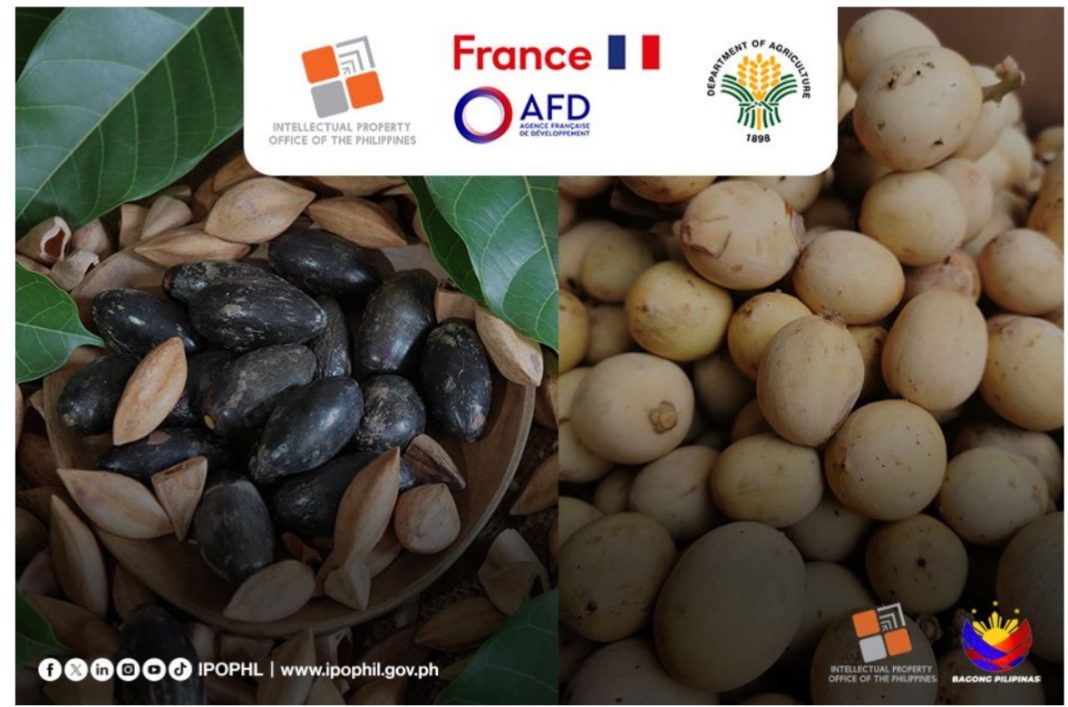
The Intellectual Property Office of the Philippines (IPOPHL), in partnership with the Agence Française de Développement (AFD) and the Department of Agriculture (DA), will be advancing Bikol Pili and Camiguin Lanzones toward geographical indication (GI) status.
The journey towards GI status for the Bikol Pili and Camiguin Lanzones has been made possible through a P30-million AFD-funded project promoting GIs in the Philippines,
Launched in May 2025 and running for 21 months, the GI project aims to shortlist 10 value chain products, select at least two high-potential GI products, and provide guidance to farmers and other value chain stakeholders throughout the registration process as part of AFD’s broader efforts to support agricultural competitiveness and strengthen climate change resilience.
From an initial list of nine products, Bikol Pili and Camiguin Lanzones were selected as pilot GIs following a comprehensive review during the Second Project Coordination Committee (PCC) Meeting on January 14, 2025.
The committee, in its presentation, highlighted that Bikol Pili was selected “due to its strong geographic identity, organized value chain, high economic potential, and natural climate resilience. The product derives a distinct flavor profile shaped by its unique environment, which is closely linked to the Bicol Region’s forested and volcanic landscapes. Pili trees also contribute to regional climate resilience, helping withstand frequent storms affecting the area.”
“Economically, Bikol Pili demonstrates significant value addition, with kernel prices increasing up to fivefold from raw materials, and a diversified product range spanning food, oil, cosmetics, and handicrafts. Its strong domestic reputation and growing international exposure in European and Asian markets further reinforce its suitability as a pilot GI with region-wide impact,” it added.
Meanwhile, Camiguin Lanzones was likewise chosen due to its strong geographic identity, organized producer base, and readiness for GI development. Renowned for its distinct sweetness and quality, the product’s reputation is closely tied to Camiguin’s volcanic soil and island ecology. Its pending collective mark application further reflects the presence of established producer organizations, coordinated stakeholders and a shared commitment to collective branding and protection.
IPOPHL Acting Director General Nathaniel S. Arevalo welcomed the committee’s decision, noting that the collaboration and consensus behind the selection of the pilot products “further strengthen the collective efforts that underpin the development of a robust and credible GI system in the Philippines.”
“Geographical indications are tools to empower local communities, preserve cultural heritage, promote rural development and enable Filipino products to stand out in regional and global markets. By pushing for the registration of more GI products, we give more Philippine products the spotlight they deserve internationally and show the culture, skills and stories that make us proud of our roots as Filipinos,” ADG Arevalo said.
Bikol Pili and Camiguin Lanzones also show how local traditions can support climate resilience. Produced using agroforestry systems and time-tested farming practices, these products help protect biodiversity, care for the land, and sustain farming communities. Rooted in local knowledge, these potential GIs encourage farming systems that are better able to adapt to a changing climate.
Uplifting farmers
In the next phase of the project, the PCC will engage value chain actors directly, including producers, processors and local institutions. These stakeholders will undergo targeted capacity-building activities, including training on the preparation of manuals of specifications, a key requirement for GI registration that defines product standards, production methods and geographic boundaries.
The remaining seven value chain products shortlisted under the project, while not selected as pilot beneficiaries, may still proceed with GI registration independently, using the tools, knowledge and lessons generated through the project.
The DA welcomed the selection of the pilot products, underscoring the value of GIs as a development tool aligned with the agency’s mandate.
“These are not merely technical milestones; they are foundational steps toward building a credible, inclusive and sustainable GI system in the Philippines,” said DA Assistant Secretary Joycel R. Panlilio. “Geographical Indications recognize the role of farmers, including small producers, preserve local knowledge, strengthen rural economies, and elevate the reputation of Philippine agricultural products both locally and internationally. GI is not just a label. It is a legacy,” she added.
Beyond pilot implementation, AFD also aims to provide legislative support to advance the country’s sui generis GI system and ensure a strong and sustainable legal foundation for GI protection in the Philippines.

