


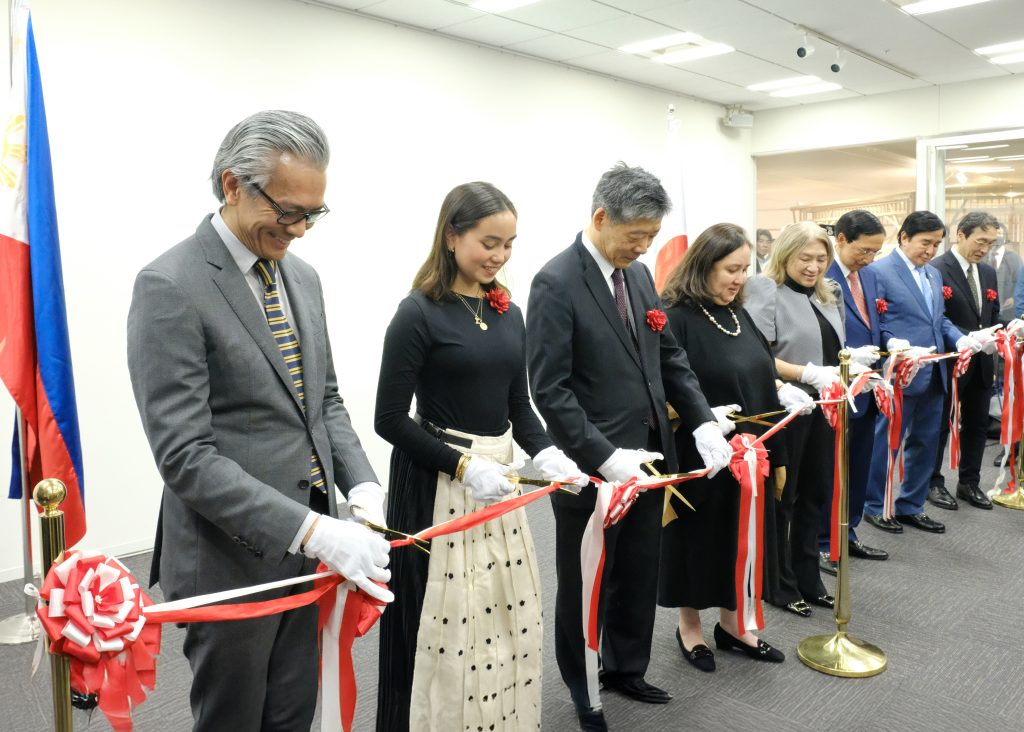
Tokyo, Japan—The Department of Trade and Industry (DTI), through its Philippine Trade and Investment Center (PTIC) in Tokyo led by Special Trade Representative Dita Angara-Mathay, launched “The Philippine Coconut: Tree of Life, Seed of Innovation” as the flagship project opening the 70th Anniversary of Philippines–Japan Diplomatic Relations.
Running from 19–30 January 2026 at the Tokyo Midtown Design Hub, the exhibition serves as the official kickoff of the year-long anniversary celebration and is implemented as part of the Coconut Farmers and Industry Development Plan (CFIDP), with support from the ASEAN-Japan Centre (AJC) and the Japan Institute of Design Promotion (JDP), in coordination with the Philippine Embassy in Japan, and with the participation of the Philippine Special Envoys to Japan, Dr. Amable Aguiluz V and Dr. Reghis Romero II.
The two-week exhibition positioned the coconut as a high-value, innovation-driven Philippine resource at the intersection of agriculture, design, sustainability, and science. As the world’s second-largest coconut producer and the leading global exporter of coconut oil, the Philippines supports approximately 3.5 million coconut farmers and more than 10 million Filipinos across the coconut value chain.
Beyond exhibition value, the initiative advanced DTI’s trade and investment mandate. On the sidelines, PTIC Tokyo engaged Japanese companies and institutions on concrete business leads, including potential partnerships on the use of coconut residues as agricultural fertilizers in Japan, discussions on a PHP 3-billion integrated coconut oil processing facility with renewable-energy components, expanded sourcing of Philippine coconut-derived medium-chain triglyceride (MCT) oil, and possible cooperation programs between the Philippine Coconut Authority (PCA) and Japanese counterparts.
The engagements highlighted high-value coconut-based applications with strong relevance to the Japanese market, particularly in healthcare, pet nutrition, and clean energy. These included coconut-derived wound-care materials, where Japan’s growing advanced wound-care market aligns with coconut-based bacterial cellulose produced from coconut water, as well as opportunities for coconut-derived MCT oil in Japan’s premium pet-nutrition segment, including formulations addressing age-related cognitive decline in pets.
The initiative also underscored the potential of coconut kernel shell as a sustainable biomass feedstock, with applications ranging from renewable power generation to emerging pathways for sustainable aviation fuel (SAF), aligning with Japan’s decarbonization agenda and demand for diversified biomass inputs.
Visitors encountered real-world applications already in use in Japan, including coconut coir geotextiles for flood control, erosion mitigation, and landslide prevention; export-ready coconut products such as Chemrez Technologies’ MCT oil; and PatchMed, a Good Design Award–winning wound dressing made from nata de coco and coconut water. A dedicated Coconut Palace section featured never-before-seen original watercolor renderings and architectural blueprints, presented alongside a scale 3D model and immersive virtual-reality tour produced by Salcedo Auctions, which also curated the accompanying art exhibition. The archival materials were presented courtesy of the Tukod Foundation, heirs of National Artist Francisco Mañosa, coinciding with the designation of the Coconut Palace as an official venue of the ASEAN 2026 Summit.
The exhibition also showcased award-recognized coconut-based furniture and co-created design products developed with Lamana designers alongside coconut-derived food products, premium spirits, and contemporary Filipino visual art. Industry-specific thematic seminars on design, architecture, food, wellness, and sustainable industry complemented the exhibits.
“What is most important is that these are no longer theoretical possibilities,” said Dita Angara-Mathay, Commercial Counselor and Head of PTIC Tokyo. “By deliberately convening public agencies, industry partners, designers, and technical experts within a single, coordinated framework, we were able to translate policy objectives into concrete market engagement. The resulting level of market interest and follow-through affirms the evolution of the Philippine coconut—from a traditional natural resource into a platform for high-value innovation across health, nutrition, design, and clean energy. This approach is essential to sustainably raising farmer incomes and strengthening the Philippines’ position in global value chains.”
Through participating exporters, processors, and institutional supply-chain partners, the initiative is estimated to have covered coconut-producing areas supporting approximately 220,000 coconut farm households, contributing to medium- to long-term demand creation and value-chain upgrading, consistent with national income-enhancement objectives for the coconut sector.

