


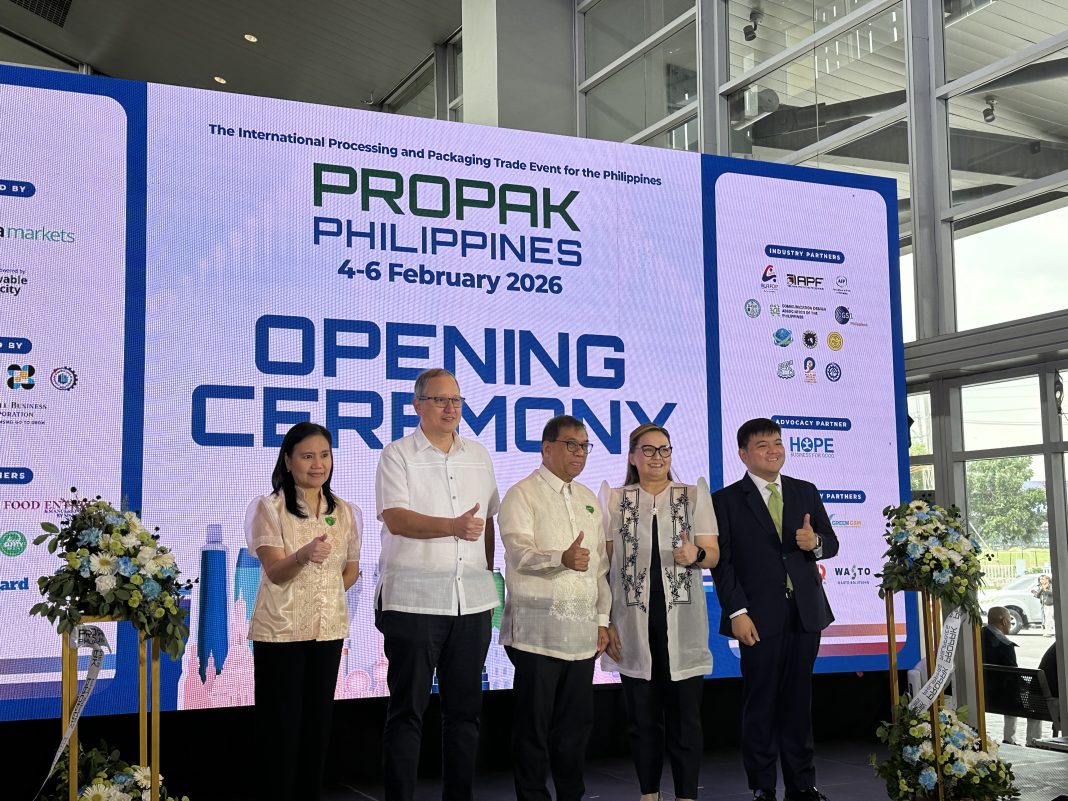
Science and Technology Secretary Renato Solidum Jr. has outlined several interventions the agency is implementing to help producers of packaging materials cope with local demand, which is expected to grow by 3.2 percent annually.
At the opening of ProPak Philippines 2026, a packaging materials trade fair, on Wednesday, February 4, Solidum said the Department of Science and Technology (DOST) has been working to assist producers and improve the quality of packaging materials in the country.
The Philippine processing and packaging market is expected to grow by 3.2 percent annually. Informa Markets said the total volume of packaging in the country is projected to rise from 78.5 billion units in 2024 to 91.8 billion units by 2029.
“The overview of the processing and packaging industry in the Philippines is very interesting, with annual growth of around 3.2 percent,” said Rungphech Chitanuwat, general manager for the Philippines at Informa Markets.
Growth has been bolstered by the increasing number of players in the industry. At least 250 micro, small, and medium enterprises participated in the three-day ProPak trade fair, which attracted at least 10,000 visitors at the World Trade Center.
According to Solidum, the DOST operates the Packaging Safety Research and Testing Laboratory. The laboratory has undertaken work on remedial packaging, migration studies, and exposure assessments, reflecting a strong commitment to public health and environmental protection.
Complementing this is the Green Packaging Laboratory, which is dedicated to developing biobased and biodegradable alternatives to petroleum-based packaging.
Using sustainable raw materials, the laboratory supports the transition to a circular economy by developing laboratory-scale prototypes, such as chitosan films and antioxidants, chitosan composites for improved sealability, bacterial cellulose films, biodegradable anti-insect packaging, animal fashions, and natural fiber-based fashioning materials.
The DOST-Industrial Technology Development Institute (ITDI), he said, is also working closely with stakeholders across the plastic value chain to accelerate the scaling up of these innovations.
Similarly, for many years, DOST-ITDI has supported players in the food processing industry through the DOST Food and Nutrition Research Institute and ITDI by developing innovative products and conducting research and development that improve further processing, extend shelf life, enhance production efficiency, and increase exportability and profitability—especially for Philippine industries and micro, small, and medium enterprises.
Solidum also announced plans to establish the Philippine National Measurement Institute to support the national quality infrastructure and further accelerate the adoption of technologies, standards, and testing.
This initiative aims to support the vision of translating into action the DOST’s Metals Industry Research and Development Center’s Advanced Manufacturing Center (AMCEN), which is the first in Southeast Asia to hold both American Society for Testing and Materials and Manufacturing Quality and Facility Safety certifications.
The AMCEN is essentially a large compound of various 3D printing facilities capable of printing plastics, ceramics, metal, and testing concrete for housing infrastructure.
“This milestone by the DOST-ITDI tells the world that the Philippines is ready for industry 4.0. It gives our manufacturing sector global credibility, ensures world-class safety, and empowers Filipino talent through advanced training in additive manufacturing,” said Solidum.
These facilities are not only located at the DOST headquarters in Bicutan and Manila but have also been established in advanced manufacturing centers and satellite offices across all regions of the country.

