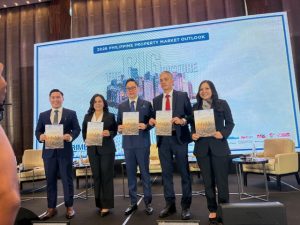
The industrial real estate sector is projected to remain the most resilient property market in the Philippines, as structural logistics demand—particularly for build-to-suit warehouses and cold storage facilities—continues to drive long-term investments, according to a study by the country’s leading property management and consultancy services firm, Prime Philippines.
During the launch of Prime Philippines’ 2026 Philippine Property Market Outlook, “The Big Picture – Rise, Reset & Reinvention,” Ruth Coyoco, Prime Philippines vice president for property advisory, said in her presentation that industrial real estate stood its ground across the pre-pandemic, pandemic, and post-pandemic periods. She attributed this performance to structural logistics demand rather than cyclical demand. In contrast, the retail, office, and hospitality real estate markets all declined during the pandemic and are still recovering from the slump.
Structural logistics demand refers to long-term, fundamental changes in supply chains that drive sustained demand for logistics services, infrastructure, and, in particular, modern, high-quality warehousing. Unlike cyclical demand, which fluctuates with economic conditions, structural demand is driven by secular trends such as the expansion of e-commerce, supply chain restructuring—including shifts from “just-in-time” to “just-in-case”—and changing consumer expectations.
Warehouses
Overall, Coyoco said the warehouse sector nationwide is still projected to grow by 45 percent annually over the next two to three years, reflecting continued confidence in long-term demand rather than speculative expansion.
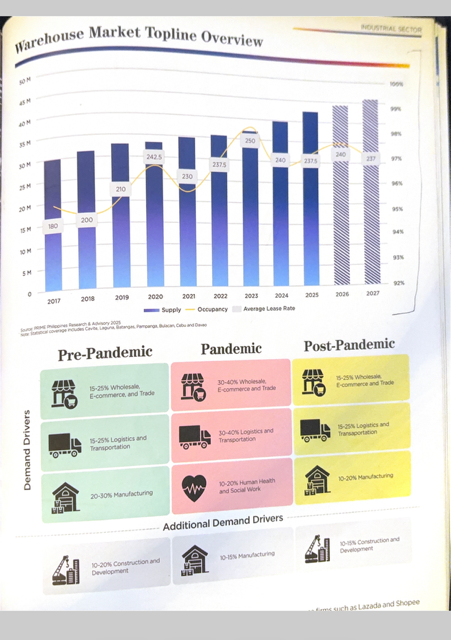
Based on Prime Philippines’ property market report, warehouse supply has steadily grown since 2017, reaching roughly 43 million square meters in 2025. Supply is expected to reach about 45 million square meters this year and 47 million square meters by 2027.
Occupancy rates, which reached a high of 98 percent in 2023 and 97 percent in 2025, are expected to tighten to around 98 percent before stabilizing at about 97 percent next year.
“Currently, the industrial real estate shows very good and positive occupancy compared to other property markets,” said Joy Rosario, head of the Industrial Market Division at Prime Philippines.
Lease rates have also risen but have stabilized over the past couple of years. From a stable average lease rate of PHP 237.5 per square meter in 2025, rates are projected to increase to PHP 240 per square meter this year before easing slightly to PHP 237 per square meter in 2027.
Pre-pandemic, Prime Philippines said industrial real estate growth was driven largely by manufacturing, which accounted for 20 to 30 percent of the market. This was followed by wholesale, e-commerce, and trade, as well as logistics and distribution, and logistics and transportation, each holding a 15 to 25 percent market share.
This period also saw a rise in lease rates as demand surged due to the growing penetration of e-commerce in the country.
During the pandemic, market dynamics shifted, with the wholesale and logistics groups each accounting for 30 to 40 percent of market share. The health crisis also created demand from the human health and social work sector, which accounted for 10 to 20 percent of the market.
The COVID-19 pandemic saw robust warehouse occupancies anchored by the adoption of online business models and e-commerce, despite declines in lease rates and uncertain public sentiment.
Post-pandemic data from Prime Philippines showed the wholesale and logistics groups each holding a 15 to 25 percent market share, while manufacturing returned with a 10 to 20 percent share of warehouse demand nationwide.
The post-pandemic period also noted a recovery in lease rates as supply picked up following the resumption of construction and operations. The years 2024 to 2025 saw continued demand growth as hybrid usage and warehouse adoption reshaped tenant behavior.
Cold storage
Within the industrial real estate space, Coyoco noted that the cold storage segment remains a steady and significant growth driver.
Supply of cold storage facilities in the Philippines has expanded by more than 35 percent over the past decade, driven by long-term demand for food security, pharmaceuticals, export-oriented logistics, and temperature-sensitive distribution, Coyoco said.
In 2025, she added, the country marked its strongest year of realized supply growth in at least a decade, with total cold storage capacity reaching around 1.2 million pallet positions.
“Growth is not driven by term cycles, but long term demand for food security, pharmaceuticals, export oriented logistics and temperature sensitive distribution,” she said. This growth is backed by completed developments rather than speculative pipeline assumptions, with expansion occurring across both Luzon and key Visayas-Mindanao markets.
Locations
Beyond traditional hubs, growth is expanding into emerging corridors as developers and occupiers increasingly favor nearby, lower-risk locations rather than moving far from established markets.
Laguna, Cavite, Batangas, Pampanga, and Bulacan remain the primary targets for warehousing facilities. Cavite, in particular, has emerged as a key expansion market, accounting for around 60 percent of new developments in 2024 and 2025.
In 2026, Prime Philippines said the next wave of major industrial warehouse supply is expected to concentrate in Pangasinan, Cavite, and Batangas, reinforcing the corridor-led expansion model surrounding Metro Manila.
Requirements that cannot be accommodated in provinces near the National Capital Region are being pushed to adjacent markets, linking performance across Central Luzon and the Cavite-Laguna-Batangas areas.
Outside Luzon, decentralization away from Mandaue in Cebu has continued toward Liloan and Consolacion, with newer activity emerging in Balamban driven by shipbuilding demand. In Davao, warehouse development is expanding north toward Bunawan, Lanang, and Panabo del Norte, reflecting rising requirements and continued diversification beyond Tibungco.
Looking ahead
Prime Philippines concluded that industrial land is expected to sustain steady growth, supported by structural logistics demand, high occupancy levels, and improving regional connectivity. Stable, end-user-driven activity will remain concentrated in established industrial hubs while selectively spilling over into provincial and regional markets. This expansion is expected to be driven by risk-aware site selection and tenant-led build-to-suit projects across provinces such as Quezon, Isabela, and Ilocos, alongside key Visayas-Mindanao gateways and emerging markets including Zamboanga del Sur, Leyte, Iloilo, and Bacolod.
With build-to-suit developments designed to support network expansion, improve delivery efficiency, and manage operating costs, demand for warehouse, cold chain, and data center facilities is expected to continue shaping land acquisition strategies and lifting land values in areas adjacent to these projects across Luzon and Visayas-Mindanao, the Prime Property Outlook report said.