


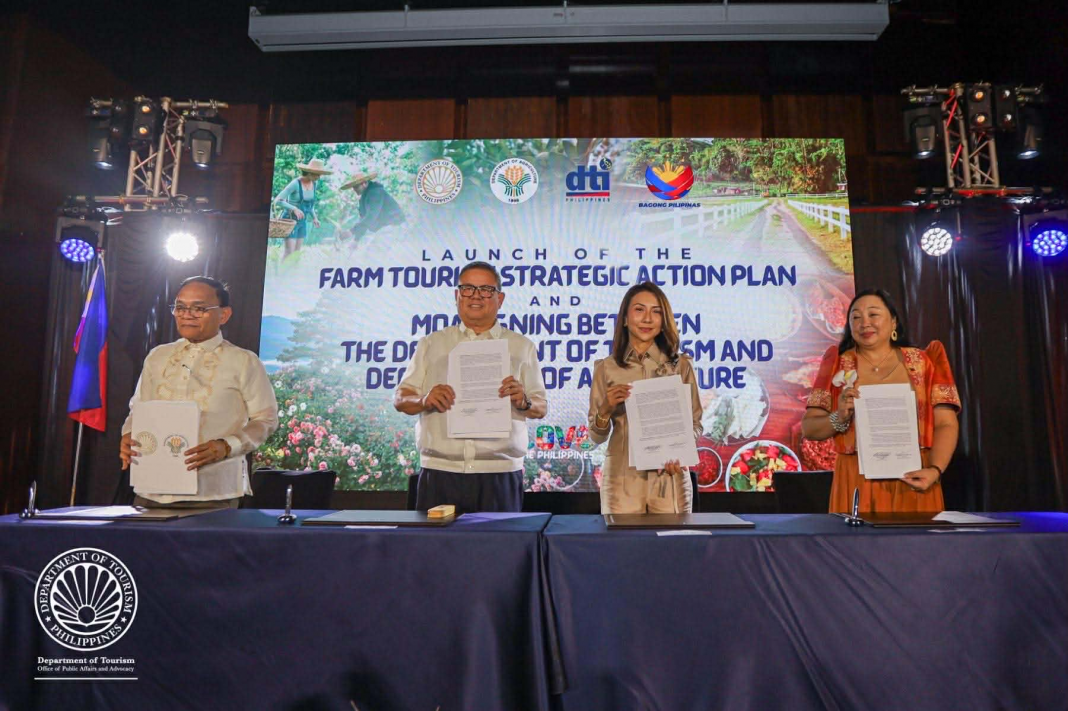
The Department of Tourism (DOT), Department of Agriculture (DA), and Department of Trade and Industry (DTI), together with private sector members of the Farm Tourism Development Board (FTDB), has launched the Farm Tourism Strategic Action Plan (FTSAP) 2026 to 2031 to promote sustainable tourism, empower Filipino farmers, and position the Philippines as a leading destination for farm and gastronomy tourism in Asia.
Tourism Secretary Christina Garcia Frasco and Agriculture Secretary Francisco Tiu Laurel Jr. led the milestone launch of the FTSAP, which operationalizes and scales the country’s farm tourism framework into a fully integrated national strategy linking tourism demand directly with agricultural production and rural enterprise.
Building on the foundation of Republic Act No. 10816, or the Farm Tourism Act of 2016, the FTSAP expands the government’s farm tourism strategy from policy framework to full operational execution by strengthening accreditation systems, integrating farm tourism sites into structured tourism circuits, and aligning infrastructure, enterprise development, and market access. The roadmap deepens engagement at the grassroots level by directly linking farmers, rural enterprises, and tourism establishments, ensuring that tourism demand translates into sustained income, employment, and long-term livelihood opportunities in rural communities.
The two cabinet secretaries also signed a Memorandum of Agreement (MOA) on Farm, Food, and Gastronomy Tourism between the DOT and DA. The agreement supports the FTSAP and expands the government’s farm tourism strategy by strengthening coordination across production, enterprise development, infrastructure, and tourism demand, creating more sustainable livelihood opportunities for farmers, producers, and rural communities.
Complementing the roadmap, the MOA institutionalizes closer collaboration between the tourism and agriculture sectors to expand farm and gastronomy tourism offerings, promote Filipino cuisine and agricultural heritage, and strengthen supply chains connecting farmers and producers directly to tourism establishments, ensuring that tourism demand translates into sustained economic opportunities at the grassroots level.
DOT, DA convergence
Secretary Frasco underscored the economic impact of strengthening linkages between tourism and agriculture, noting that tourism serves as a vital driver of rural development amid strong global growth in agritourism. She cited international projections showing agritourism expanding from USD 69 billion in 2019 to approximately USD 197 billion by 2032, while surveys by UN Tourism indicate that 59 percent of Member States identify rural tourism as a priority and 96 percent expect continued growth in the sector.
“When tourism demand for food and culinary experiences is intentionally linked to Filipino farmers and rural enterprises, visitor spending strengthens local economies. Farm tourism allows agriculture to participate directly in this higher value tourism model,” she added.
The partnership supports coordinated infrastructure development, including Farm-to-Market Roads aligned with tourism circuits, and ensures that tourism growth drives sustained demand for local agricultural products, creating expanded livelihood opportunities for Filipino farmers and rural communities.
Agriculture Secretary Tiu Laurel, on his part, emphasized that the partnership strengthens agriculture’s integration into the broader tourism economy and creates stable market opportunities for Filipino producers.
“This is not simply about adding tourist spots to farms. It is about creating stable institutional demand for local produce. It is about encouraging value-adding, strengthening supply chains, and integrating agriculture into the broader service economy. When hotels and restaurants consistently source from Filipino farmers, they stimulate rural investments, generate employment, and expand economic activity beyond primary production,” Secretary Tiu Laurel said.
A Joint Technical Working Group composed of representatives from the DOT, DA, DTI, and private sector stakeholders will oversee the implementation of programs and initiatives under the roadmap and partnership, coordinate stakeholders across sectors, and develop work plans to ensure effective and sustained execution of farm, food, and gastronomy tourism development nationwide.
The DOT reaffirmed its continuing efforts to advance farm tourism nationwide through accreditation, capacity building, and targeted promotion of agricultural tourism destinations. As of February 2026, the Department has accredited 138 farm tourism sites across the country, reflecting the growing importance of farm tourism in diversifying tourism products and strengthening rural economies since the enactment of the Farm Tourism Act of 2016.
Supporting the implementation of the roadmap and partnership, the DOT also convened a high-level meeting of the FTDB, bringing together national government agencies and private sector partners to strengthen governance and coordination for farm tourism development. The Board designated alternate representatives, strengthened coordination mechanisms, and welcomed private sector partners as part of its expanded institutional structure.
Secretary Frasco emphasized that farm tourism plays a vital role in positioning the Philippines for value-driven tourism growth while strengthening rural livelihoods.
“For small business owners in rural communities, whether operating a family farm, a cooperative producing coffee or cacao, a rural café sourcing local ingredients, or a community offering harvest experiences, this convergence we’re forging today creates structured access to markets, contracts, certification, training, and sustained demand,” the Tourism Chief said.
She added that the FTSAP reflects the Philippines’ commitment to strengthening its countryside as a competitive and sustainable tourism destination.
“Tourism worldwide is advancing toward value-driven growth. ASEAN is aligned with this direction. The Philippines is positioning its countryside to participate fully in that shift through coordinated public policy and responsible private sector partnership,” the Secretary Frasco said.

