


The World Trade Organization (WTO) released its latest “Global Trade Outlook and Statistics” report, projecting a moderation in global merchandise trade growth to 1.9% in 2026, down from a stronger-than-expected 4.6% in 2025.
The slowdown follows a year of surging demand for Artificial Intelligence (AI) enabling products and a “frontloading” of imports by businesses seeking to navigate shifting tariff policies. While the baseline remains positive, economists warn that sustained conflict in the Middle East and elevated energy prices pose significant downside risks to the recovery.
In 2025, trade in AI-enabling goods—including semiconductors and data transmission equipment—surged by 21.9%, reaching a value of $4.18 trillion. Despite representing only one-sixth of global trade, these products accounted for 42% of all trade growth last year. This tech boom, combined with limited tariff retaliation, allowed 2025 to outperform previous October forecasts.
The WTO baseline scenario, which assumes a stabilization of energy prices, outlines the following:
-
Merchandise Trade: Growth to slow to 1.9% (2026) before rebounding to 2.6% (2027).
-
Commercial Services: Growth to ease to 4.8% (2026) from 5.3% in 2025.
-
Global GDP: Projected to remain steady at 2.8% for both 2026 and 2027.
-
Regional Leaders: Asia and South America are expected to lead export growth at 3.5%, while Europe’s exports are projected to stagnate at 0.5%.
The report highlights a “high energy price scenario” triggered by ongoing Middle East instability. If crude oil and LNG prices remain elevated, global GDP could be shaved by 0.3 percentage points, potentially dragging merchandise trade growth down to just 1.4%.
Furthermore, the WTO flagged critical disruptions to the Strait of Hormuz, a vital artery for fertilizer exports.
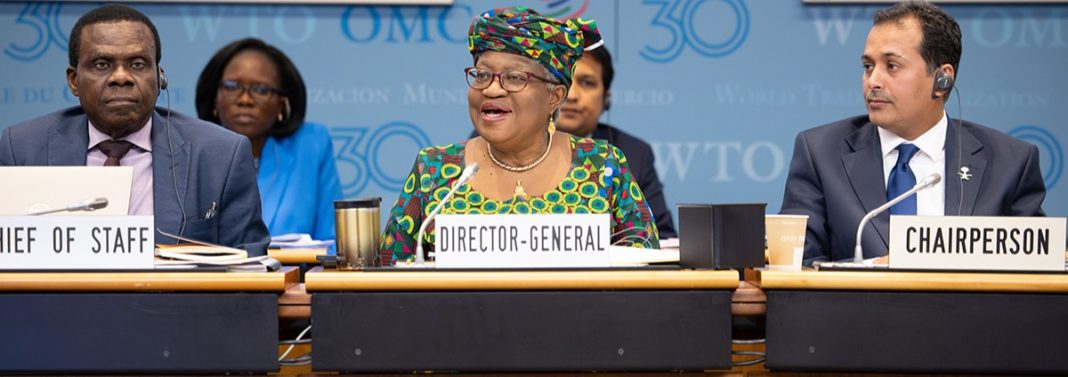
“The outlook reflects the resilience of global trade, buoyed by high-technology products,” said WTO Director-General Ngozi Okonjo-Iweala. “However, sustained increases in energy prices could increase risks for global trade, with potential spillovers for food security. WTO members can cushion this impact by maintaining predictable trade policies.”
There is notable upside potential if the Middle East conflict is short-lived and AI investment remains aggressive. In such a case, merchandise trade growth could reach 2.4% in 2026. The report also confirms that 72% of world trade continues to be conducted on a Most-Favoured-Nation (MFN) basis, underscoring the continued dominance of the multilateral trading system despite recent policy shifts.

