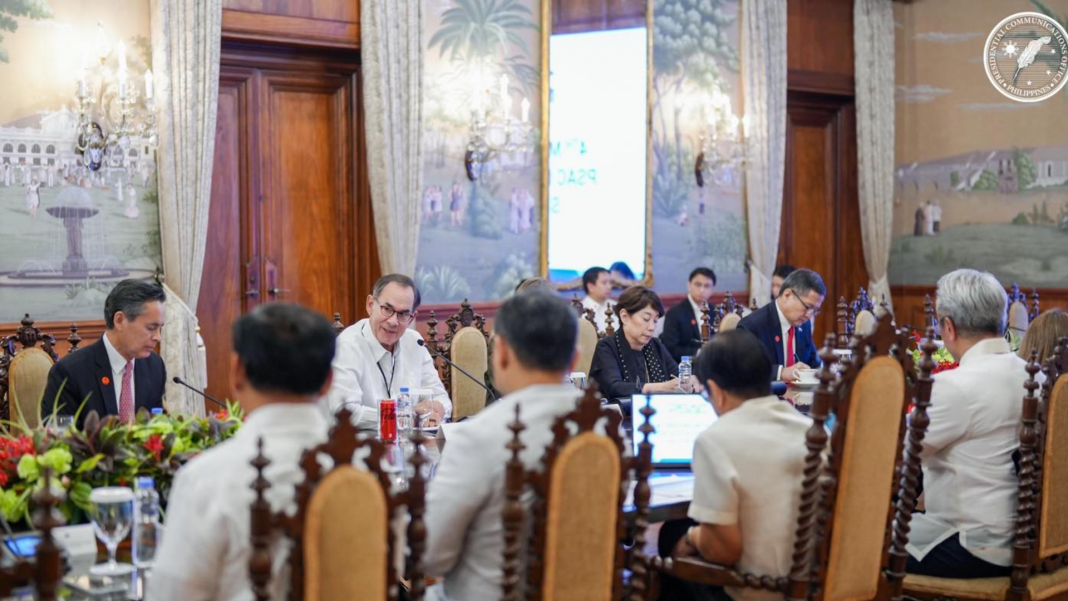
The Private Sector Advisory Council (PSAC), Malacanang’s private-sector advisory on economy, recommended the grant of targeted subsidies delivered through digital platforms, possible extension of tax incentives for export-oriented firms, and accelerate upskilling strategy to protect jobs.
The recommendations were presented during the 4th Meeting of the PSAC Education and Jobs Sector Group at Malacañang on April 8, where business leaders and policymakers outlined targeted interventions to mitigate the impact of global volatility on Filipino workers and enterprises.
President Ferdinand Marcos Jr. said the discussions underscored a shared direction between policymakers and industry leaders.
PSAC said the government should focus on addressing cost pressures, mobility and supply chain disruptions to preserve jobs. Thus, targeted subsidies could help cushion skyrocketing fuel prices, which are driving operating costs higher.
“With workers relying on public transport, the council recommended subsidies or financial assistance for public utility vehicle operators to keep jeepneys and buses running,” the group said.
Jobs
At the same time, it called for accelerated digital infrastructure rollout to enable remote work and reduce dependence on physical mobility.
Foremost, PSAC’s proposals center on rapid job matching, workforce redeployment, and accelerated project execution to absorb displaced workers.
The group recommended expanding nationwide job fairs and fast-tracking hiring across both government and private sectors, alongside the immediate restart of infrastructure and school construction projects.
To cushion potential displacement among overseas Filipino workers (OFWs), PSAC also proposed streamlined redeployment processes, micro-credential training across key industries, and expanded support for entrepreneurship and MSMEs.
“Our focus is twofold: immediate job preservation and long-term workforce transformation. By investing in skills, accelerating job matching, and supporting enterprises, we can help ensure that Filipinos remain productive and competitive despite global headwinds,” said Sabin Aboitiz, PSAC Lead Convener and President and CEO of Aboitiz Group.
AI Upskilling
Another central component of the strategy is the rollout of “AIUDA” (AI Upskilling para sa Digital Asenso), a rapid re-skilling initiative designed to transition workers into digital and remote roles within weeks.
The program outlines tiered pathways—from basic AI-assisted tasks to higher-value digital work—aimed at enabling employment in areas such as data annotation, virtual assistance, analytics, and online entrepreneurship.
This builds on private sector-led efforts such as Elevate AIDA, a flagship program of Aboitiz Foundation which trains Filipino women for AI-related digital jobs and connects them to work opportunities in the digital economy.
To ensure long-term resilience, PSAC proposed greater flexibility in learning modalities, faster release of government subsidies for students and institutions, and regulatory adjustments to allow schools and training providers to adapt quickly while maintaining quality outcomes.
PSAC’s recommendations underscore a whole-of-nation approach that brings together public policy, private sector innovation, and digital transformation to address both immediate disruptions and longer-term workforce challenges as global uncertainties persist.