


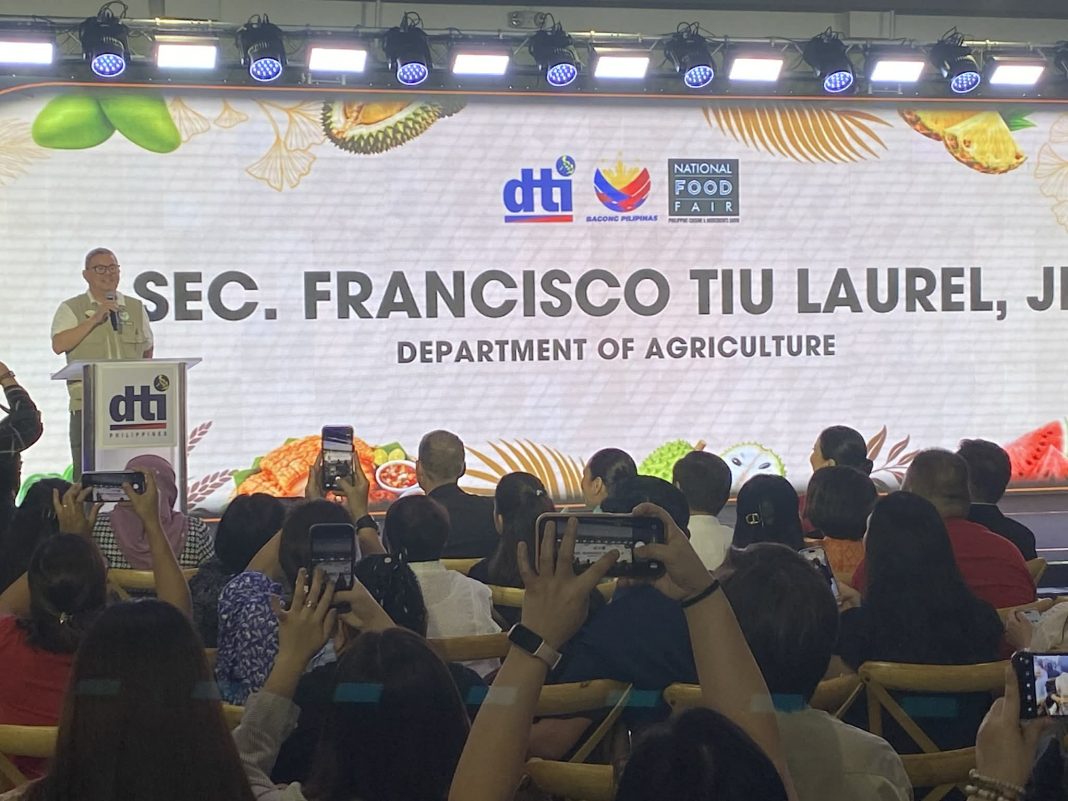
Agriculture Secretary Francisco P. Tiu Laurel Jr. on Wednesday highlighted the growing role of micro, small and medium enterprises in raising the value of farm and fishery output, saying these business ventures are key to creating jobs and boosting incomes in a sector where many remain among the country’s poorest.
“Raw produce is only the beginning. The real work starts when MSMEs step in, extending shelf life, expanding market reach, and increasing value,” Tiu Laurel said at the National Food Fair organized by the Department of Trade and Industry.
He pointed to the participation of more than 320 enterprises from across Luzon, Visayas and Mindanao as evidence of how local harvests can be transformed into competitive offerings. “That is not just a number. It is 320 bright ideas turning local harvests into national pride,” he said.
Rice, fish, coconut and cacao, he added, are only starting points for a broader value chain driven by processing, packaging, and innovation.
For the government, he said, strengthening MSMEs forms part of a wider effort directed by President Ferdinand Marcos Jr. to shift agriculture away from subsistence toward value-added production. By connecting farmers and fisherfolk to enterprises that extend shelf life and improve market access, more income can be retained within rural communities, he added.
Tiu Laurel also stressed the need to keep food affordable even as the sector upgrades. “At the same time, we remain focused on keeping food within reach of every Filipino family, especially during these challenging times,” he said.
Imported rice currently sells at around P55 to P60 per kilo, with prices expected to ease to about P50 once President Ferdinand Marcos Jr. issues an executive order setting a price cap.
Prices of key protein items have remained relatively stable. Tilapia is about P150 per kilo while bangus ranges from P240 to P260. Pork prices are steady at around P280 per kilo for imports and up to P360 for local supply. Chicken prices are also holding at reasonable levels due to ample production.
“Step by step, the DA is actively working on bringing balance back to the market,” Tiu Laurel said.
The agriculture chief said the government is supporting higher-value industries such as coconut, which he described as “not just the tree of life” but also a source of livelihoods, exports and innovation.
He also cited the rise of returning overseas Filipino workers who have entered the food business. “You turned homecoming into enterprise and built something meaningful from your return,” he said, adding that initiatives such as halal certification are helping Filipino products reach global markets.
Tiu Laurel appealed for unity among as agriculture stakeholders as the sector and the entire nation navigate the challenges posed by soaring input and logistics costs as a result of soaring oil prices.

